
Arabic Grammar and Beautiful Quran Recitation
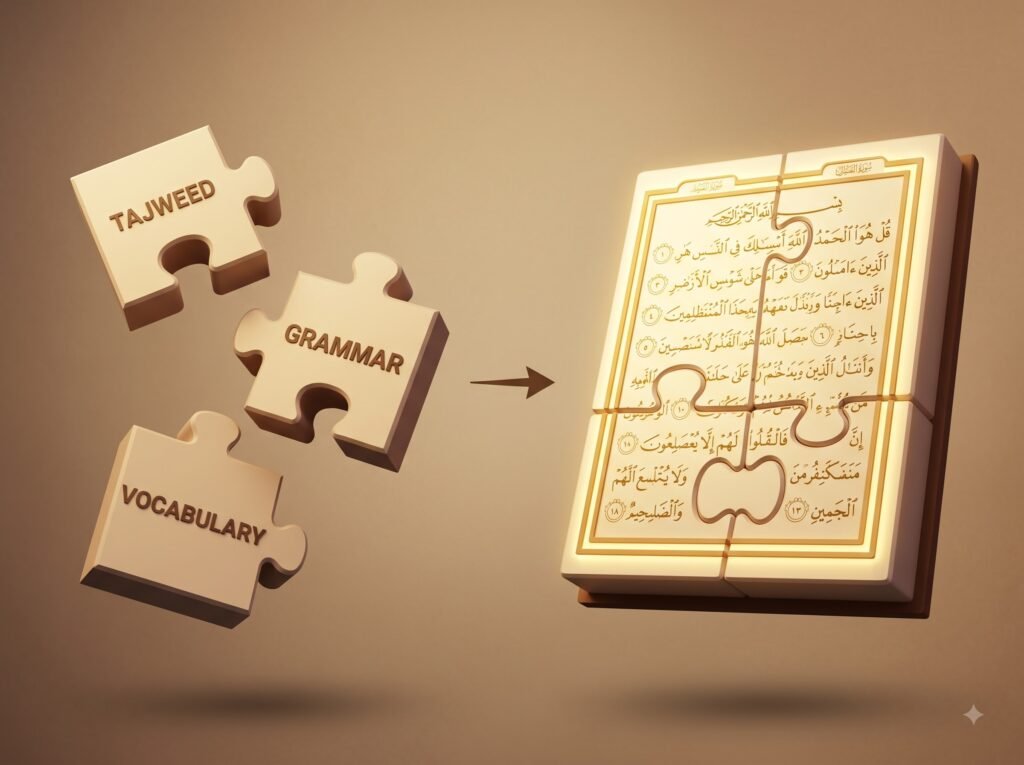
Most students of the Quran are taught to treat tajweed, Arabic grammar, and vocabulary as three separate subjects — three different classes, three different textbooks, three different teachers. You memorize tajweed rules in one lesson, grammar tables in another, and vocabulary lists on your own time, hoping it all somehow comes together when you open the mushaf.
It rarely does. And that’s not because you’re not trying hard enough. It’s because these three subjects were never meant to be learned apart.
Why Beautiful Recitation Feels Out of Reach
If you’ve ever wondered what is tajweed really about, the textbook answer usually sounds like this: a set of rules governing how to pronounce Arabic letters correctly when reciting the Quran. True — but incomplete. That definition makes tajweed sound like a checklist of dos and don’ts, something to memorize and apply mechanically.
But ask any reciter who has truly mastered their recitation, and they’ll tell you something different: tajweed isn’t a checklist. It’s a result. It’s what naturally happens when you understand the language you’re reciting.
This is the missing piece most students never get: tajweed, grammar, and vocabulary are not three subjects. They are three views of the same system — the Arabic language itself.
Grammar Explains the “Why” Behind Tajweed
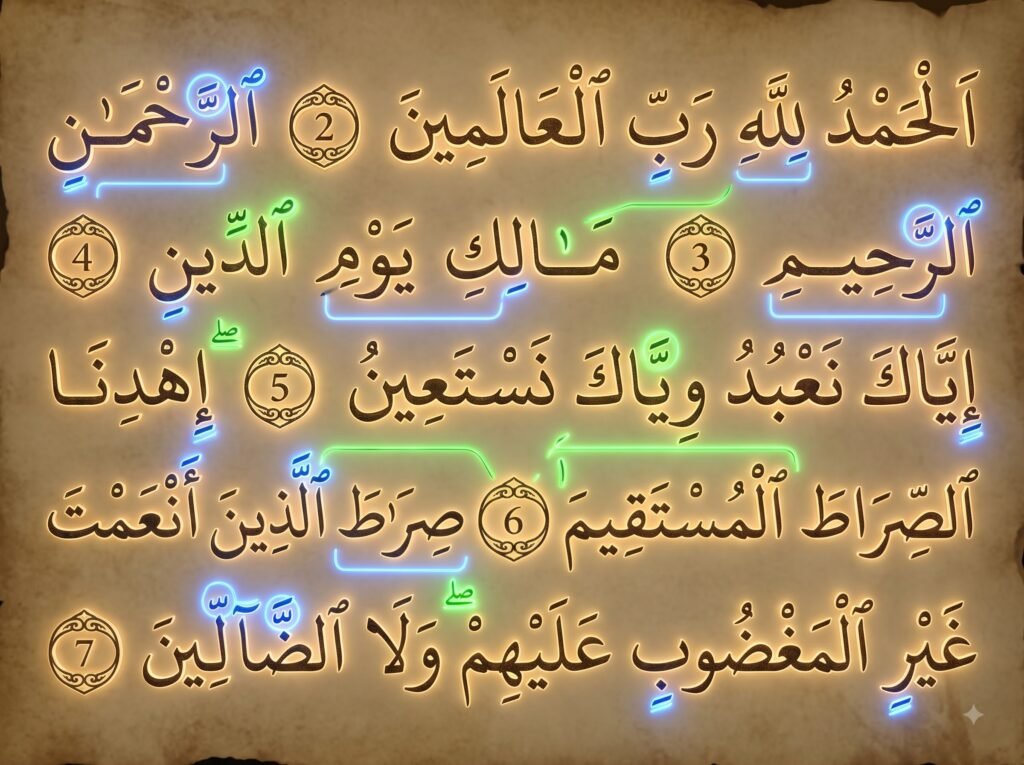
Here’s a simple example. Students are often taught to elongate certain sounds, soften others, and pause at specific points — without ever being told why the Quran is structured that way at that exact spot.
The answer is almost always grammatical. A pause exists because a sentence has grammatically ended. A vowel changes because of a grammatical case ending (i’raab). A letter is pronounced with emphasis because of its position within a word’s root structure.
This is the essence of tajweed arabic grammar as a combined subject: once you can see the grammar, the tajweed rule stops being an arbitrary instruction and becomes something obvious — even predictable. You stop asking “what’s the rule here?” and start asking “what is this word doing in the sentence?” — and the correct recitation follows naturally.
Vocabulary Is the Bridge, Not a Side Task
There’s a third piece that’s just as often ignored: vocabulary. Many students recite fluently without knowing what a single word means. They can produce the sounds correctly but have no relationship with the meaning behind them.
But vocabulary isn’t just “extra knowledge” — it’s what makes grammar make sense in the first place. Once you know the root meaning of a word, its grammatical form starts to explain itself. Once grammar explains itself, tajweed follows. It’s a chain, not a stack of unrelated topics.
This is why so many people try to learn tajweed online through isolated apps or short rule-based courses and still feel stuck. They’re treating the symptom — pronunciation — without addressing the cause — understanding.
One Language, One System
Imagine trying to read a beautifully written paragraph in your native language, but only being taught punctuation rules — no grammar, no vocabulary, just where to pause and how long to hold a sound. You could technically read it aloud. But you wouldn’t be reading it well, and you certainly wouldn’t understand it.
That’s what tajweed without grammar and vocabulary actually feels like.
The moment students stop learning these three subjects in isolation and start seeing them as one connected system, everything changes. Recitation stops being a performance of memorized sounds and becomes an act of genuine understanding — which is, after all, what beautiful recitation was always meant to be.
Where to Start
If you’re ready to stop memorizing tajweed rules in a vacuum and start understanding why they exist, the starting point isn’t more tajweed drills — it’s grammar and vocabulary, taught together, the way they were always meant to be learned.
- Start with the fundamentals in our Arabic Grammar Basics guide
- Build your Quranic vocabulary with our Quran Vocabulary series
- Then come back and see how every tajweed rule suddenly makes sense
Ready to Learn the Connected Way?
Stop treating tajweed as a list of rules to memorize by heart. Learn Arabic the way it was designed to be learned — grammar, vocabulary, and tajweed, together, as one system.
Start your free trial at roots-muslimschool.com and experience the connected way to learn.
