
Mawlid an-Nabi 2026
The Mawlid is not just a date on the Islamic calendar.
The Arabic words surrounding it — Mawlid, Nabi, the names of the Prophet ﷺ, the ayah of salawat — open up everything about why this day carries the weight it carries.
Above the Debate — Where Every Muslim Agrees
Before the roots, there is something worth establishing clearly.
Mawlid 2026 — the 12th of Rabi al-Awwal 1448H — arrives in the context of a longstanding scholarly discussion about the permissibility of its commemoration. That discussion is real. The scholars on both sides are serious. And this post will not attempt to resolve it.
Rather, this post begins from the one place where every Muslim already stands — regardless of their position on Mawlid. Every Muslim agrees that the Prophet ﷺ deserves to be known and loved as deeply as possible. Every Muslim agrees that his name deserves to be understood, not just recited. And every Muslim agrees that the ayah in which Allah and His angels honor him deserves to be felt, not merely read.
This post, therefore, serves that agreement. It takes the three most central Arabic words of this season — مَوْلِد (Mawlid), نَبِيّ (Nabi), and يُصَلُّون (Yusalloon) — and reveals the root beneath each one. Specifically, the root beneath each word reveals why it was chosen — and why the day that carries these words carries the weight it carries.
📌 Ghost Callout Block — Three-Word Root Breakdown Card
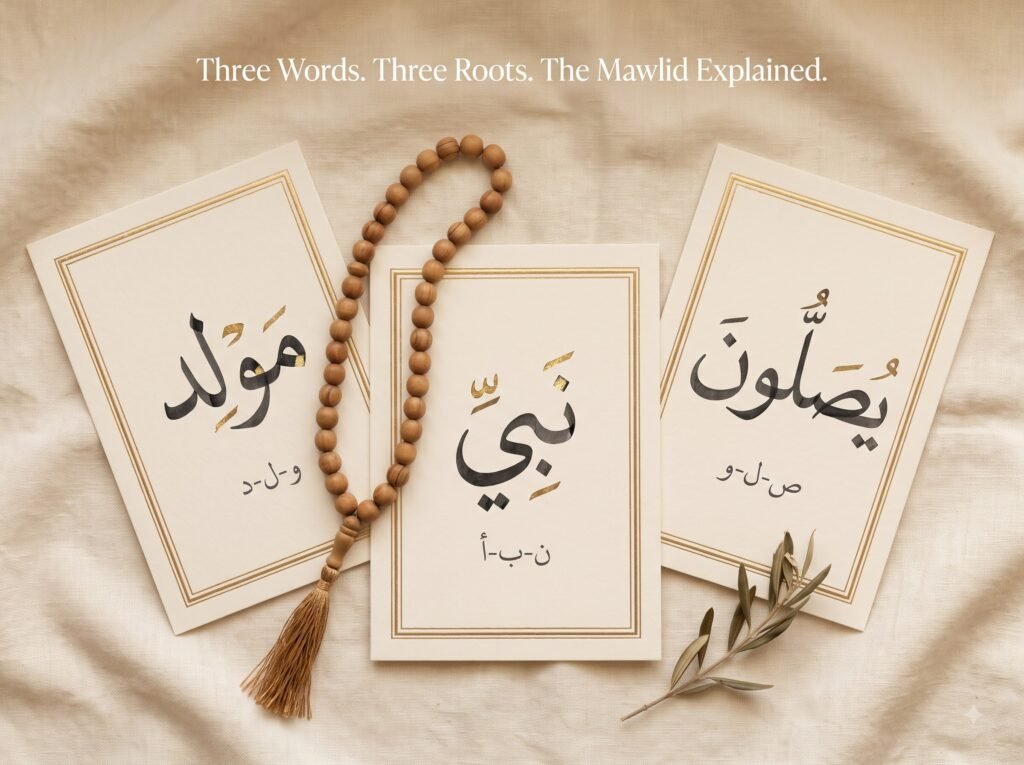
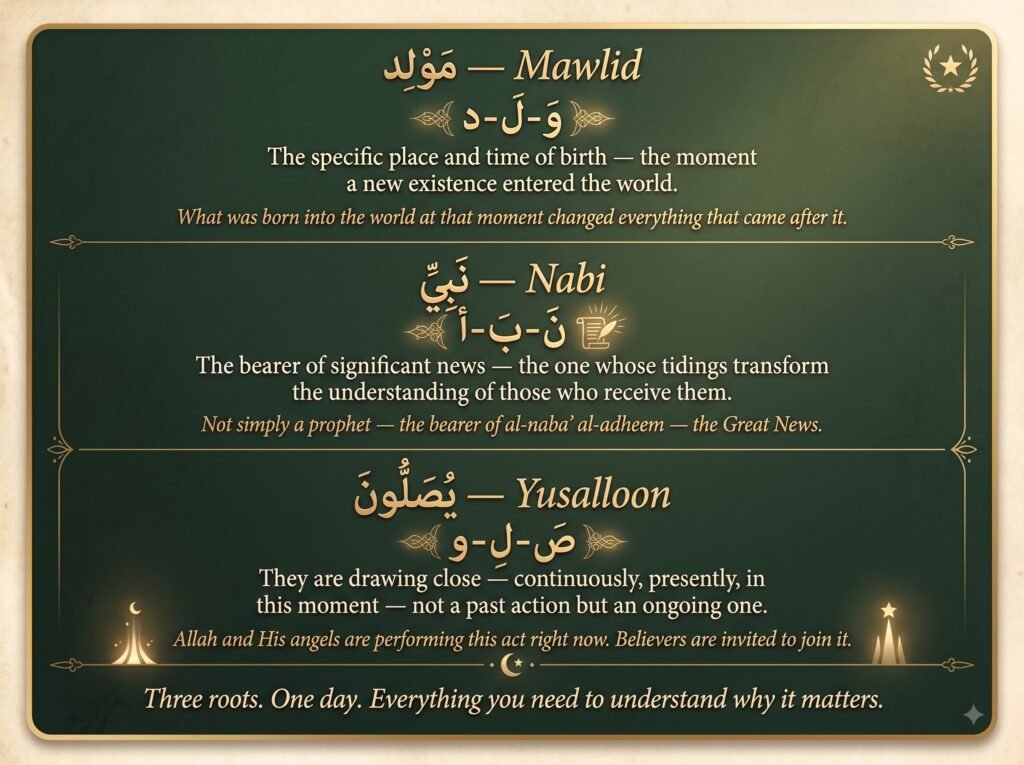
Three Words. Three Roots. The Mawlid Explained.
مَوْلِد — Mawlid | Root: و-ل-د (Waw-Lam-Dal)
The specific place and time of birth — the moment a new existence entered the world.
Theological significance: What entered the world at that moment changed everything that came after it.
نَبِيّ — Nabi | Root: ن-ب-أ (Nun-Ba-Hamza)
The bearer of significant news — the one whose tidings transform the understanding of those who receive them.
Theological significance: Not simply a prophet — the bearer of al-naba’ al-adheem — the Great News.
يُصَلُّون — Yusalloon | Root: ص-ل-و (Sad-Lam-Waw)
They are drawing close — continuously, presently, in this moment — not a past action but an ongoing one.
Theological significance: Allah and His angels perform this act right now. Believers are invited to join it.
Three roots. One day. Everything you need to understand why it matters.
The First Word — مَوْلِد (Mawlid)
The word مَوْلِد comes from the root و-ل-د (waw-lam-dal) — the root of birth, of the moment a new living existence arrives in the world.
This root is not abstract. In Arabic, it carries the physical, specific, moment-bound quality of birth. From it come وَلَدَ (walada — he gave birth), وَلَد (walad — a child), مَوْلُود (mawlood — a newborn), وِلَادَة (wiladah — the act of birth), and أَوْلَاد (awlad — children, the born ones).
مَوْلِد, grammatically, is a place-and-time noun. In Arabic, this specific form describes the location and moment at which an action takes place. It means literally the place and time of birth — the geographical and temporal point at which someone entered the world.
Consequently, Mawlid an-Nabi is not simply “the Prophet’s birthday” in the contemporary cultural sense. Rather, it marks the specific moment when what he was and what he carried arrived in human history. The distinction matters enormously.
What Arrived in That Moment
What entered the world was not simply a person. It was the bearer of the final revelation — the one whom Allah describes as a mercy to all the worlds. It was the man whose name Allah Himself would elevate. His mention joined Allah’s own in the shahada. Furthermore, the Quran describes his example as the best pattern for anyone who hopes in Allah and the Last Day.
Understanding the root, therefore, changes what the word Mawlid means every time you say it. It is not nostalgia for a past event. Instead, it is the commemoration of the specific moment when the world changed — the divinely appointed point of entry for the bearer of the last message.
The Second Word — نَبِيّ (Nabi)
The word نَبِيّ comes from the root ن-ب-أ (nun-ba-hamza) — and this root carries a meaning that most translations of the word “prophet” consistently miss.
The root ن-ب-أ is the root of significant news. Specifically, it describes the kind of tidings whose arrival transforms the situation of everyone who receives them. From this root: نَبَأ (naba’ — significant news), أَنْبَأَ (anba’a — he brought important news), نَبَّأَ (nabba’a — he conveyed crucial information), and أَنْبِيَاء (anbiya’ — prophets, literally “the bearers of significant tidings”).
A نَبِيّ (Nabi), therefore, is not a prophet in the abstract generic sense. He is a bearer of naba’ — of news so significant that its arrival divides understanding into before and after.
The Great News He Carried
The Quran uses this same root for the greatest of all news. Surah An-Naba opens with the question: “About what are they asking one another? About the great news” — عَنِ النَّبَإِ الْعَظِيمِ. That surah addresses the Day of Judgment and the truth of the final revelation — the most significant tidings in human history.
Moreover, the bearer of that revelation — the one who carried al-naba’ al-adheem from the Creator to His creation — is النَّبِيّ (al-Nabi). His defining identity is that he carries news of ultimate significance. On the day that commemorates his entry into the world, consequently, the word Nabi carries a specific weight. He did not simply arrive. The Great News arrived with him. The root of his title encodes that fact into every syllable of his name.
The Third Word — يُصَلُّون (Yusalloon)
The most recited ayah of Mawlid season is Surah Al-Ahzab, 33:56:
“Indeed, Allah and His angels send blessings upon the Prophet. O you who believe — send blessings upon him and greet him with a worthy greeting.”
The word at the center of this ayah — يُصَلُّون (yusalloon) — is the word most Muslims repeat without fully understanding what it describes.
The root ص-ل-و (sad-lam-waw) carries the core meaning of connection, drawing close, moving toward. It is the same root that gives us صَلَاة (salah — prayer) and صَلَوَات (salawat — blessings). The root describes the act of orienting toward and drawing close to the one being addressed.
The Ongoing Act — Present, Not Past
يُصَلُّون is the present imperfect form — describing an action not completed in the past but ongoing in the present moment. This grammatical form is crucial. The ayah does not say Allah and His angels sent blessings in the past. Rather, it says they are sending — continuously, presently, right now as you read this sentence — performing an act of drawing close and honoring.
This changes everything about how the ayah lands. When you say Allahumma salli ala Muhammad this Mawlid, you are not commemorating something Allah did historically. Instead, you are joining something He is doing right now — adding your act of drawing close to an ongoing movement of honoring that Allah Himself initiated and sustains.
Furthermore, the command to believers — صَلُّوا عَلَيْهِ (send blessings upon him) — is an invitation into that ongoing act. Every salawat sent this Mawlid joins the continuous movement of Allah’s own honoring of His Prophet ﷺ. The root reveals, consequently, that there is no more appropriate response to this day than the act it was designed to invite.
What Three Roots Give You
These three roots — و-ل-د, ن-ب-أ, ص-ل-و — together give a complete theological picture of this day.
The مَوْلِد marks the specific moment when the bearer of the Great News entered the world. The نَبِيّ names the one who arrived carrying the most significant tidings humanity has ever received. And يُصَلُّون describes what Allah and His angels are doing about it — right now, continuously — and what believers are invited to join.
Understanding even one of these three roots changes how you experience this day. Understanding all three, moreover, changes how you experience the Prophet ﷺ — not just during Mawlid season, but in every salah, every tashahhud, and every time you say his name.
This is what Arabic root learning gives — not simply vocabulary, but a fundamentally different relationship with the words that carry your deen.
→ Explore the Arabic roots behind the names of the Prophet ﷺ — what Muhammad, Ahmad, and Mustafa actually mean: Names of Prophet Article
→ Read the complete guide to what salawat means in Arabic: Salawat Meaning Article
→ Explore the seerah through Arabic roots:Seerah
Learn Every Word You Say About Him
Learn Every Word You Say About Him
→ Learn Arabic at roots-muslimschool.com
The Prophet ﷺ carried jawami al-kalim — the ability to express the deepest meaning in the fewest words. Every word scholars use to describe him, every ayah that honors him, and every name he carried grows from a language whose depth translation cannot reach.
Root-based Arabic learning gives you access to that depth. Start with the three words of this day. Then expand outward into the Quran he was sent to deliver.
The first class is free. His language has been waiting.
May Allah make this Mawlid 2026 the occasion on which we begin to understand not just that he came — but what it means, in every root of every word, that he came. Ameen. 🌙and not just that he came — but what it means, in every root of every word, that he came. Ameen. 🌙
