
Arabic Alphabet for Beginners
You open a page of Arabic. The letters curve, connect, and run from right to left. Your brain says: “This is impossible.”
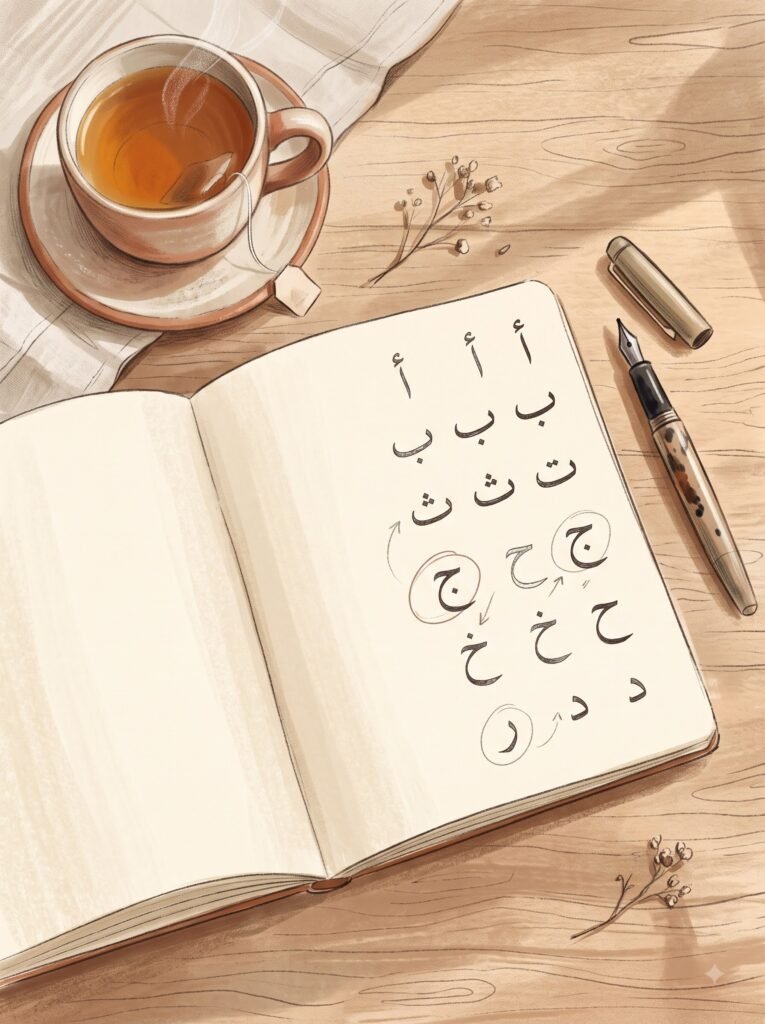
Almost every student we teach feels this in the first five minutes. Yet the same students are usually sounding out words within a few weeks. If you’re learning Arabic as an English speaker, the alphabet looks like the hardest part but is actually one of the easiest.
This is the first step in our guide to Is Arabic Hard to Learn? The Honest Answer for Non-Arab Muslims.
Only 28 Letters (English Has 26)
The Arabic alphabet has 28 letters, just two more than English. There are no capital letters to memorize, no silent letters, and no spelling chaos like “though, through, tough.” In Arabic, a letter almost always makes the same sound every time.
Compare that to English, where “ough” is pronounced at least six different ways. Arabic is far more predictable.
“But the Letters Change Shape!” Yes, and It Follows a Pattern
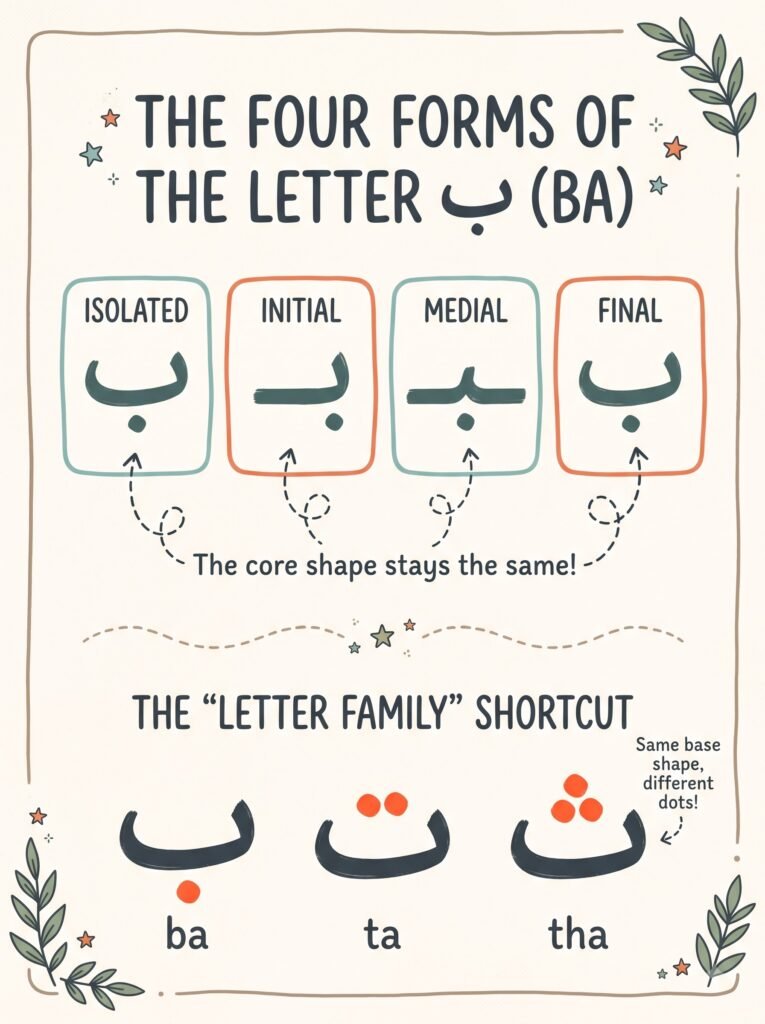
This is the part that scares beginners. Most Arabic letters have up to four forms, depending on where they appear in a word:
- Isolated (standing alone)
- Initial (start of a word)
- Medial (middle)
- Final (end)
Here is the good news: the core shape stays recognizable. Think of it like handwriting, where your “a” looks slightly different depending on how it connects. You aren’t learning 100+ symbols. You’re learning 28 letters in a few predictable outfits.
A shortcut that saves time: many letters share one base shape and differ only by dots. ب (ba), ت (ta), and ث (tha) look almost identical, with one, two, or three dots. Learn them as a family and you’ve learned three letters at once.
Also, six letters (ا د ذ ر ز و) don’t connect to the letter after them. Once you know this, the rule is easy to apply.
A Realistic Timeline
Let’s be honest, not just encouraging. With 15 to 20 minutes of daily practice and a teacher correcting your pronunciation:
| Stage | Typical timeframe |
|---|---|
| Recognizing all 28 letters | 1 to 2 weeks |
| Reading connected letters and short words | 3 to 6 weeks |
| Reading smoothly, with confidence | A few more weeks of practice |
Everyone moves at their own pace. But the pattern holds: weeks, not years. Speed comes with repetition, and that’s exactly why a consistent routine matters more than natural talent.
The Sounds That Need a Little Extra Practice
Most Arabic sounds have an English match. A handful don’t, and these deserve patience:
- ع (ʿayn): a deep throat sound with no English equivalent
- ح (ḥa): a soft, breathy “h” from the throat
- خ (kha): like the “ch” in Scottish loch
- ق (qaf): a “k” produced further back in the throat
- The emphatic letters (ص ض ط ظ): heavier, deeper versions of familiar sounds
Learning these by listening and repeating with a teacher is far more effective than reading about them. This is where live feedback makes the biggest difference.
Why Reading Early Is a Game Changer for Quran Learners
Here’s the motivation boost. Once the alphabet clicks, you can start sounding out Quran pages yourself. You may not understand every word yet, but reading the script is the foundation for everything that follows: tajweed, vocabulary, and grammar.
Many students say this is the moment Arabic stops feeling like a locked door. If you’re following a Quran Arabic beginner guide, mastering letters and sounds is always step one.
A small note: most Arabic outside the Quran is written without short vowel marks (the little symbols above and below letters). The Quran includes them, which actually makes it easier for beginners to read accurately. You can learn the vowel marks quickly, and they help you pronounce every word correctly from day one.
5 Tips to Learn the Arabic Alphabet Faster
- Learn letters in families. Group them by shape (the dot trick above).
- Practice daily, briefly. Fifteen focused minutes beat a two-hour weekend session.
- Write by hand. Tracing letters builds memory faster than only reading.
- Say each letter aloud. Train your ear and mouth together.
- Get corrected early. Mispronunciations become habits quickly. A teacher stops that.
Your Next Step
You don’t need to be “good at languages.” You need a clear path and a little time each day. If you’d like to see how the alphabet fits into the bigger journey, read our breakdown of the stages of learning Arabic, or start building your foundation with our Beginner Arabic course.
Not sure where you stand? Take our free Arabic readiness quiz. Link in bio.
