
Online Arabic Classes vs Arabic Homeschooling
Every Muslim parent asks this question at some point.
Here is the honest answer — based on real results, not marketing.
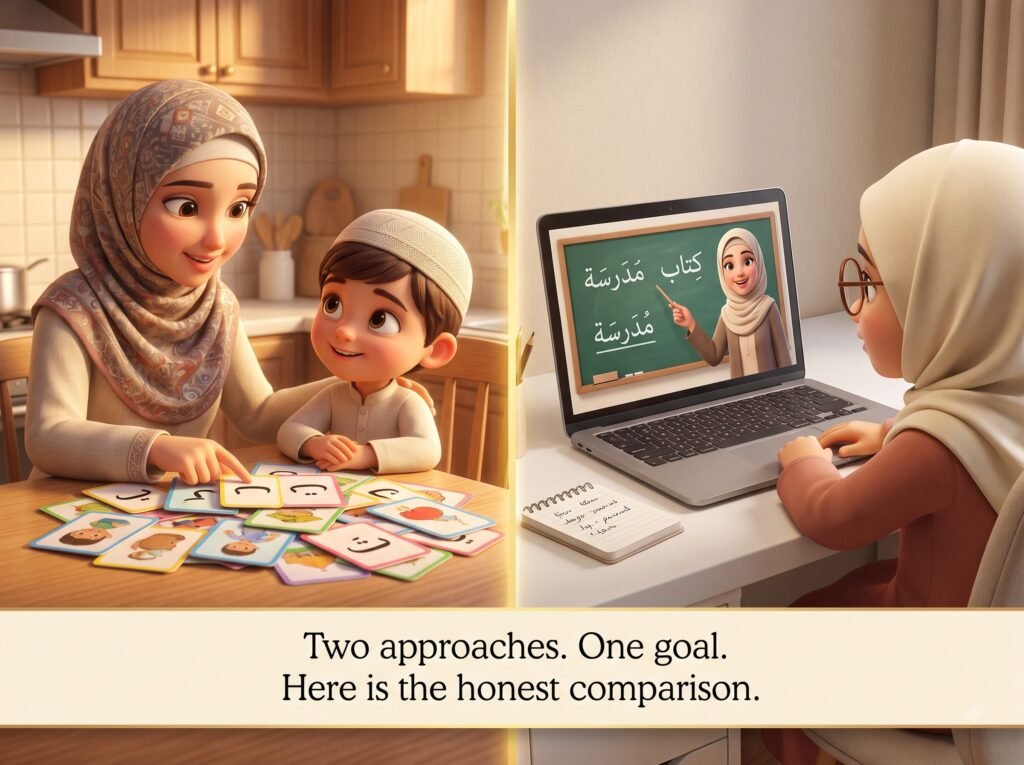
Why This Post Will Not Simply Tell You Online Classes Are Better
Before the comparison begins, there is something worth saying clearly.
This post comes from an online Arabic school. That means it has an obvious incentive to tell you that online classes are superior in every way — and to quietly ignore the genuine advantages of Arabic homeschooling.
Instead, this post will do something more useful: tell you the complete truth across five specific dimensions, including the dimensions where homeschooling genuinely outperforms online classes. Because the goal is not to sell you a program. The goal is to help you make the right decision for your child — and that requires honesty more than it requires marketing.
The online Arabic vs homeschool question, moreover, does not have a single correct answer. It has a correct answer for your family, based on your specific circumstances, your child’s specific profile, and your specific goals. This comparison gives you the information to find that answer.
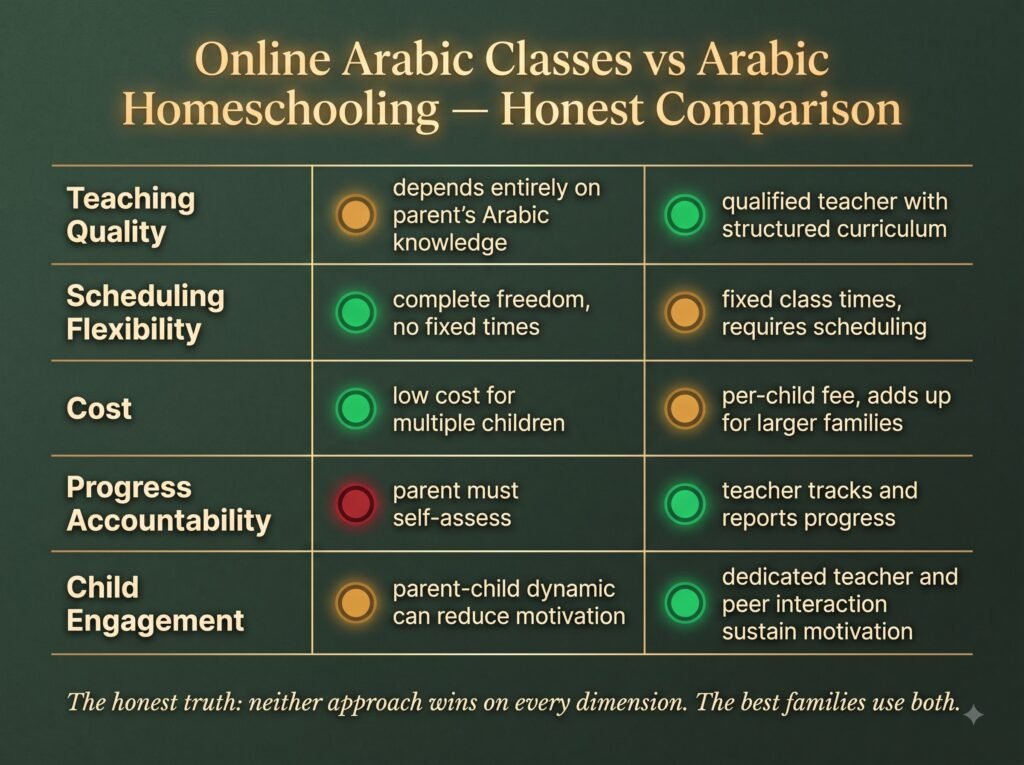
📌 Ghost Callout Block — Honest Comparison Table
Online Arabic Classes vs Arabic Homeschooling — Honest Comparison
| Dimension | Arabic Homeschooling | Online Arabic Classes |
|---|---|---|
| Teaching Quality | 🟡 Depends entirely on parent’s Arabic knowledge | 🟢 Qualified teacher with structured curriculum |
| Scheduling Flexibility | 🟢 Complete freedom — no fixed times | 🟡 Fixed class times require scheduling |
| Cost | 🟢 Low cost — especially for multiple children | 🟡 Per-child fee adds up for larger families |
| Progress Accountability | 🔴 Parent must self-assess — easy to miss gaps | 🟢 Teacher tracks and communicates progress |
| Child Engagement | 🟡 Parent-child dynamic can reduce motivation | 🟢 Dedicated teacher sustains engagement |
The honest truth: neither approach wins on every dimension. The best families use both.
Dimension 1 — Teaching Quality and Consistency
Where homeschooling wins: A parent who knows Arabic well and is consistent with daily practice can deliver exceptional Arabic instruction. The personalization is unmatched — the parent knows the child’s learning style, attention span, and the specific Islamic context that makes each word meaningful. Furthermore, the daily touchpoint a parent can provide exceeds what any weekly class can replicate.
Where online classes win: The majority of Muslim parents in Western countries do not have strong Arabic themselves — and Arabic homeschooling collapses at the ceiling of what the parent knows. A child whose parent cannot go beyond the alphabet cannot learn beyond the alphabet from that parent. Additionally, teaching your own child requires a specific pedagogical skill that most parents do not possess — knowing Arabic and knowing how to teach Arabic to a seven-year-old are fundamentally different competencies.
Online classes provide a qualified teacher who understands both the language and the pedagogy of teaching it to children. Specifically, a root-based curriculum provides a structured progression that self-directed home learning rarely achieves.
Honest verdict: If your Arabic is strong and your teaching approach is structured, homeschooling can match or exceed online class quality. For most Western Muslim parents, however, the teaching quality ceiling of homeschooling arrives quickly — and a qualified teacher extends that ceiling indefinitely.
Dimension 2 — Scheduling Flexibility
Where homeschooling wins: Clearly and significantly. Arabic homeschooling happens on your schedule — after Fajr, during the school run, at breakfast, whenever your family’s rhythm allows. There are no fixed class times, no rescheduling fees, and no missed sessions because of a doctor’s appointment. For families with irregular schedules, multiple children, or parents working from home, this flexibility is a genuine and significant advantage.
Where online classes win: Structured class times, while less flexible, create a consistency that flexible home schedules often undermine. The fixed appointment creates accountability — the child knows Arabic class happens on Tuesday at 4pm, and that reliability builds the habit of showing up. Many families find that the flexibility of homeschooling gradually becomes the permission to skip — and skipping accumulates.
Honest verdict: Homeschooling wins on flexibility. Online classes win on the consistency that fixed scheduling produces. Families with strong internal discipline can leverage homeschooling’s flexibility effectively. Families who struggle with self-imposed consistency benefit from the accountability of a scheduled class.
Dimension 3 — Cost
Where homeschooling wins: Straightforwardly and significantly. The materials required for Arabic homeschooling — a workbook, a free vocabulary PDF, and consistent daily time — cost almost nothing. For families with two, three, or four children learning Arabic simultaneously, the cost advantage of homeschooling compounds dramatically.
Where online classes win: Cost per outcome, rather than cost per session, often favors online classes. A child who progresses through a structured root-based curriculum in six months reaches a comprehension level that years of inconsistent homeschooling may never produce. The cost of online classes, furthermore, includes the teacher’s expertise — something homeschooling cannot replicate without cost.
Honest verdict: For large families and tight budgets, homeschooling wins on cost. For families with one or two children and a specific comprehension goal and timeline, online classes often deliver better cost-per-outcome. The hybrid model — home practice daily, online class twice weekly — keeps costs manageable while capturing both advantages.
Dimension 4 — Accountability and Progress Tracking
Where homeschooling wins: The parent who homeschools Arabic has complete visibility into their child’s learning — they see every session, every struggle, every breakthrough. There are no communication gaps between teacher and parent because they are the same person.
Where online classes clearly win: Self-assessment is the most significant structural weakness of Arabic homeschooling. Most parents cannot accurately identify what their child does not know — because the gaps in the parent’s own Arabic create blind spots in their assessment of the child’s Arabic. A child can spend months “learning Arabic” at home while consolidating the same small set of words and never progressing beyond them — and the parent may not notice.
Online teachers assess objectively — identifying specific gaps, tracking root vocabulary retention, and communicating progress in structured reports. Furthermore, the teacher can identify learning difficulties, attention patterns, and comprehension gaps that a parent, being too close to the child, consistently misses.
Honest verdict: Online classes win decisively on progress accountability. This dimension alone is frequently the reason families who started with homeschooling eventually add a live class — they realize their child has gaps they cannot see or address.
Dimension 5 — Child Engagement and Motivation
Where homeschooling sometimes wins: For some children — particularly younger ones and those with strong relationships with a highly motivated parent — the intimacy of home learning creates deep engagement. Learning Arabic alongside a parent who visibly values it sends a powerful identity message: this is what our family does.
Where online classes consistently win: The parent-child dynamic that works beautifully in other subjects frequently breaks down in Arabic instruction. Children who happily accept correction from a teacher resist the same correction from a parent. The emotional stakes of parent-child interaction interfere with the learning relationship in ways that neither party intends.
Additionally, a dedicated Arabic teacher creates a specific kind of motivation that parents cannot replicate — the motivation of having someone whose entire professional attention is on your progress and who celebrates your specific Arabic breakthroughs. Children consistently report higher motivation in live classes with qualified teachers than in parent-led home sessions — even when the parent is more knowledgeable than the teacher.
Honest verdict: Online classes win on sustained child engagement for most children above age seven. The parent-child teaching dynamic, while valuable for many subjects, introduces emotional complexity that reduces Arabic learning motivation over time.
The Approach That Actually Works — The Hybrid Model
Most Muslim families who achieve genuine Arabic comprehension results do not choose between homeschooling and online classes. Rather, they combine both.
The structure that consistently produces the best outcomes looks like this:
Daily home practice (5–10 minutes): One root word from the free PDF, one ayah read aloud, one reflection question. Anchored to Fajr. Done by a parent and child together. Costs nothing. Takes no scheduling.
Live online class (twice weekly): A qualified teacher providing structured root-based instruction, tracking progress, identifying gaps, and delivering the specific expertise and accountability that home practice cannot provide.
The daily home practice ensures consistency and keeps the language present in the child’s daily life. The live class ensures quality, progression, accountability, and the motivation that comes from a dedicated teacher.
Consequently, the question is not online classes or homeschooling. For most families, the right question is: how do I combine both in a way that works for our schedule and budget?
→ Read about how Muslim families are using the hybrid model this school year: [Link to Back to School Arabic Article]
→ See what real students achieved with online Arabic classes: [Link to Student Stories Post]
See the Difference for Yourself
The most efficient way to answer the online Arabic vs homeschool question for your specific child is not more research. It is one live session.
→ Try a Free Trial Class at roots-muslimschool.com
One session. Live. Root-based. Specifically designed for children at whatever starting point yours is at right now. By the end of that session, you will know — from your child’s own response — whether live online teaching adds something that home practice alone is missing.
The trial is free. The answer will be clear.
May Allah make the Arabic of the Quran accessible to every Muslim child — through whatever combination of home practice, live teaching, and parental dedication their family can build. Ameen. 🌙
