
Arabic Word Root Explained: One Root, a Whole Word Family
Imagine learning one word and getting ten more for free.
That is how Arabic works. Most Arabic words are built on a root, a small set of letters, usually three, that carries the core meaning. Once you can spot it, new vocabulary stops feeling like a wall of unfamiliar sounds and starts feeling like a family you already know.
Here is Arabic word root explained in one line: the root is the skeleton of the word, and everything else is clothing.
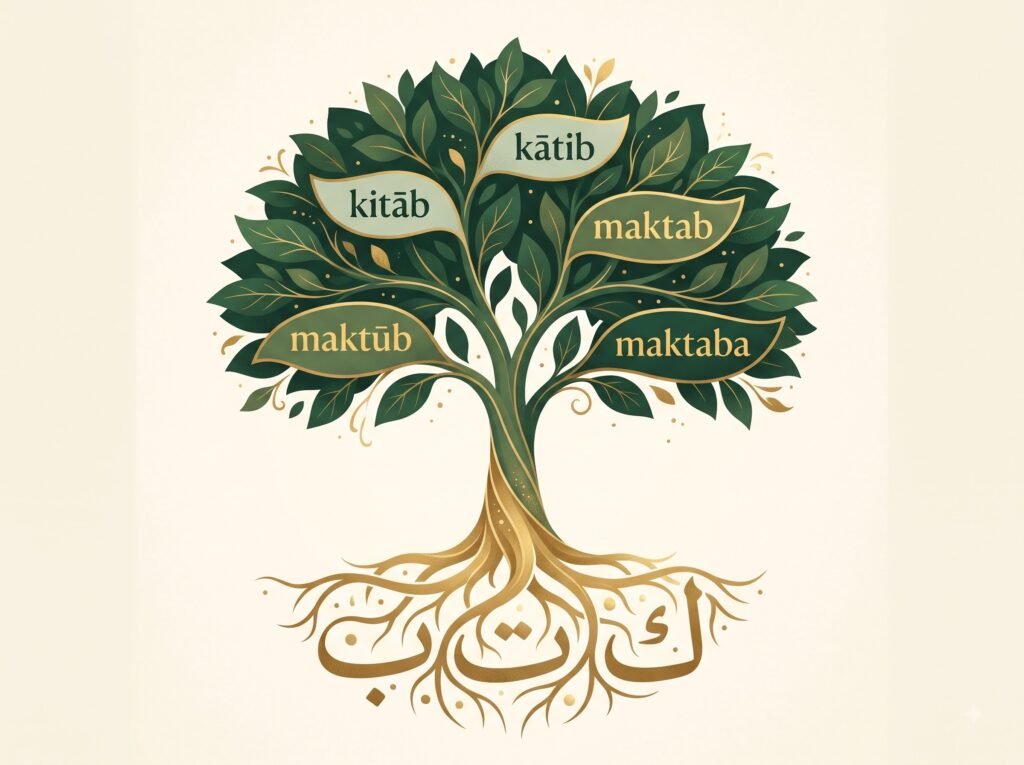
Meet the root ك-ت-ب
The three letters ك – ت – ب (k-t-b) carry the idea of writing. Alone they are only a skeleton, but add vowels, prefixes and patterns and you get a whole family:
| Word | Transliteration | Meaning |
|---|---|---|
| كِتَاب | kitāb | book |
| كَاتِب | kātib | writer |
| مَكْتُوب | maktūb | written |
| مَكْتَب | maktab | office, desk |
| مَكْتَبَة | maktaba | library |
| كَتَبَ | kataba | he wrote |
Six words, one root, one idea. A kātib is someone who does the writing, a maktūb is the thing that has been written, and a maktaba is the place where written things are kept. You can usually guess the meaning before you open a dictionary.
Why this matters for learners
Most beginners memorise Arabic words one by one, which is slow and easy to forget. Roots work differently:
- You learn families, not single words. One root gives you many related words.
- You can guess new words. If you know the root and the pattern, you can often work out the meaning.
- You remember more. Connected words stick better than isolated ones.
Arabic dictionaries are even organised by root, so finding a word means finding its skeleton first.
Roots in the Qur’an
This is where roots become exciting for Qur’an learners. The same ك-ت-ب root appears again and again:
- الْكِتَاب (al-kitāb, the Book) appears in the opening verses of Surah Al-Baqarah.
- كُتِبَ (kutiba, “it has been prescribed”) appears in the verse about fasting (2:183).
- كَاتِب (kātib, a scribe) appears in the long verse about recording debts (2:282).
Different words, different verses, one root. Once you notice it, the Qur’an starts to feel more connected.
A small warning: roots are not magic
A root gives you the core idea, not the exact meaning. The word’s pattern and its context shape the final sense, and a few roots contain weak letters (و، ي) that change or disappear in some forms. Treat the root as a strong clue, then confirm with context.
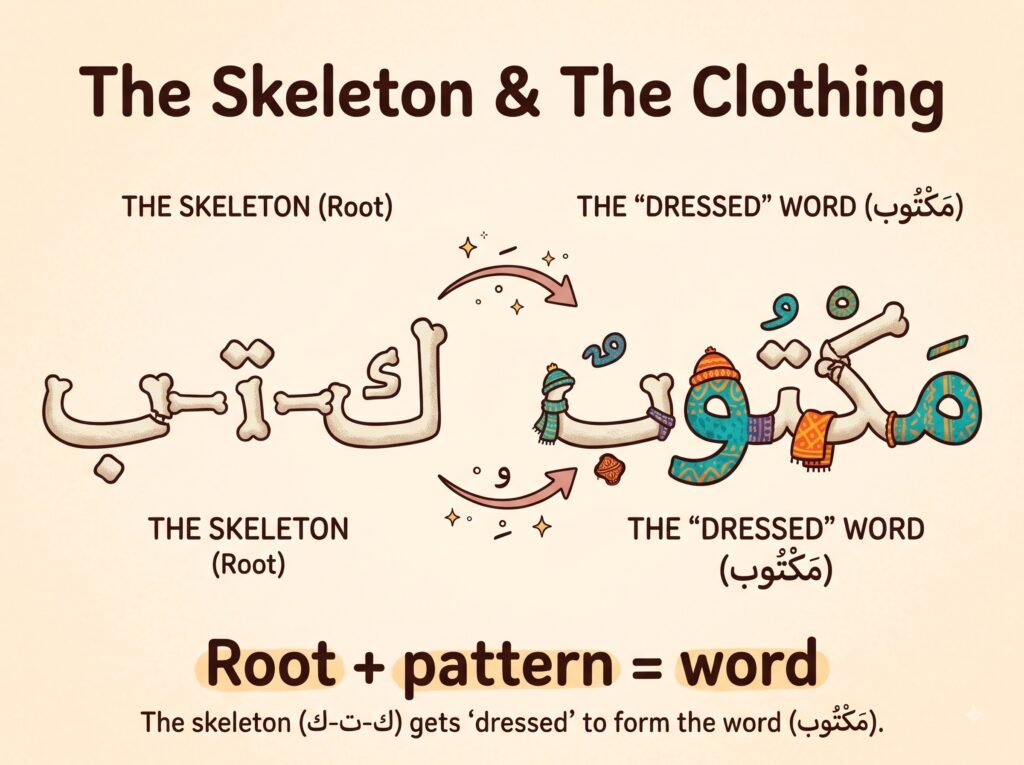
Try it yourself
Pick any word you know from Al-Fatiha and ask: what are the three letters carrying the meaning? That is the first step toward reading with understanding.
New to this topic? Start with our guide, Arabic Root System Explained, and if the letters themselves still feel unfamiliar, review Arabic Alphabet for Beginners.
Ready to see roots in action?
Try the free Al-Fatiha reader and tap any word to see its root: roots-muslimschool.com/fatiha
