
Salah Vocabulary: What You Recite Every Day
You have prayed thousands of times. You know when to stand, when to bow, and when to place your forehead on the ground. But do you know what the words mean?
For many non-Arab Muslims, the words of Salah are memorized sounds. They are beautiful and familiar, yet often unclear. The good news is that you do not need years of study to change this. You need a smart starting point.
Our Arabic learning plan for October began exactly where every Muslim’s day begins: prayer. We broke down the words of every rakah so they stop being sounds and become meaning. Here is how you can do the same.
Why Start Your Arabic Journey with Salah?
Salah is the one thing you already repeat every day. That makes it the perfect classroom.
- You already know the sounds. You are connecting meaning to words you have heard and said for years.
- You get daily practice. Five prayers a day means constant review without extra effort.
- It builds focus (khushūʿ). Understanding what you say helps your heart stay present.
Learning Salah vocabulary is also one of the fastest routes to learn Arabic for Quran, because many of the same words appear again and again in the Book of Allah.
The Secret That Makes It Easy: Arabic Roots
Most Arabic words grow from a root, usually three letters. Learn the root once, and you unlock a whole family of words. This is the heart of Islamic Arabic vocabulary. Instead of memorizing hundreds of separate words, you learn a handful of roots and see patterns everywhere.
Let’s look at three roots from your prayer.
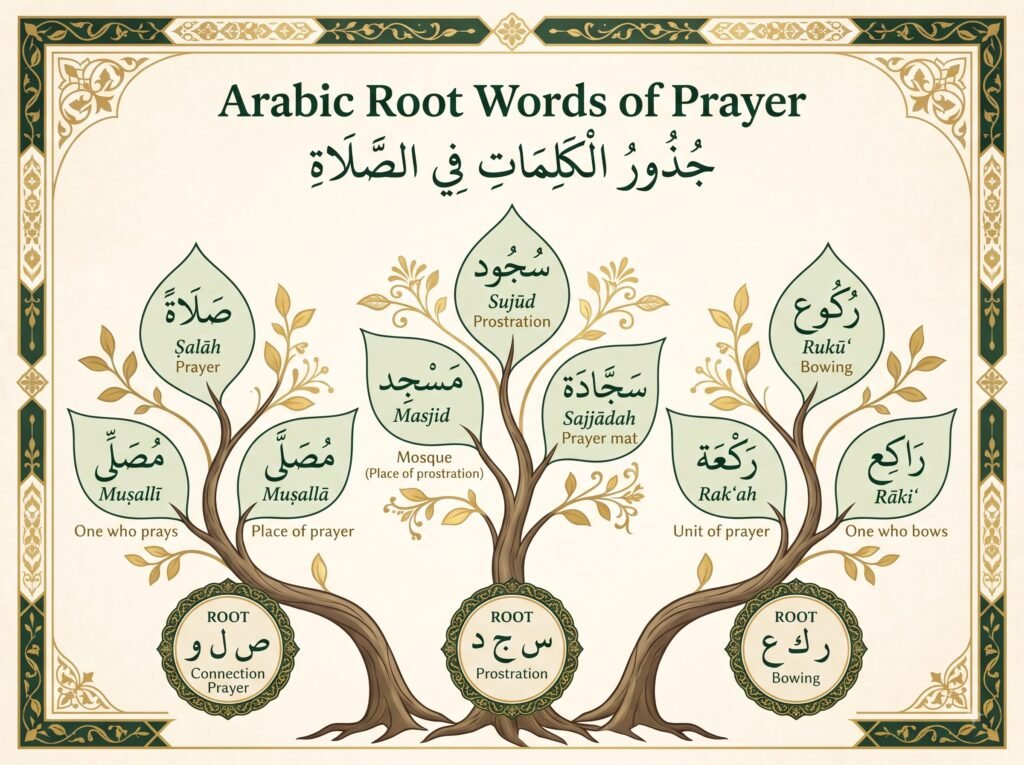
Root 1: ص ل و (ṣ-l-w), The Root of Prayer
| Arabic | Transliteration | Meaning |
|---|---|---|
| صلاة | Ṣalāh | Prayer |
| مصلّى | Muṣallā | Prayer place |
| تصلية | Taṣliyah | Sending blessings |
This root is tied to connection and devotion. When you say “Ṣalāh,” you are naming the act that links you to Allah. Notice how muṣallā simply means “the place where ṣalāh happens.” Once you see the pattern, new words feel familiar.
Root 2: س ج د (s-j-d), The Root of Prostration
| Arabic | Transliteration | Meaning |
|---|---|---|
| سجدة | Sajdah | A single prostration |
| سجود | Sujūd | Prostrations (plural) |
| مسجد | Masjid | Place of prostration |
Here is a lovely insight: the word masjid literally means “the place of prostration.” Every time you say it, you are describing what you do there. Sujūd is also the closest moment to Allah in prayer, which makes knowing its root even more meaningful.
Root 3: ر ك ع (r-k-ʿ), The Root of Bowing
| Arabic | Transliteration | Meaning |
|---|---|---|
| ركوع | Rukūʿ | Bowing |
| ركعة | Rakʿah | One unit of prayer |
Every time you count your prayer in rakʿahs, you are using a word that comes from bowing. The structure of Salah is built into its vocabulary.
How to Practice Salah Vocabulary Daily
- Pick one root per week. Do not rush. Depth beats speed.
- Say the family of words aloud. For example: ṣalāh, muṣallā, taṣliyah.
- Notice the root in your next prayer. Listen for it as you recite.
- Review for 10 minutes a day. Short, regular sessions build lasting memory.
- Follow a structured plan. A guided path keeps you consistent.
Keep Going: Your Next Steps
Salah vocabulary is only the first step. From here, you can build reading skills, grow your Quran vocabulary, and explore Allah’s Names through their roots.
- Read our full guide: Arabic Learning Roadmap
- Explore every level and format on our Courses page
Looking for a non-Arab Muslim Arabic course monthly? Our one-theme-per-month structure keeps learning simple, clear, and achievable.
Call to Action
November enrollment is open. Book your free trial and start where October left off.
