
The Root-Based Method Explaine
A deep dive into the trilateral root system and why it’s the fastest path to real Quranic understanding.
[Image 1 goes here. See the image descriptions below.]
Most learners start Arabic by memorising word lists. It works for a while, then stalls. There are thousands of words, and no obvious way to connect them.
The root-based method fixes this. Instead of learning words one by one, you learn the small building blocks that generate them. In this guide, the Arabic root system explained simply, you’ll see how three letters can open up hundreds of words in the Quran.
Why Word Lists Hit a Wall
Imagine learning English by memorising a dictionary, one entry at a time. You’d know plenty of words but see no connection between write, writer and written.
Arabic learners face the same problem, but Arabic has a shortcut English doesn’t. Its vocabulary is built on a system. Once you see the system, new words stop feeling new.
1. A Root Is the Skeleton of a Meaning
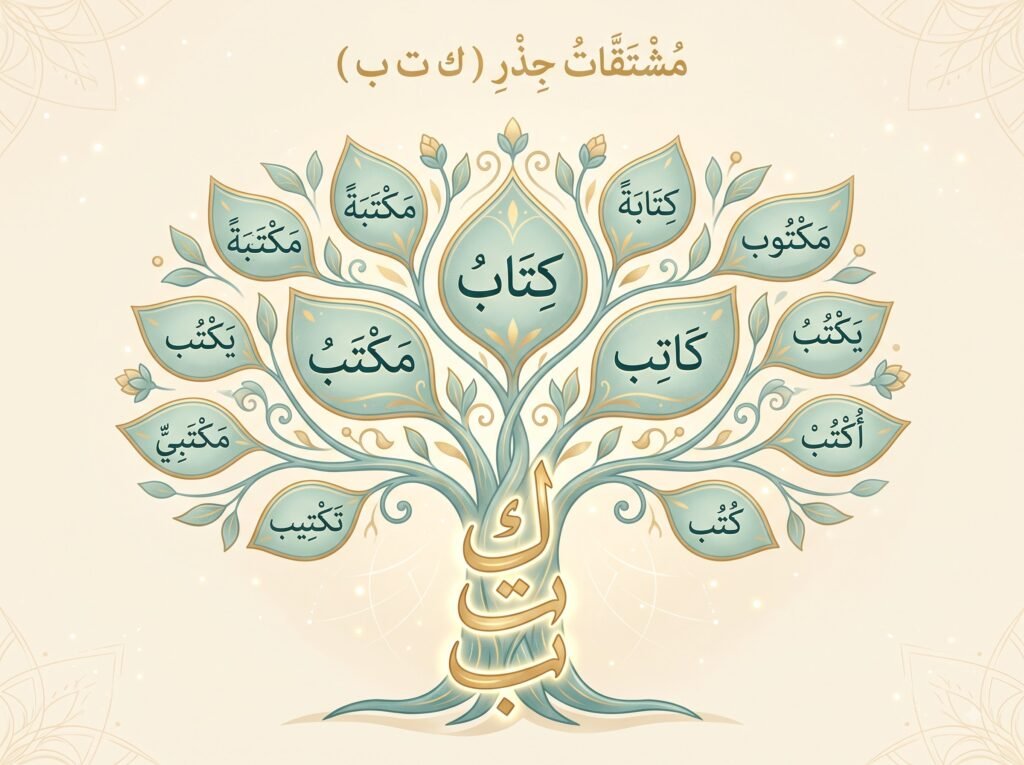
Most Arabic words grow from a root of three letters, which carries a core idea. This is what trilateral root Arabic means. Take ك-ت-ب (k-t-b), the idea of writing:
| Word | Arabic | Meaning |
|---|---|---|
| kitab | كتاب | book |
| kataba | كتب | he wrote |
| katib | كاتب | writer |
| maktab | مكتب | office or desk |
| maktub | مكتوب | written |
Learn one root, and you understand a whole family of words. The idea even stretches into the Quran: in “kutiba ‘alaykumus-siyam” (2:183), the same root means “prescribed,” as in fasting being written upon believers.
(A small number of Arabic words have four-letter roots. Three-letter roots cover most of the language.)
2. Patterns Add the Twist
If the root is the skeleton, the pattern (wazn) is the clothing. The same patterns work across hundreds of roots:
- The doer: katib (writer), ‘alim (knower), sabir (one who is patient)
- The thing done: maktub (written), ma’lum (known)
- The place: maktab (office), masjid (place of prostration, from س-ج-د)
- Intensifying or causing: ‘alima (he knew) becomes ‘allama (he taught)
Once you spot a pattern, you can guess the meaning of words you’ve never seen. That skill turns a learner into a reader.
3. You Already Know Roots You Didn’t Realise
You use the root system every day:
- ر-ح-م (r-h-m): Ar-Rahman, Ar-Rahim, rahmah. All point to mercy.
- س-ل-م (s-l-m): Islam, Muslim, salam. All point to peace and submission.
- س-ج-د (s-j-d): sujud, masjid, sajid. All point to prostration.
- ق-ر-أ (q-r-‘): Quran and iqra’ (“read!”), the very first word revealed, share a root that most scholars link to reading and recitation.
Every time you say the Bismillah, you’re using the root system. The method simply shows you what was already there.
4. Case Study: Sabr (ص-ب-ر)
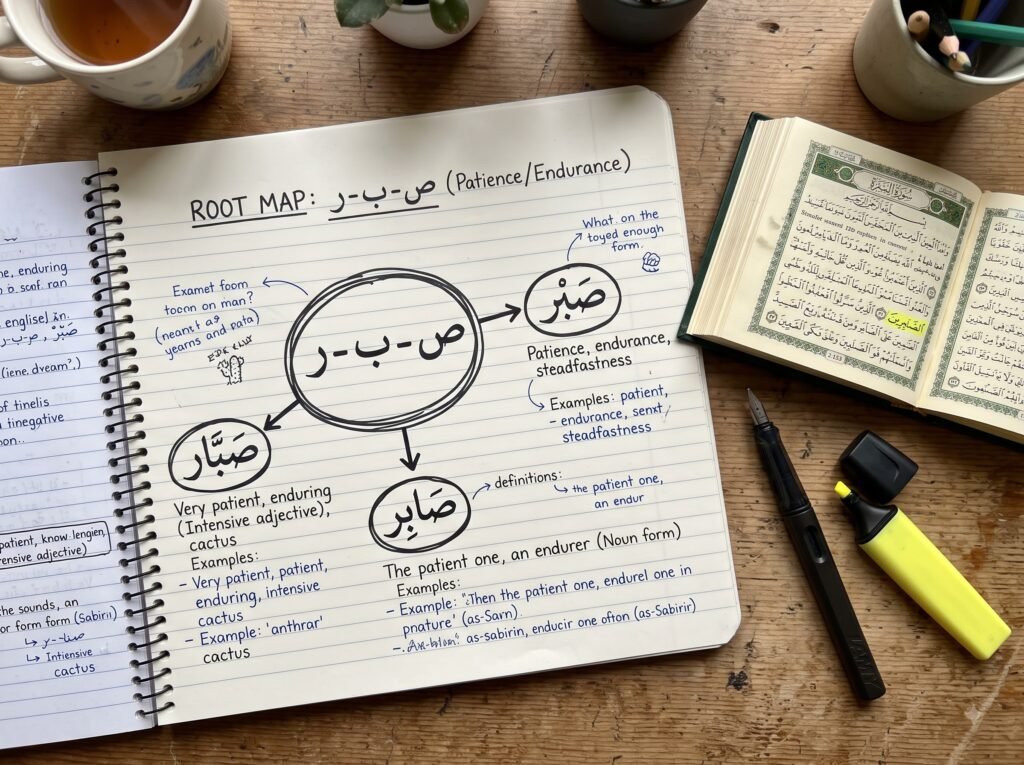
Sabr is usually translated as “patience,” but the root paints a fuller picture: steadfastness, holding firm, restraining oneself. Its family includes sabr (patience), sabir (the patient one) and sabbar (very patient).
Now read “Inna Allaha ma’as-sabirin” (2:153), “Indeed, Allah is with the patient.” Once you see the root, as-sabirin stops being a random word and becomes a familiar friend.
Watch our short video for the full walkthrough: 3 Letters, 1 Root: Sabr
5. Why This Is the Fastest Path to Real Understanding
Roots repeat constantly across the Quran, so every root you learn pays off again and again. Instead of hundreds of disconnected words, you build a compact map that grows with you.
This is the heart of the Quranic Arabic method we teach at Roots:
- Learn one root a day and link it to 5-10 words.
- Spot the pattern, not just the vocabulary.
- Read verses with recognition, not just recitation.
- Revisit roots in context, so they stick.
A Fair Word of Caution
Roots are powerful, but they aren’t magic. Understanding the Quran also takes grammar, context and, for deeper meanings, the guidance of qualified scholars. Roots give you the foundation. The rest gets built on top of it.
That’s why the method works best with a structured path and a teacher who can guide you.
How to Start Today
- Pick one root you already know, like ر-ح-م or س-ل-م.
- Write down every word from it that you can think of.
- Find one of those words in a verse you know by heart.
- Repeat tomorrow with a new root.
Ten minutes a day is enough to begin.
Quick FAQs
Do I need to know Arabic already?
No. The root method works from day one, even for complete beginners.
Is it useful for both Modern Standard Arabic and Quranic Arabic?
Yes. The root system is shared, so what you learn carries across.
How many roots are in the Quran?
Roughly 1,700 distinct roots, and many of them appear again and again. Exact counts vary slightly by method, but the point stands: a manageable set of roots opens up a lot of the text.
Can I learn this on my own?
You can start alone, but a teacher helps you avoid common mistakes and stay consistent.
Ready to See the Quran Differently?
Three letters really can open a lot of doors. With the right method and guidance, those doors lead somewhere meaningful: verses you recognise, words you understand, and prayers you feel.
