
Why Adults Learn Quranic Arabic Faster Than They Think
You’ve told yourself you’re too old, too busy, and that Arabic is too hard. This article is for you.
Maybe you’ve said it out loud. Maybe it’s just a quiet thought you carry every time you finish your Salah and realize you still don’t know, word for word, what you just said to Allah. “I should have started this when I was younger.” “My brain doesn’t work like that anymore.” “I don’t have time to sit with a textbook for hours a day.”

Here’s the truth nobody tells you: those excuses are based on a myth. And once you understand why, the path forward becomes a lot clearer — and a lot closer than you think.
The Myth: “Kids Learn Languages Faster”
We’ve all heard it. Children are sponges. Their brains are wired for language. Adults are stiff, self-conscious, and slow.
It’s true for some kinds of language learning — specifically, picking up native-like accents through years of total immersion. But that’s not what you’re trying to do. You’re not trying to become a five-year-old fluent in playground Arabic. You’re trying to understand the Quran — its words, its structure, its meaning. That is a completely different task, and it turns out adults have serious advantages here that children simply don’t.
Why Adults Actually Have the Edge
1. You already have context. A child learning Arabic has to learn the concepts and the language at the same time. You don’t. You already know what prayer is, what mercy means, what a prophet’s story feels like. When you learn that rahma means mercy, you’re not learning a new idea — you’re attaching a word to something you already understand deeply. That shortcut alone puts you years ahead of where a child would be.
2. You have discipline a child doesn’t. Children learn language through years of unconscious repetition. Adults can sit down, set a goal, and work toward it deliberately. You can tell yourself “I will learn 10 root words this week” and actually follow through. That kind of intentional practice compresses years of passive learning into months of focused effort.
3. You have the single strongest ingredient: motivation. This is the one that changes everything. A child learns their first language because they have no choice — it’s survival. You’re choosing to learn Quranic Arabic because you want a closer relationship with your Lord, because you’re tired of relying on someone else’s translation, because you want to feel the words of the Quran the way they were revealed. That kind of motivation doesn’t fade after a bad day. It’s the reason adult learners, again and again, outperform expectations.
So Why Does It Feel So Hard?
Because most people are using the wrong method.
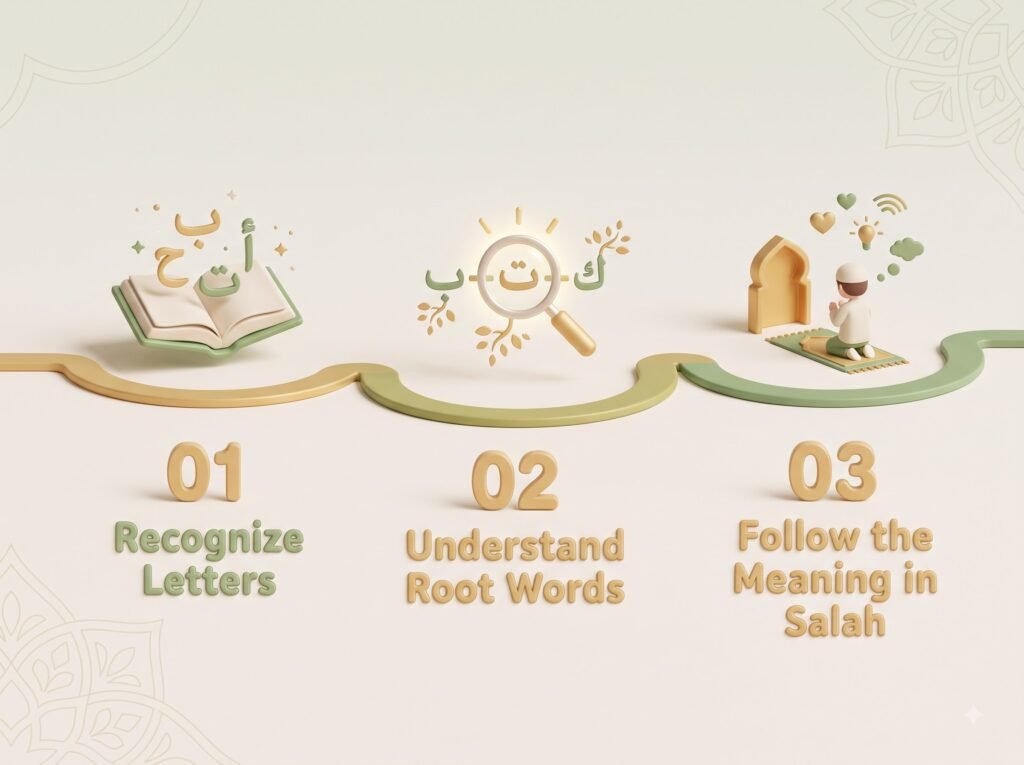
Quranic Arabic isn’t learned the way you’d learn to order coffee in Cairo. You don’t need thousands of vocabulary words for daily conversation. You need a specific, targeted skill set: recognizing common root patterns, understanding how Quranic grammar repeats itself, and building familiarity with the few hundred words that make up the vast majority of the Quran’s text.
This is a finite, learnable system — not an endless mountain. The problem isn’t your age or your intelligence. The problem is that most people try to learn Arabic the way schools teach French or Spanish: slowly, broadly, and without any real connection to their goal. When your only goal is to understand the Quran, you don’t need that. You need a method built specifically for that goal.
What a Realistic Timeline Looks Like
You don’t need years. With focused, consistent practice — even just a few sessions a week — most adult learners begin recognizing root words and following basic meaning within a matter of months, not years. It won’t happen overnight, and it shouldn’t be rushed. But it also isn’t the decade-long project most people assume it is.
The difference between someone who gets there and someone who gives up isn’t talent. It’s whether they had a clear, structured path — and whether they stuck with it long enough to feel the first real moment of understanding.
The Moment Everything Changes
Ask anyone who has done this and they’ll tell you about a specific moment: standing in Salah, reciting a surah they’ve said a thousand times, and suddenly hearing it differently. Not reciting sounds — understanding words. That shift doesn’t just improve your Arabic. It transforms your prayer itself. (We wrote a whole piece on this — read How Understanding Arabic Transforms Your Salah if you want to know what that moment actually feels like.)
You’re Not Too Old. You’re Not Too Late.
The only real barrier between you and understanding the Quran in its own language isn’t your age, your schedule, or your past attempts that didn’t stick. It’s simply not having the right method — one built for adults, built around your goal, and built to fit into a real, busy life.
That’s exactly what we do at Roots.
Book your first adult class at Roots — it’s free, no commitment. Come see for yourself how much closer you already are than you think.
