
10 Arabic Words Every Muslim Should Know About Hajj
Millions make Hajj each year. Millions more follow it from home.
But how many truly understand what they are saying — or what the rituals they are watching are actually named after?
Hajj is not simply a sequence of physical actions performed in a specific geography. Rather, it is a spiritual architecture — and every ritual within it carries a name whose Arabic root reveals what that ritual is designed to do at the deepest level.
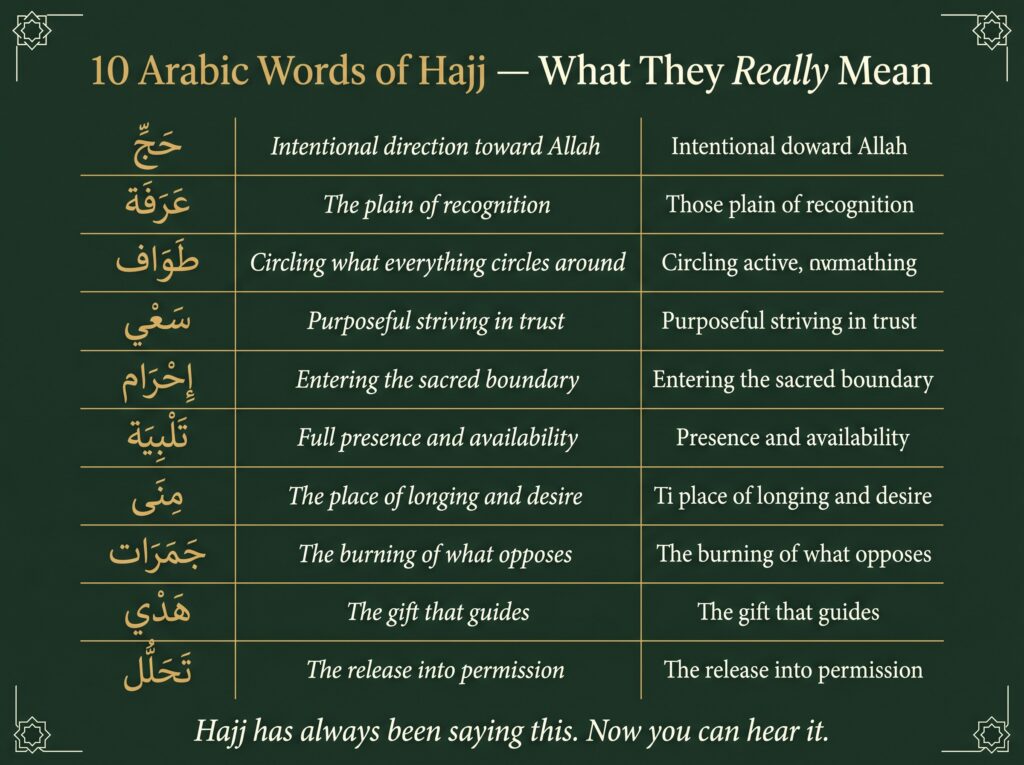
Here are ten Arabic words of Hajj. For each one: the Arabic, the root letters, what most people understand it to mean, and the root meaning that reveals the ritual’s architectural purpose.
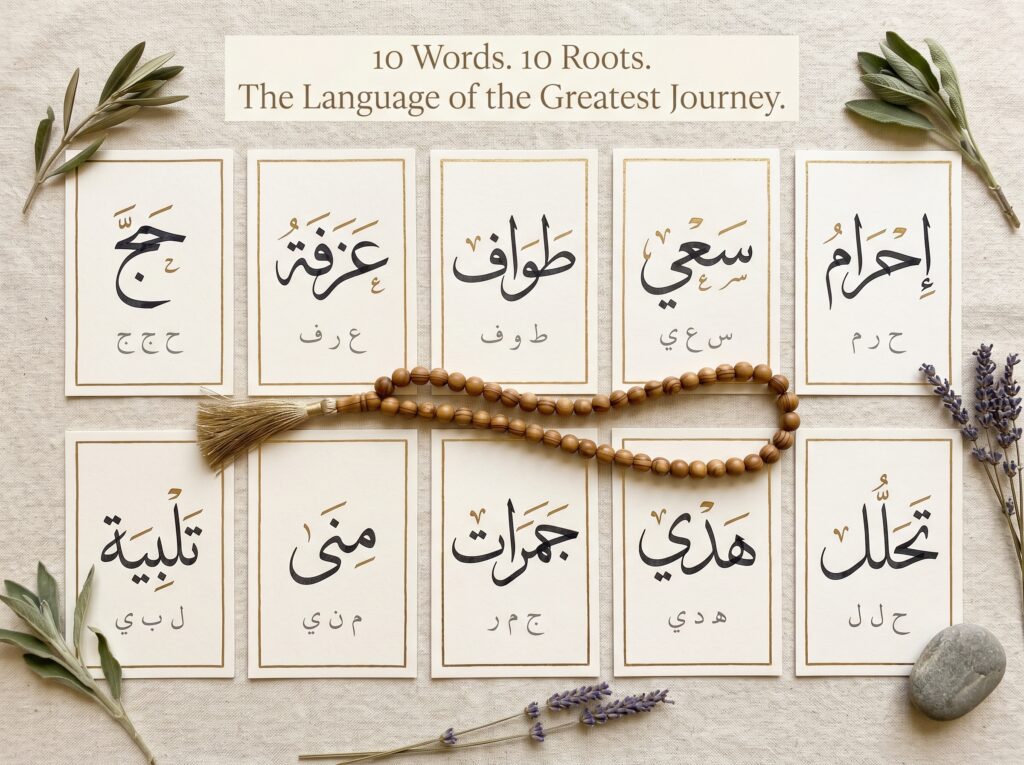
Word 1 — حَجّ (Hajj)
📌 Ghost Callout Block
Arabic: حَجّ Root letters: ح-ج-ج (ha-jeem-jeem) Common understanding: Pilgrimage, the fifth pillar of Islam Deep root meaning: The act of setting out with complete intentional resolve toward a specific destination — the purposeful direction of the entire self toward something that cannot be avoided
Everything begins here. Before any ritual, before ihram, before Mecca — there is the meaning of the word itself.
The root ح-ج-ج carries the core meaning of purposeful, resolved direction toward a destination. A حُجَّة (hujjah — from the same root) is a proof or argument — the thing that points conclusively toward a conclusion that cannot be escaped. The مَحَجَّة (mahajja) is the clear path, the established road of those who came before.
Hajj, therefore, is not simply a journey. Rather, it is the act of directing oneself toward Allah with complete resolve — setting the entire self in His direction with the same conclusiveness that a proof points toward its conclusion.
Every ritual that follows is an expression of that fundamental act of direction.
Word 2 — عَرَفَة (Arafah)
📌 Ghost Callout Block
Arabic: عَرَفَة Root letters: ع-ر-ف (ayn-ra-fa) Common understanding: The plain outside Mecca where pilgrims stand — the central ritual of Hajj Deep root meaning: The place of knowing — recognition, acquaintance, and the intimate knowledge that comes from direct personal encounter
The Prophet ﷺ said: “Hajj is Arafah.” It is, consequently, the ritual that the entire pilgrimage builds toward and turns on.
The root ع-ر-ف is the root of مَعْرِفَة (ma’rifah) — intimate knowledge, recognition from direct experience — the kind of knowing that comes not from information but from encounter. A عَارِف (aarif) is one who knows deeply, from the inside.
The plain of Arafah is, therefore, the place of recognition — the place where pilgrims stand before Allah and are known by Him, and where the standing itself is an act of عَرَفَ: the servant presenting themselves to be recognized by the One who already knows everything, on the day when that recognition carries the weight of the entire year’s forgiveness.
Word 3 — طَوَاف (Tawaf)
📌 Ghost Callout Block
Arabic: طَوَاف Root letters: ط-و-ف (ta-waw-fa) Common understanding: The circling of the Kaaba — seven circuits performed upon arrival in Mecca Deep root meaning: To circle, to surround, to orbit around a central point — to make something the axis around which all movement turns
The root ط-و-ف describes the act of moving around something in a circular path — orbiting it, surrounding it, making it the fixed center of one’s movement. From the same root comes طَائِف (one who circumambulates) and يَطُوفُ (he circles around).
Tawaf, therefore, is not simply a religious exercise performed around a sacred building. Rather, it is a declaration made with the body: this is what everything else in my life circles around. The Kaaba at the center of the tawaf is the House of Allah — and every circuit declares that He is the fixed point, the axis, the center around which the pilgrim’s entire existence orbits.
Furthermore, the Quran tells us that the angels perform tawaf around the Bayt al-Ma’mur — the House directly above the Kaaba in the heavens. The pilgrim’s tawaf, consequently, joins a circulation that never stops.
Word 4 — سَعْي (Sa’i)
📌 Ghost Callout Block
Arabic: سَعْي Root letters: س-ع-ي (sin-ayn-ya) Common understanding: The walking and running between Safa and Marwa — seven times Deep root meaning: Purposeful striving and determined effort — movement directed by intention rather than impulse, effort sustained by purpose rather than energy alone
The root س-ع-ي describes striving — not casual movement but deliberate, purposeful effort directed toward something. The Quran uses this root for the striving of the believer: “And that the human being shall have only what they strive for” (Surah An-Najm, 53:39).
Sa’i commemorates Hajar RA — the mother of Ismail ﷺ — running between two hills in the desert searching for water for her child. Her movement was not panic. It was purposeful striving in the context of complete trust in Allah. And that movement was so beloved to Allah that He preserved it as a ritual of Hajj for every pilgrim until the Day of Judgment.
Sa’i, therefore, teaches every pilgrim something profound: that purposeful striving and complete trust in Allah are not in tension. They are, in fact, the same act — and the root of the word encodes that lesson permanently.
Word 5 — إِحْرَام (Ihram)
📌 Ghost Callout Block
Arabic: إِحْرَام Root letters: ح-ر-م (ha-ra-meem) Common understanding: The sacred state entered before Hajj — the white garments worn, the prohibitions observed Deep root meaning: The act of making something haram — entering a boundary of sacred prohibition that sets the one within it apart from ordinary existence
The root ح-ر-م is one of the most significant root families in the Quran. It gives us حَرَام (forbidden), حَرَم (the sacred sanctuary), مُحَرَّم (Muharram — the sacred month), and حُرْمَة (sanctity, inviolability).
إِحْرَام is the verbal noun of the act of entering this sacred state — literally, the making-sacred, the entering-into-prohibition. When a pilgrim enters ihram, they are not simply putting on white garments and giving up certain activities. Rather, they are placing themselves inside a sacred boundary — making their person haram in the same way the Haram itself is haram — set apart, inviolable, existing in a state that ordinary life does not permit.
The two white garments of ihram, furthermore, carry a deliberate echo: every person who has ever lived will be wrapped in two white cloths at death. Ihram is, consequently, a rehearsal of that final state — the pilgrim practicing for the moment when they will stand before Allah with nothing but their deeds.
Word 6 — تَلْبِيَة (Talbiyah)
📌 Ghost Callout Block
Arabic: تَلْبِيَة Root letters: ل-ب-ب (lam-ba-ba) Common understanding: The declaration Labbayk Allahumma labbayk — chanted continuously from ihram throughout Hajj Deep root meaning: Full presence and complete availability — the state of being entirely oriented toward the one who called, with nothing held back
The root ل-ب-ب carries the meaning of presence and essential availability. The dual form لَبَّيْكَ — here I am for you, twice over — is the response of a servant who has been called and who presents themselves completely available. Not tentatively. Not conditionally. Fully, repeatedly, continuously present.
From the same root: لُبّ (lubb) — the core, the essence, the heart of something. And أُولُو الأَلْبَاب — those of deep understanding, those who have arrived at the core of things.
The Talbiyah, therefore, is not simply a chant. Rather, it is the declaration of the pilgrim’s entire availability to Allah — I am here, I am present, I am at the core of my purpose, and that purpose is You. Every repetition is a renewal of that availability. Consequently, scholars encourage pilgrims to say it constantly — because the state it declares is the state Hajj is designed to produce.
Word 7 — مِنَى (Mina)
📌 Ghost Callout Block
Arabic: مِنَى Root letters: م-ن-ي (meem-nun-ya) Common understanding: The valley near Mecca where pilgrims spend the nights of Hajj and perform the stoning of the Jamarat Deep root meaning: Wishes, desires, longings — the things the heart reaches toward and hopes for
The root م-ن-ي gives us مُنْيَة (munya — a wish, a longing, a hope), يَتَمَنَّى (he wishes, he longs for), and أَمَانِي (amaani — wishes, desires, longings).
Mina, therefore, is the valley of desires — the place named after the human capacity for longing and hope. Scholars have noted that this naming is not incidental: Mina is the place where pilgrims spend the majority of their Hajj nights, where they make dua in the most sustained way, where the accumulated wishes of millions of Muslims are raised to Allah simultaneously.
The valley is named, consequently, after what fills it — the wishes of the servants who come to Allah with their longings on the most significant days of the year.
Word 8 — جَمَرَات (Jamarat)
📌 Ghost Callout Block
Arabic: جَمَرَات Root letters: ج-م-ر (jeem-meem-ra) Common understanding: The three stone pillars representing Shaytan — stoned by pilgrims during Hajj Deep root meaning: Live embers, burning coals — that which continues to burn and glow with active heat long after the visible flame is gone
The root ج-م-ر describes live embers — the state of burning that continues beneath the surface, that holds active heat without visible flame. A جَمْرَة is a single live coal. The جَمَرَات are the three pillars at which pilgrims throw stones — and their name carries this root meaning.
The ritual of stoning the Jamarat commemorates Ibrahim ﷺ driving away Shaytan when he appeared to dissuade Ibrahim from obeying Allah’s command. Each stone thrown by a pilgrim is, therefore, a declaration: I reject what burns with the fire of opposition to Allah’s command.
Furthermore, the root reveals something about the nature of Shaytan’s influence: it is not a dramatic visible flame but persistent live embers — the kind that require active, repeated rejection rather than a single definitive moment. The three rounds of stoning on three consecutive days encode this lesson into the ritual’s structure.
Word 9 — هَدْي (Hady)
📌 Ghost Callout Block
Arabic: هَدْي Root letters: ه-د-ي (ha-dal-ya) Common understanding: The sacrificial animal offered during Hajj Deep root meaning: A gift that guides — guidance offered as a gift, or a gift whose nature is to lead toward something
The root ه-د-ي is among the most significant root families in the entire Quran. It gives us هُدَى (huda — guidance), هَدِيَّة (hadiyya — a gift), يَهْدِي (He guides), and الْهَادِي (Al-Hadi — one of the beautiful names of Allah, the Guide).
The هَدْي — the sacrificial animal — shares its root with guidance and with gifts. It is therefore not simply a ritual sacrifice but a gift offered to Allah whose very name carries the meaning of guidance: I offer this in the path of the One who guides, as an act of obedience to the One whose guidance I am following.
Furthermore, it commemorates the sacrifice of Ibrahim ﷺ — and the root reveals the theological core of that event: Ibrahim’s obedience was itself an act of following guidance, and the animal that replaced his son was Allah’s guidance arriving at the moment of greatest need.
Word 10 — تَحَلُّل (Tahallul)
📌 Ghost Callout Block
Arabic: تَحَلُّل Root letters: ح-ل-ل (ha-lam-lam) Common understanding: The exiting of ihram — when the pilgrim becomes permitted to do what ihram prohibited Deep root meaning: The releasing of a knot, the untying of what was bound, the return to the permissible after a period of sacred restriction
The root ح-ل-ل is the root of حَلَال (halal — permissible), حَلَّ (to untie, to release, to solve), and حُلُول (arrival, the settling into a place). It is the opposite root of ح-ر-م — the root of ihram.
تَحَلُّل is therefore the completion of the arc that ihram began. The pilgrim entered the sacred boundary (ihram — from ح-ر-م). The pilgrim now exits it, releasing the knot of sacred restriction and returning to the permissible world — changed by what happened inside the boundary.
The root consequently reveals that Hajj is not simply a journey with rituals. Rather, it is a complete arc: entry into sacred restriction, transformation within it, and emergence into the ordinary world carrying what the sacred state produced. The pilgrim who performs tahallul is not simply removing their ihram garments. They are completing a spiritual untying — returning to the world as someone whose knot of separation from Allah has been loosened.
Ten Words. Ten Doorways.
These ten Arabic words are not simply vocabulary items. Rather, each one is a doorway into the language that the Quran was revealed in — the language in which Allah chose to encode the most important knowledge ever given to humanity.
When you understand the root of حَجّ, you understand direction. When you understand عَرَفَة, you understand recognition. When you understand تَلْبِيَة, you understand presence. Together, furthermore, they map a complete spiritual journey that every Muslim can inhabit more deeply — whether at Hajj or following from home.
This is what Arabic root learning gives. Not new information — but new depth in everything you already know and love.
→ Read the complete introduction to the Arabic root method: [Link to Arabic Roots Method Article] → Explore Arabic for beginners — start your root learning journey today: [Link to Arabic for Beginners Article]
Learn Arabic With Us
→ Explore our live classes and courses at roots-muslimschool.com
Root-based Arabic learning designed specifically for Muslim adults and children — built to deliver Quranic comprehension, not just vocabulary lists. Live classes, structured courses, and a community of Muslims building real understanding of the language of their deen.
This Hajj season — understand every word of the journey.
May Allah grant every Muslim who reads this the tawfiq to understand His words — and may He accept the Hajj of every pilgrim who stands on Arafah this year. Ameen. 🌙
