
Is Arabic Hard to Learn? The Truth for Adult Muslims
The number one reason Muslims do not start learning Quranic Arabic is that they believe they are too old or it is too hard.
Here, moreover, is what science actually says.

The Belief That Stops More Muslims Than Anything Else
There is a conversation that happens in Muslim communities with remarkable consistency.
Someone mentions they wish they could understand what they recite in salah. Someone else nods and says they have always wanted to learn Arabic. A third person says they tried once and found it too difficult. And the conversation ends — not with a plan, but with a shared understanding that Arabic is simply beyond reach for adults who did not grow up with it.
This conversation, consequently, repeats itself in every mosque, every Islamic studies circle, and every Muslim household where the gap between recitation and comprehension quietly widens year by year.
The belief driving that conversation — that adults cannot effectively learn languages, and that Arabic is particularly beyond reach — is, however, one of the most thoroughly debunked assumptions in cognitive science. Furthermore, it is causing real and ongoing harm: disconnecting millions of Muslims from the meaning of the words they address to Allah five times every day.
In this post, therefore, we are going to examine that belief directly. Not with reassurance, but with research. Four specific myths. Four specific rebuttals. And then the honest nuance that makes the whole picture complete.
📌 Ghost Callout Block — Four-Myth Rebuttal Card
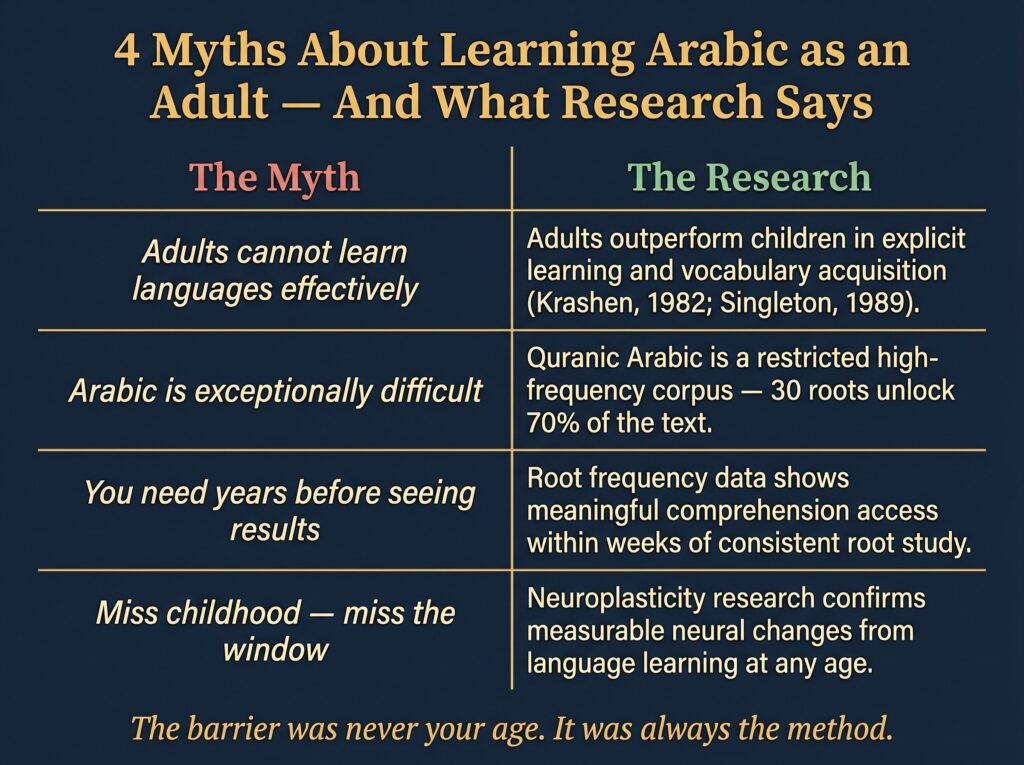
4 Myths About Learning Arabic as an Adult — And What Research Says
| The Myth | The Research |
|---|---|
| ❌ Adults cannot learn languages effectively | ✅ Adults outperform children in explicit learning tasks and vocabulary acquisition — research consistently shows adult advantages in motivated, meaning-based learning |
| ❌ Arabic is exceptionally difficult | ✅ Quranic Arabic is a restricted, high-frequency corpus — 30 root families unlock approximately 70% of the text |
| ❌ You need years before seeing results | ✅ Root frequency data shows meaningful comprehension access is achievable within weeks of consistent root study |
| ❌ Missing childhood means missing the window | ✅ Neuroplasticity research confirms measurable neural changes from language learning occur at any age |
The barrier was never your age. It was always the method.
Myth 1 — Adults Cannot Learn Languages Effectively
This myth has its origins in legitimate science — specifically in the critical period hypothesis, first proposed by neurologist Wilder Penfield in the 1950s and popularized by linguist Eric Lenneberg in the 1960s. The hypothesis suggested that language acquisition was most efficient before puberty, after which the brain’s neurological flexibility for language declined significantly.
This finding was real, but its popular interpretation was significantly overstated. Specifically, the critical period applies most strongly to phonological acquisition — the ability to develop a native-like accent and to distinguish between sounds that do not exist in your first language. In these narrow areas, earlier exposure does produce advantages.
For vocabulary acquisition, reading comprehension, and meaning-based language engagement, however, the research tells a different story.
Studies by Krashen (1982) and Singleton (1989) — among many others — found that adults consistently outperform children and adolescents in the early stages of explicit language learning. The reasons are neurologically straightforward: adults have larger working memories for processing explicit grammatical rules, stronger pattern recognition abilities developed through years of cognitive experience, greater capacity for self-directed motivated study, and — crucially — more developed semantic networks that allow new vocabulary to attach to existing meaning structures far more efficiently than in children.
In other words, the adult brain is not a diminished language learning brain. Rather, it is a different language learning brain — one with specific, significant advantages in exactly the type of learning that Quranic Arabic requires.
Myth 2 — Arabic Is Exceptionally Difficult
Arabic is categorized by the US Foreign Service Institute as a Category IV language — their highest difficulty rating for English speakers, requiring an estimated 2,200 class hours to reach professional working proficiency in Modern Standard Arabic.
This statistic is frequently cited as evidence that Arabic is simply beyond reach for adult learners. It is, however, being applied to the wrong goal.
The FSI rating describes the challenge of achieving full conversational and professional fluency in Modern Standard Arabic — the ability to read newspapers, conduct business negotiations, and understand regional dialects. This is, indeed, a significant undertaking that requires years of sustained study.
Learning to understand Quranic Arabic, however, is a fundamentally different task — and a significantly more accessible one.
The Quran is a corpus of approximately 77,430 words. When analyzed by root family, the distribution of those words is extraordinarily concentrated: a relatively small number of root families account for a disproportionately large percentage of total word occurrences. Furthermore, the goal of Quranic Arabic study is reception — reading with understanding — rather than production — speaking fluently. Neurologically, receptive language skills require substantially less acquisition than productive ones.
The challenge of understanding the Quran in Arabic is therefore not the challenge that the FSI difficulty rating describes. It is a different, narrower, and far more tractable challenge — one measured in months of focused root study rather than years of full language acquisition.
Myth 3 — You Need Years Before Seeing Results
This myth is, in many ways, the most practically damaging of the four — because it functions as a pre-emptive demotivation. If results take years, why begin at all?
The reality of root-based Quranic Arabic learning, however, is structurally different from the timeline most people imagine.
Researchers studying the Quranic Arabic Corpus — a detailed morphological annotation of every word in the Quran — have analyzed the frequency distribution of root families across the entire text. Their findings demonstrate that the top 30 root families by frequency account for approximately 70% of all word occurrences in the Quran.
This means, practically, that a learner who spends four to six weeks systematically studying the 30 highest-frequency root families — learning the core meaning of each root and its most common derivatives — gains meaningful recognition access to approximately 70% of the words they will encounter on any given page of the Quran.
Not 70% of the roots. Seventy percent of the actual words on the page.
Furthermore, the recognition compounds. Each new root learned does not add a fixed number of words to the learner’s comprehension. Instead, it unlocks a family of related words that appear across hundreds of ayahs — each encounter with a familiar root reinforcing and deepening the original learning.
Results, with the root-based approach, begin in weeks. Not years. Weeks.
Myth 4 — If You Did Not Learn as a Child, You Missed the Window
This is the most emotionally loaded myth of the four — and consequently the most resistant to rebuttal through statistics alone.
Many adult Muslims carry a genuine sense of loss about not having learned Arabic in childhood. The feeling is real and understandable. The conclusion drawn from it — that the window is now permanently closed — is, however, not supported by neuroscience.
Contemporary neuroplasticity research has fundamentally revised the older understanding of brain rigidity in adulthood. Studies using neuroimaging have shown that adult language learners produce measurable structural changes in the brain — including increased gray matter density in regions associated with language processing and enhanced white matter connectivity between language areas — at every age studied, including in participants in their sixties and seventies.
The adult brain retains, throughout life, the capacity to form new neural pathways in response to language learning. The rate of pathway formation may differ from childhood. The pathways themselves, however, form just as real and just as permanently.
Additionally, adult learners bring something to language study that children simply do not have: motivation grounded in meaning. A Muslim adult who wants to understand what they recite in salah has a depth of intrinsic motivation that no classroom incentive can replicate. And research on adult learning consistently shows that intrinsic, meaning-based motivation is the single strongest predictor of language learning success.
The window did not close. It opened differently. And for the adult Muslim who wants to understand the Quran, it is, therefore, open right now.
The Honest Nuance — What Is Genuinely True
Having addressed the four myths directly, there is an honest nuance worth stating clearly.
Arabic does require sustained effort. There is no method — root-based or otherwise — that delivers Quranic comprehension without consistent engagement over time. The five-minute daily routine works precisely because it is daily. The PDF companion works because it is used regularly, not occasionally. The June course works because it provides structure for the sustained engagement that results require.
Furthermore, the root-based approach is not equally suited to every Arabic learning goal. For someone who wants to speak Modern Standard Arabic conversationally or understand regional dialects, the root method is a foundation — not a complete solution. For someone whose specific goal is to understand the Quran they recite, however, it is the most efficient available approach by a significant margin.
Be honest with yourself about your goal. If your goal is to understand your salah, your Quran, your duas — then the root approach, done consistently in five minutes a day, will deliver results that you will feel within weeks.
That is not a marketing claim. It is a structural consequence of how the Quran was written and how the Arabic root system works.
Where to Start — Right Now
The research has been presented. The myths have been addressed. The honest nuance has been stated.
What remains, therefore, is simply the decision to begin.
→ Watch the Myth Busted series on YouTube — each episode addresses one Arabic learning myth with live examples from the Quran: [Link to YouTube]
Your Next Steps
→ Download the Free 50-Word Quranic Vocabulary PDF Fifty of the highest-frequency root families in the Quran, laid out simply and beautifully — no prior Arabic knowledge required. This is your starting point. Four to six weeks of daily engagement with this PDF, using the five-minute routine, gives you meaningful access to 70% of the words in the Quran. Completely free.
→ Join the June Arabic Roots Course Waitlist The free PDF gives you the foundation. The June course gives you the complete structured system — root learning, pattern recognition training, applied Quranic reading, and a community of adult non-Arab Muslims building the same comprehension together. Designed specifically for adult beginners. Be first to know when enrollment opens.
→ Share With Someone on the Fence You know someone who has been telling themselves Arabic is too hard. Someone who wishes they could understand their salah but has talked themselves out of trying. Send them this post. The research deserves to reach the people it can free.
May Allah make the Quran accessible to every Muslim who reaches for it — regardless of age, background, or how many years have passed since they first wished they could understand it. The door is open. It always was. Ameen. 🌙
