
How to Learn Arabic for Quran Understanding.
You want to understand the Quran in Arabic.
You do not know where to start. You may have tried before and stopped. You may have been meaning to start for years and never quite begun.
Here is an honest guide — built for exactly where you are right now.

You Are Not Starting From Zero
Before the five stages, there is something worth saying directly.
Most Muslims who want to learn Arabic for the Quran believe they are starting from nothing. In fact, they are not. If you have been praying salah for any length of time, you already know dozens of Arabic words and phrases — you have heard them hundreds or thousands of times. You know الرَّحْمَن and الرَّحِيم. You know سُبْحَانَ الله and الْحَمْدُ لِلَّهِ. You know إِيَّاكَ نَعْبُدُ even if you do not yet know what it means.
Furthermore, whatever your starting point — whether you have never opened an Arabic workbook, whether you tried once and stopped after three weeks, or whether you have been carrying the intention for years without acting on it — you are in exactly the same position as every Muslim who eventually succeeded at this.
At the beginning. Which is the only place this journey can start.
Here are the five stages that take you from where you are to where you want to be.
Stage 1 — Clarify the Goal
Timeline: One conversation with yourself — before anything else The one mistake to avoid: Aiming for the wrong target
📌 Ghost Toggle Block — Stage 1
The goal is Quranic comprehension — not conversational Arabic fluency.
This single distinction removes approximately 80% of the intimidation that stops most Muslims from starting.
Full conversational fluency in Modern Standard Arabic is a genuinely demanding undertaking — the US Foreign Service Institute rates it among the most challenging languages for English speakers, requiring approximately 2,200 hours of study to achieve professional working proficiency. This is the daunting number most Muslims are unconsciously measuring themselves against when they think about learning Arabic.
Quranic comprehension is a fundamentally different goal — and a significantly more accessible one.
The Quran is a specific, bounded corpus of approximately 77,430 words. When analyzed by root family, its vocabulary distribution is extraordinarily concentrated: a relatively small number of root families account for a disproportionately large percentage of word occurrences. The goal of Quranic Arabic study, moreover, is reception — reading with understanding — rather than production — speaking fluently. Neurologically, receptive language skills require substantially less acquisition than productive ones.
Consequently, the question is not: Can I learn Arabic? The question is: Can I learn to read the Quran with meaningful comprehension?
The answer to that question, with the right method and daily consistency, is yes — within months, not years.
The one mistake to avoid at this stage: Beginning with a goal you have not explicitly defined. Without clarity on the goal, you will unconsciously measure your progress against the wrong standard — full fluency — and feel like you are failing when you are, in fact, succeeding at something more achievable and more relevant.
Stage 2 — Learn the Arabic Alphabet and Letter Sounds
Timeline: 2–4 weeks with daily practice of 10–15 minutes The one mistake to avoid: Skipping this stage
📌 Ghost Toggle Block — Stage 2
The Arabic alphabet has 28 letters. Most of them have four forms depending on their position in a word — standalone, initial, medial, and final. Several letters share similar shapes and are distinguished only by the number and position of dots beneath or above them.
This sounds more complex than it is. In practice, most adult learners who engage with the alphabet consistently for 2–4 weeks reach functional letter recognition — the ability to identify letters in Quranic text — before the end of that period.
Recommended resources for this stage:
A beginner’s Arabic alphabet workbook with tracing exercises — the physical act of writing letters dramatically accelerates recognition. Alternatively, an Arabic alphabet app that uses spaced repetition for letter review — 10–15 minutes daily is sufficient at this stage, and consistency matters far more than session length.
What success looks like at Stage 2: You can look at a line of Arabic text and identify each letter — slowly, with effort, but accurately. You are not reading fluently. You are reading. That is the target.
The one mistake to avoid at this stage: Trying to memorize all four forms of every letter before moving forward. Learn to recognize letters in running text — imperfectly but consistently — and the four forms will become familiar through repeated exposure. Perfectionism at Stage 2 is the most common reason learners never reach Stage 3.
Stage 3 — Enter the Root System
Timeline: 4–8 weeks of daily root study with the free PDF The one mistake to avoid: Starting with grammar instead of roots
📌 Ghost Toggle Block — Stage 3
This is the stage where the method diverges most sharply from traditional Arabic learning — and where the results begin to arrive.
The Quran is built on a three-letter root system. Almost every word in the Quran traces back to a three-letter root that carries a core meaning — and when you learn that root, you do not learn one word. You unlock a family of related words that appear across hundreds of ayahs.
Research on the Quranic Arabic Corpus — a detailed morphological analysis of every word in the Quran — demonstrates that the top 30 root families by frequency account for approximately 70% of all word occurrences in the Quran. Mastering 30 roots, therefore, gives you meaningful recognition access to 70% of the words on any given page of the Quran.
This is the stage where most adult learners experience their first genuine comprehension moment — the first time a familiar ayah suddenly reveals meaning that was always there but never accessible. Furthermore, that moment typically arrives within the first two weeks of consistent root study.
The resource for this stage: The free 50-word Quranic Vocabulary PDF — fifty of the highest-frequency root families in the Quran, laid out simply and beautifully with core meanings and key derivatives. No prior Arabic knowledge required beyond the alphabet familiarity built in Stage 2.
The one mistake to avoid at this stage: Beginning with Arabic grammar tables. Grammar is a valuable tool — but it is a tool for analyzing language you already recognize, not for building the initial recognition system. Starting with grammar before roots produces complexity before reward, drains motivation before the method has delivered results, and is the primary reason most self-directed Arabic learners stop at this stage.
→ Read the complete explanation of why the root method works — and the research behind it: [Link to Arabic Roots Method Article]
Stage 4 — Apply Roots in Daily Quran Reading
Timeline: Ongoing — this is the habit that compounds indefinitely The one mistake to avoid: Waiting until you know enough before starting
📌 Ghost Toggle Block — Stage 4
Stage 4 is not a stage you complete. Rather, it is the daily practice that runs continuously alongside and beyond every other stage — the habit that turns root knowledge into lived Quranic comprehension over time.
The structure is the 5-minute Fajr routine: immediately after the final salam of Fajr, before your phone is unlocked, you open your Quran, read one ayah, look up one root word in the free PDF, sit with the meaning for one minute, and make a short dua.
Five minutes. Every day. Anchored to Fajr.
Why this works when longer sessions do not: Research on habit formation consistently shows that small habits anchored to existing behaviors are dramatically more sustainable than large commitments requiring independent motivation. Fajr is the one Islamic practice most Muslims already perform consistently. Attaching five minutes of root study to it means the habit inherits Fajr’s consistency — you do not need new motivation, you borrow the existing motivation of a practice already in your life.
Furthermore, the compounding effect of five minutes daily over six months is 182 sessions — more Arabic exposure than most weekend Islamic school programs deliver in two years.
The one mistake to avoid at this stage: Waiting until you have finished Stage 3 before beginning Stage 4. Start the daily five-minute routine as soon as you have your first ten roots from Stage 3. The application reinforces the root learning, and the root learning deepens the application. They work together — consequently, starting both simultaneously accelerates both.
Stage 5 — Go Structured With Live Classes
Timeline: When you are ready for depth that self-study alone cannot reach The one mistake to avoid: Believing self-study is sufficient for the long term
📌 Ghost Toggle Block — Stage 5
Stages 1 through 4 will take most committed self-directed learners from zero Arabic to meaningful Quranic comprehension. They will unlock the experience of salah with understanding, make the Quran speak in meaning rather than just sound, and build the daily habit that compounds indefinitely.
What they cannot fully deliver, however, is the depth that comes from structured, interactive learning with a qualified teacher — the ability to ask questions when a root does not make sense, to have your understanding corrected before it calcifies into a misunderstanding, to progress through a curriculum designed by someone who understands both the language and the learner.
Live online classes provide three specific things that self-study cannot:
First: Real-time feedback — the ability to hear whether your understanding of a root is accurate before you carry a mistake into every future encounter with that word. Second: Curriculum structure — a progression designed to build each stage of comprehension on the previous one, rather than the self-directed learner’s inevitable gaps and repetitions. Third: Community accountability — the single most powerful predictor of learning consistency, according to educational research.
The one mistake to avoid at this stage: Waiting for the perfect moment to begin. There is no stage of Arabic knowledge at which you are too much a beginner for a live class. The Roots Muslim School trial class is designed specifically for the learner who has never studied Arabic before — or who tried and stopped — and wants to experience the structured method before committing.
→ Explore the best online Arabic classes for Muslim adults and children: [Link to Best Online Arabic Classes Article]
Where You Are After the Five Stages
At the end of these five stages — or even partway through them — you will have something that no translation app, no subtitled video, and no summary of Islamic knowledge can give you.
You will have a direct relationship with the language of the Quran. Not fluency. Not linguistic mastery. Rather, a working, daily, living connection — the experience of opening the Quran and recognizing words, of standing in salah and knowing what you are saying, of making dua in Arabic and feeling the weight of each root you have learned carrying the meaning you are addressing to Allah.
This is what the journey produces. And it starts from exactly where you are right now.
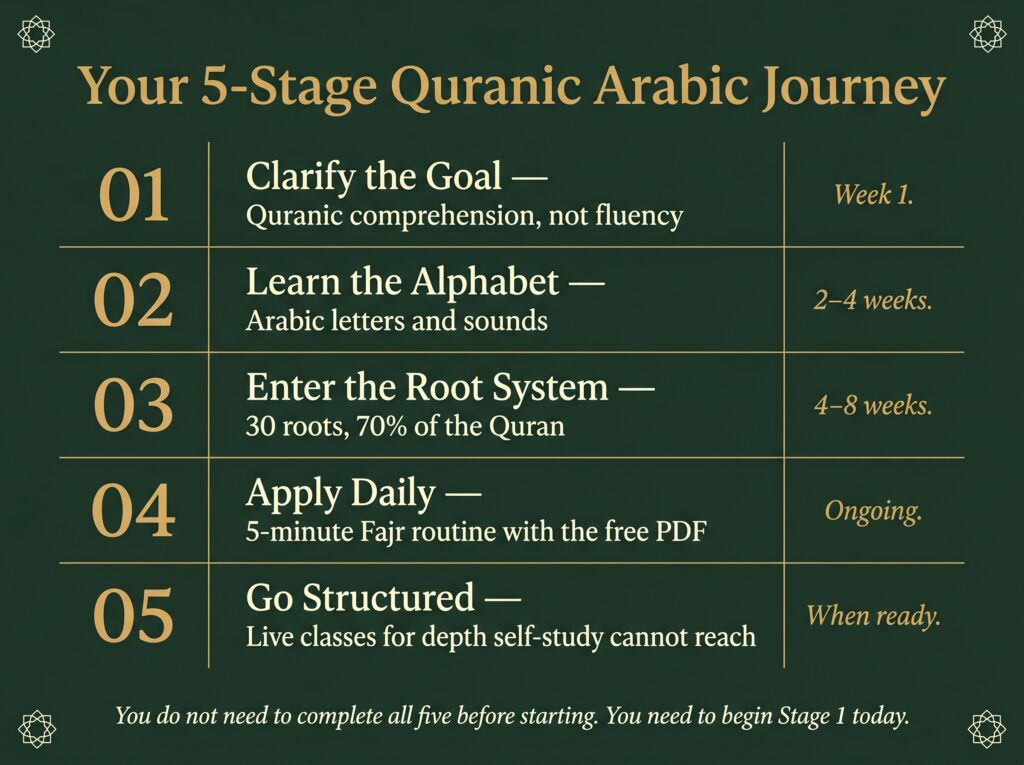
Your Five-Stage Roadmap at a Glance
| Stage | What You Do | Timeline |
|---|---|---|
| 1 — Clarify the Goal | Define Quranic comprehension as the target | Before anything else |
| 2 — Learn the Alphabet | Arabic letters and sounds with daily practice | 2–4 weeks |
| 3 — Enter the Root System | 30 roots, free PDF, daily study | 4–8 weeks |
| 4 — Apply Daily | 5-minute Fajr routine with the Quran | Ongoing |
| 5 — Go Structured | Live classes for depth and accountability | When ready |
You do not need to complete all five before starting. You need to begin Stage 1 today.
Your Next Step
→ Try a Free Arabic Class With Roots Muslim School
The trial class is free, live, and designed specifically for the adult Muslim beginner — whether you are at Stage 2, Stage 3, or have not yet started Stage 1. Experience the structured root-based method in a single session and see what becomes possible when the method matches the goal.
→ Download the Free 50-Word Quranic Vocabulary PDF Your Stage 3 companion — fifty root families, simply laid out, completely free. Start Stage 3 today.
→ Share With a Muslim Who Has Been Meaning to Start You know someone who has been meaning to start learning Arabic for the Quran for longer than they would like to admit. Send them this guide. The beginning is the same for everyone — and it is always available.
May Allah make the language of His Book accessible to every Muslim who reaches for it — and may He make the reaching itself an act of worship. Ameen. 🌙
