
5-Minute Arabic Routine: Anchor It to Your Day (Busy Parents)
You have wanted to learn Arabic for years. You bought the book, downloaded the app, and maybe even made a beautiful study schedule. Then real life arrived: a toddler who won’t sleep, a work deadline, a dinner that needs cooking.

If that sounds familiar, the problem isn’t your commitment. The problem is that most advice assumes you have a free hour. You don’t, and that’s okay.
The best 5 minute Arabic routine doesn’t ask for new time. It borrows time you already use.
[IMAGE 1 HERE: hero image, see descriptions below]
What Is Habit Stacking (and Why Does It Work)?
Habit stacking means attaching a new habit to one you already do automatically. Behavior researcher BJ Fogg calls the existing habit an “anchor” in his Tiny Habits method, and author James Clear popularized the term “habit stacking” in Atomic Habits. The formula is simple:
After I [current habit], I will [new tiny habit].
It works because you don’t have to remember or feel motivated. The first habit becomes the reminder for the second. Research on “implementation intentions” (specific if-then plans) has also consistently found that people are more likely to follow through when they decide when and where they’ll act in advance.
For a busy parent Arabic habit, this matters. Your day is unpredictable, but certain moments repeat almost every day. Those are your anchors.
Your Daily Anchors: Where Arabic Already Fits
Look at your day and find moments that are short, repeatable, and already automatic:
| Anchor moment | 5-minute Arabic action |
|---|---|
| Kettle boiling | Review 3 flashcards |
| First sip of tea after Fajr | Read one short ayah slowly and note one word you recognize |
| Driving to school | Play a 3-minute Arabic audio lesson |
| After wudu for Maghrib | Review three Arabic words |
| Waiting for the microwave | Name 5 objects in the kitchen in Arabic |
| Bedtime routine | Teach your child one new word |
You don’t need all of these. Pick one. One anchor, done consistently, beats six anchors attempted for a week.
Try This Tonight: The Wudu Anchor
Here is the easiest starting point for many Muslim families, because wudu is a habit you already have.
After you make wudu for Maghrib, review three Arabic words. That’s it.
For example, this week you could use words from the moment itself:
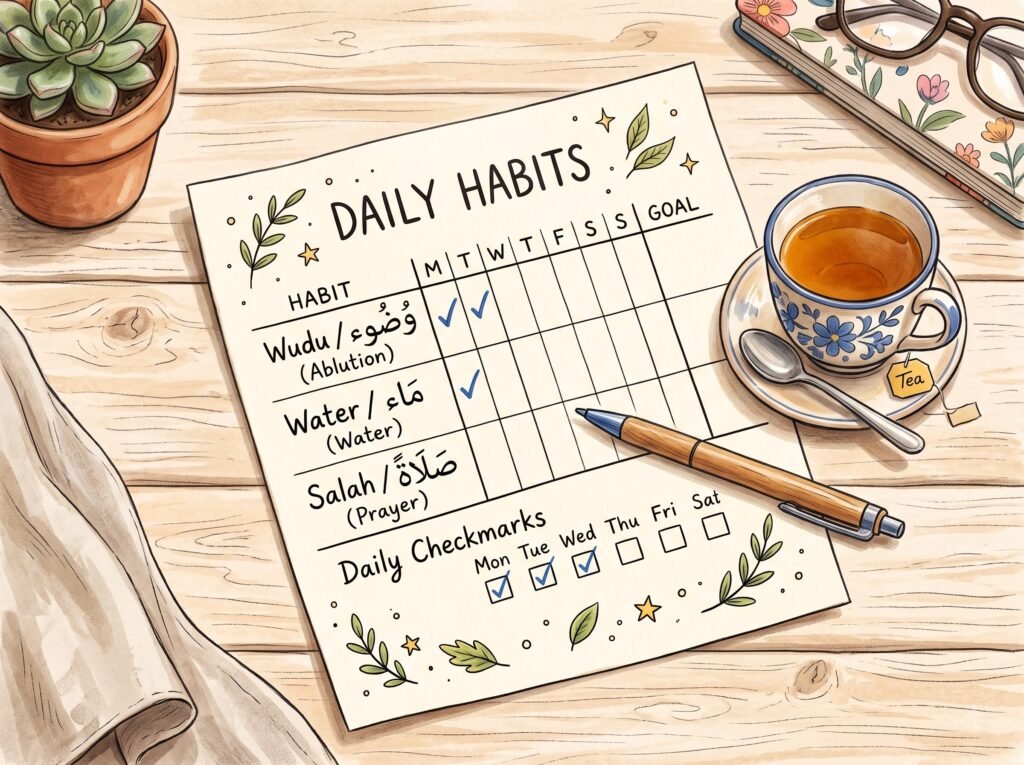
- وُضُوء (wuḍū’): ablution
- مَاء (mā’): water
- صَلَاة (ṣalāh): prayer
Say each one out loud twice, then move on to your prayer. That takes about a minute, which is well under budget. If you want the full five, use the extra time to say each word in a simple sentence, or teach one word to your child.
There’s a bonus here: you’re learning words connected to your worship, so they stick faster and carry more meaning.
Make Your Anchor Stick: 4 Simple Rules
- Keep it tiny. If it takes more than five minutes, shrink it. A habit you can do on your worst day is the one that lasts.
- Prepare the tools in advance. Put your flashcards next to the kettle or your lesson on your phone’s home screen. Removing friction is the secret of quick daily Arabic practice.
- Say the plan out loud. “After Maghrib wudu, I review three words.” Specific plans beat vague intentions.
- Celebrate immediately. A quiet “Alhamdulillah” or a checkmark on a tracker tells your brain the habit was worth it.
What If You Miss a Day?
You will. Everyone does, and that’s part of realistic Muslim parenting time management.
A well-known 2009 study from University College London on habit formation found that missing a single day didn’t significantly derail people’s progress. The same study found that forming a habit took anywhere from about 18 to 254 days, with an average of around 66. In other words, slow and imperfect is normal.
There is also beautiful reassurance in our own tradition. The Prophet ﷺ said that the most beloved deeds to Allah are those done consistently, even if they are small (narrated in Bukhari and Muslim). Five minutes, repeated, is exactly that.
So if you miss today, don’t quit. Just don’t miss twice.
See It in Action
Want to watch how this looks in a real, chaotic household? Check out our video, The 5-Minute Arabic Habit, where we walk through picking your anchor and building your first week step by step.
Your Next Step
Don’t try to overhaul your schedule. Choose one anchor from the list above, attach one tiny Arabic action to it, and start tonight.
To make it easier, download our free 5-minute daily routine tracker and put your first checkmark on the page after Maghrib wudu.
Small steps, taken daily, add up. Bismillah, start with three words.
