
5 Arabic Roots of Knowledge: How Arabic Explains Learning
Before “school” or “study,” Arabic already had a family of roots for learning.
Every word for knowing, reading, thinking, or understanding in Arabic grows from a three-letter root. Learn one root and you unlock a whole family of words. In this September recap, we look at five of the most useful roots for anyone learning Arabic or reading the Quran.
Each one has a small story hidden inside it.
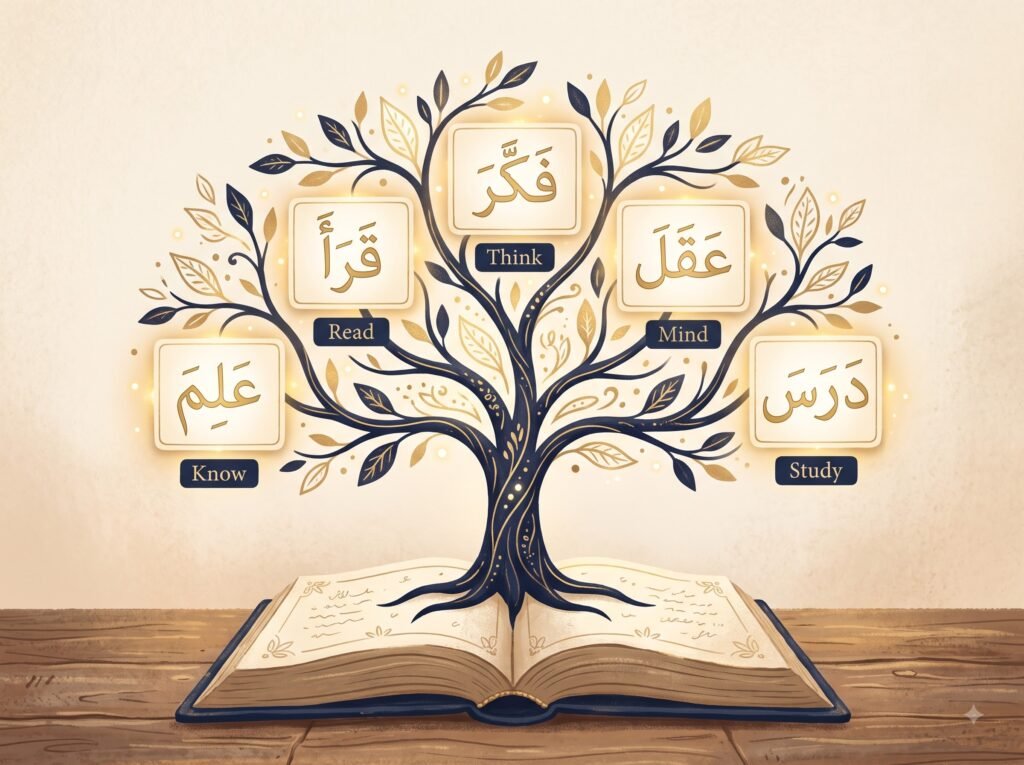
1. ع-ل-م (ʿ-l-m): The Root of Knowledge
This is the big one. The root ʿ-l-m gives you:
- ʿilm (علم): knowledge
- ʿālim (عالم): a scholar, one who knows
- taʿlīm (تعليم): education, teaching
- ʿalāma (علامة): a sign or mark
The link between “knowledge” and “a sign” is worth a pause. In this root, to know something is to recognize its marks. Knowing starts with noticing. The root also gives ʿālam (world), which many Arabic speakers understand as “the place full of signs.”
2. ق-ر-أ (q-r-ʾ): The Root of Reading
Qaraʾa (قرأ) means “to read” or “to recite.” From the same root comes Qurʾān, usually translated as “the recitation.”
This tells you something about the culture behind the word. In early Arabic, reading meant speaking the text aloud, not silently scanning it. Knowledge was something you voiced, heard, and passed on.
You will also see this root in the command iqraʾ (“read!” or “recite!”).
3. ف-ك-ر (f-k-r): The Root of Thought
Fikr (فكر) means “thought,” and tafakkur (تفكّر) means “reflection,” the deliberate act of thinking something through.
The second form matters. The tafaʿʿul pattern often suggests effort and repetition, so tafakkur is not a passing idea but a mind working at something. Think of it as thinking with intention.
4. ع-ق-ل (ʿ-q-l): The Root of Intellect
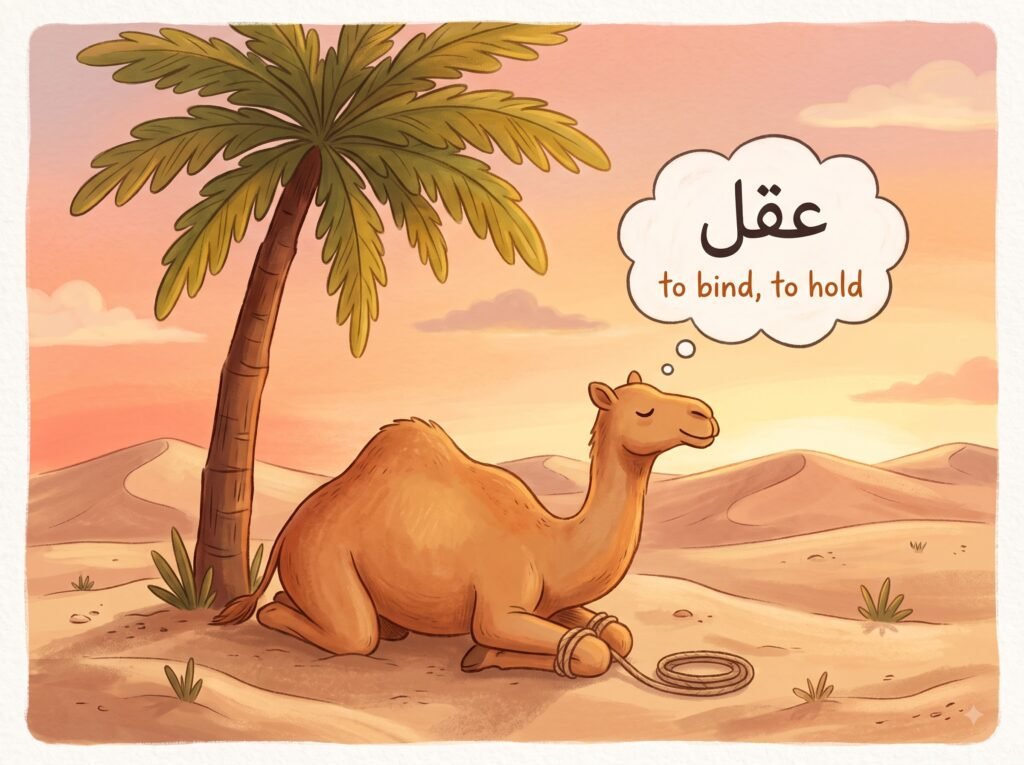
ʿAql (عقل) means “intellect” or “reason.” The root originally meant “to tie or bind,” as in hobbling a camel so it cannot wander off. The rope used for this is called an ʿiqāl.
So the mind, in Arabic, is what holds your thoughts in place. It keeps impulses from running loose. It is a lovely picture, and a memorable one.
5. د-ر-س (d-r-s): The Root of Study
We added a fifth root to complete the set, because this one gives you the Arabic word for the place where learning happens.
- darasa (درس): to study
- dars (درس): a lesson
- mudarris (مدرّس): a teacher
- madrasa (مدرسة): a school
Some classical dictionaries link the root to the idea of wearing something down through repeated use, like a path worn smooth by many footsteps. Studying, then, is going over something again and again until it becomes familiar. (Scholars discuss this original sense, so treat it as a helpful image rather than the only explanation.)
Quick Recap
| Root | Core idea | Family words |
|---|---|---|
| ع-ل-م | To know | ʿilm, ʿālim, taʿlīm, ʿalāma |
| ق-ر-أ | To read, recite | qaraʾa, Qurʾān |
| ف-ك-ر | To think | fikr, tafakkur |
| ع-ق-ل | To bind, hold | ʿaql |
| د-ر-س | To study | dars, mudarris, madrasa |
Why Roots Beat Memorizing Lists
You could memorize twenty separate words. Or you could learn five roots and recognize dozens. Once you see ʿ-l-m in ʿilm, taʿlīm, and ʿalāma, new words stop feeling new. That is the whole idea behind our learn Arabic roots series.
Want to catch up on everything from this month? Watch our ‘September Recap’ Reel + YouTube Short for a fast visual review of all 30 roots.
Enjoyed this? Follow along for October’s new set of roots.
