
Why Arabic Apps Don’t Help You Understand the Quran
You finished the tree. You still can’t understand Surah Al-Baqarah. Here’s why that’s not your fault.
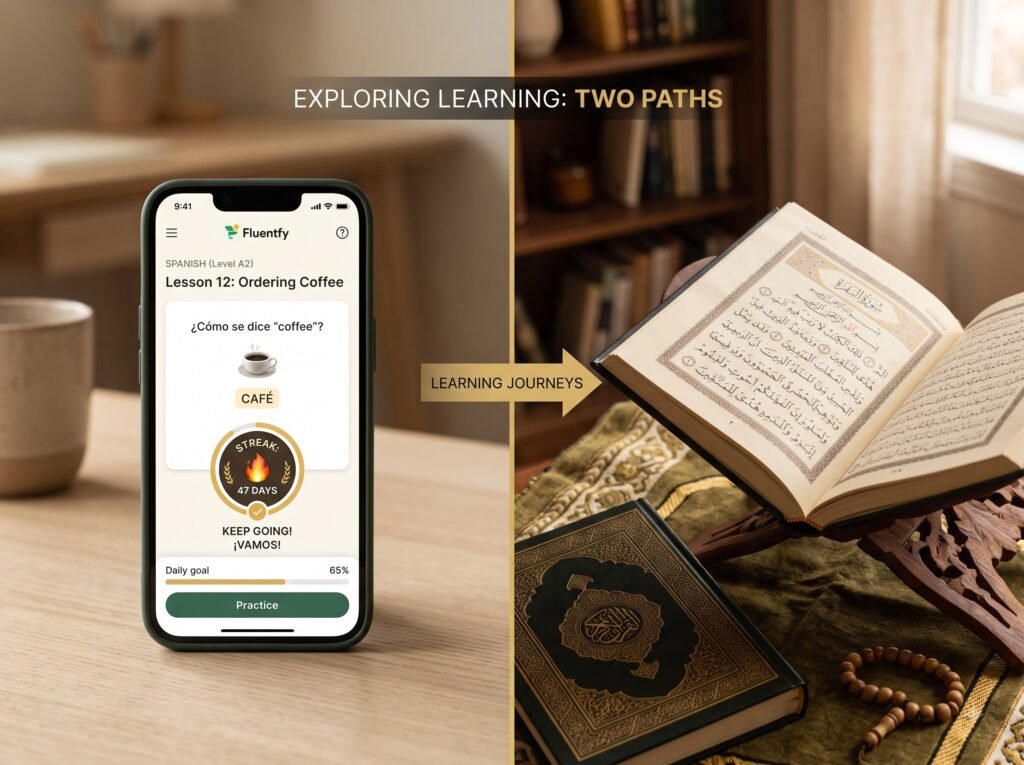
You downloaded the app. You did the daily streak. You unlocked “Level 5 Fluent” badges, learned how to order coffee, ask for directions, and say “where is the bathroom” in flawless Arabic.
Then you opened the Quran.
And nothing you learned showed up.
No “ayna” leading you to a verb you recognized. No grammar pattern you’d drilled a hundred times. Just… a wall of unfamiliar words, in a rhythm and structure that felt like a completely different language.
If that’s happened to you, here’s the truth almost no app will tell you upfront: it is a different language — or close enough to one that it might as well be.
The App Wasn’t Built for You
Most popular language apps are designed around a single use case: travel and daily conversation. Their entire content pipeline — the vocabulary lists, the example sentences, the grammar order — is optimized for someone landing in Cairo, Dubai, or Beirut who needs to survive their trip.
That’s not a flaw. It’s just not your goal.
These apps teach what’s called conversational Arabic — really, a specific regional dialect (Egyptian, Levantine, Gulf, and so on). Dialects are the Arabic people actually speak at home, in markets, on the street. They’re rich, alive, and constantly evolving — but they’re also regional. Egyptian Arabic and Moroccan Arabic can sound almost like two different languages to each other.
Quranic Arabic isn’t a regional dialect at all. It’s Classical Arabic — the fixed, formal register the Quran was revealed in over 1,400 years ago. It doesn’t shift by country. It doesn’t borrow slang. Its grammar is more intricate, its vocabulary more precise, and its sentence structures built for a completely different purpose: not small talk, but revelation.
So when an app teaches you “izzayak” (how are you, Egyptian dialect) and you’re hoping to eventually understand “iyyaka na’budu wa iyyaka nasta’in” — you were never on the same track to begin with.
Same Alphabet, Different Language Goals
Here’s the mental model that makes this click for most students:
| Conversational (Dialect) Arabic | Quranic (Classical) Arabic | |
|---|---|---|
| Purpose | Everyday speech, travel, socializing | Understanding revelation, formal texts |
| Where it’s used | Homes, streets, markets — varies by country | The Quran, classical texts, formal khutbahs |
| Grammar | Simplified, flexible, evolves regionally | Fixed, highly structured, precise |
| Vocabulary | Loanwords, slang, regional expressions | Root-based, deliberate, unchanged for centuries |
| Consistency | Different in Cairo vs. Casablanca vs. Kuwait | The same everywhere, for everyone |
They share an alphabet and a common ancestor. That’s about it. Learning one gives you almost no shortcut into the other — which is exactly why finishing a conversational app can leave you feeling like you learned “Arabic” and yet still can’t follow a single ayah without a translation underneath it.
This Isn’t a Knock on the Apps
It’s worth saying clearly: apps like Duolingo, Busuu, or similar platforms aren’t bad. They’re often genuinely well-designed — for what they’re built to do. If your goal is ordering food in Amman or chatting with a coworker in Riyadh, they can help.
The mismatch isn’t a quality problem. It’s a goal problem. You had one destination in mind — understanding the words Allah revealed — and you were handed a map to a different city.
So What Actually Gets You to the Quran?
Understanding Quranic Arabic isn’t about memorizing more vocabulary faster. It’s about learning the system the Quran is built on:
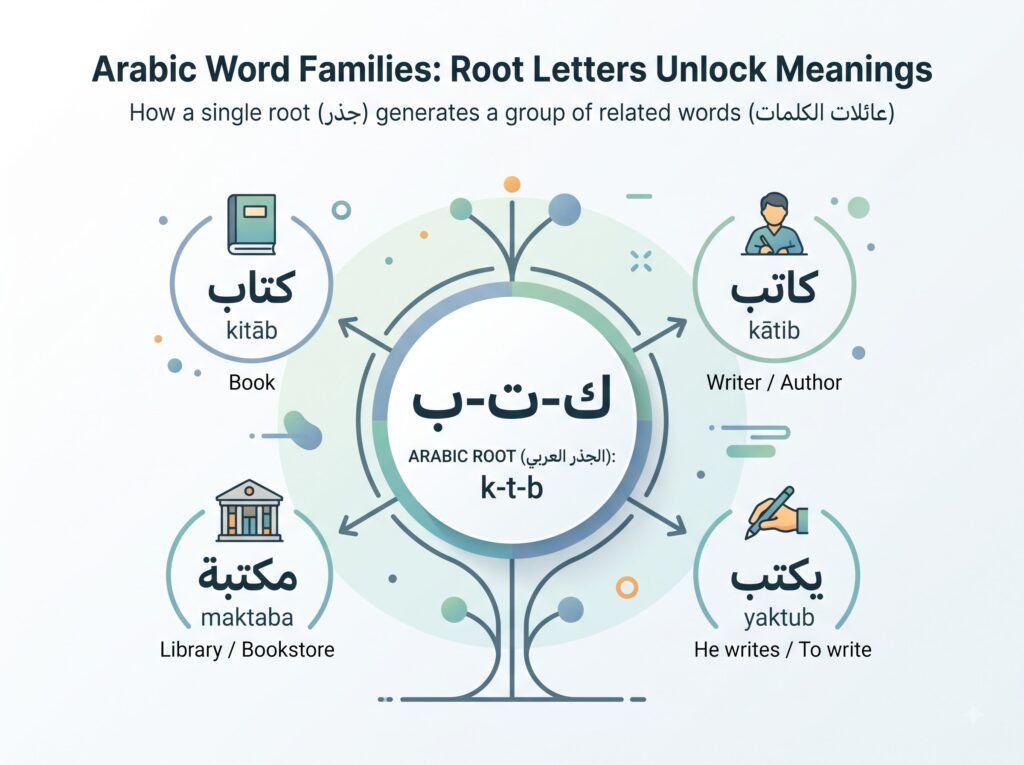
- Root letters — most Arabic words trace back to a 3-letter root that carries a core meaning, and once you know the system, whole families of words start unlocking at once.
- Classical grammar (nahw and sarf) — the rules that tell you why a word takes a certain form, not just what it means.
- Quranic vocabulary in context — learning words the way they actually appear across the Quran, not in a “how do I get a taxi” sentence.
This is a genuinely learnable skill. Thousands of non-Arabs — native English, Urdu, French, and Indonesian speakers among them — have built real, lasting comprehension of the Quran using this approach. It just requires the right kind of Arabic from day one, not a faster version of the wrong one.
Where to Go From Here
If you’ve felt discouraged, unintelligent, or like Arabic “just isn’t for you” — pause on that thought. You were likely doing everything right, aimed at the wrong target. The frustration was a mismatch in design, not a limit in your ability.
Curious how different Quranic Arabic programs actually approach this? We broke down how Roots compares to other well-known options — including Studio Arabiya and Bayyinah — in Roots vs. Studio Arabiya vs. Bayyinah, covering method, pace, and what kind of learner each is built for.
Roots teaches Quranic Arabic specifically. See the difference for yourself in a free class →
