What to Expect in Your First Arabic Lesson as an Adult Muslim
Most adults are nervous before their first Arabic lesson. Here’s exactly what happens.
If you’ve been putting off booking a class because you’re picturing something like your old high school language class — a teacher firing questions at you, other students judging your mistakes, homework piling up before you’ve even learned the alphabet — take a breath. That’s not what this is. And honestly, that fear is the single biggest reason adults delay starting for years, sometimes decades, when the actual first lesson looks nothing like what they imagined.
Let’s walk through exactly what happens, step by step, so you can walk in already knowing there’s nothing to be nervous about.
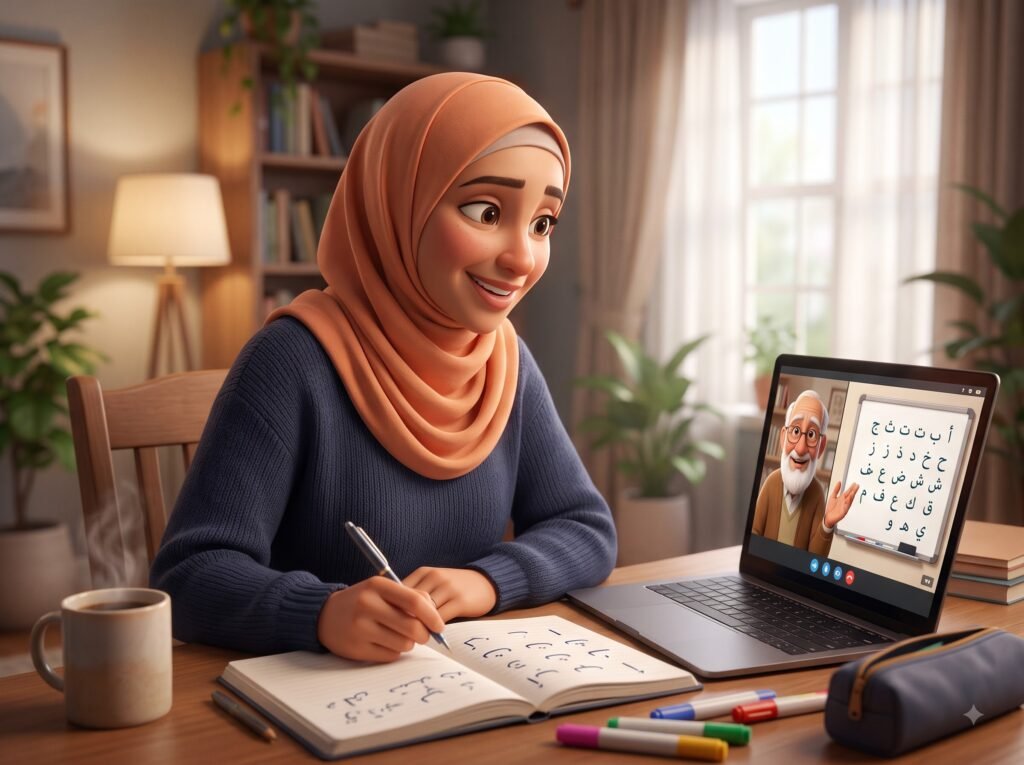
Before the Lesson: You Don’t Need to Prepare Anything
No, really. You don’t need to memorize the alphabet beforehand. You don’t need to “brush up” on anything. You don’t need to feel embarrassed that you’re 30, 45, or 60 years old and starting from zero. Your teacher already knows you’re a beginner — that’s the entire point of the lesson. Show up as you are.
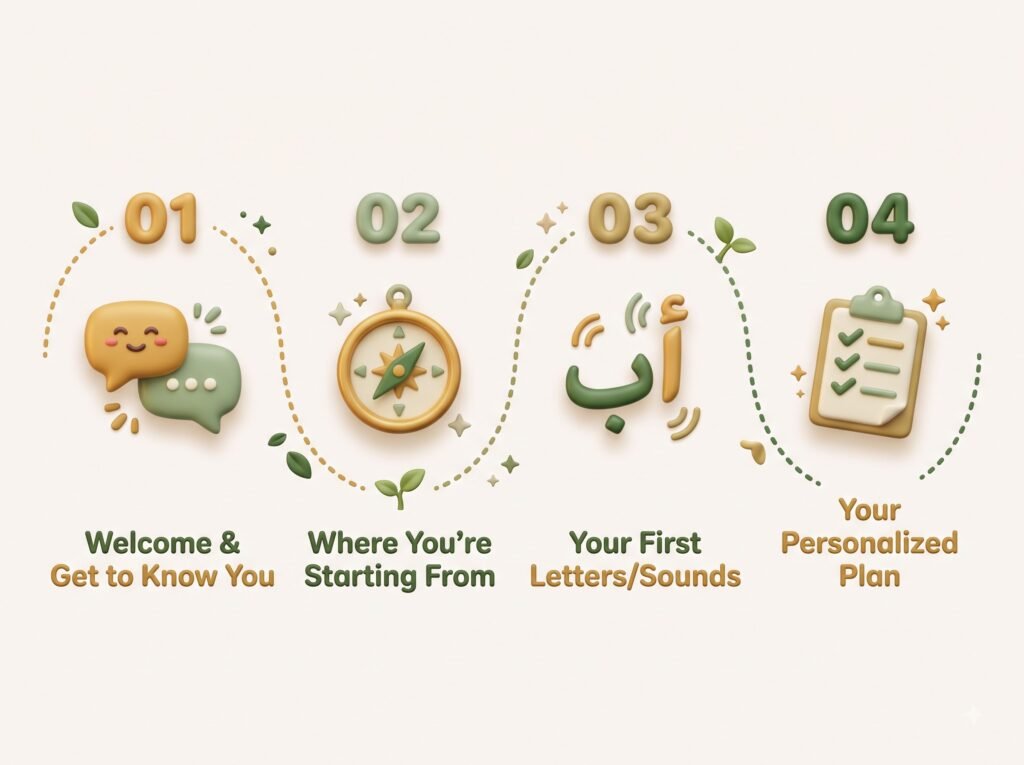
Minute 1–5: A Real Conversation, Not a Test
Your first few minutes won’t feel like an exam. Your teacher will ask about you — why you want to learn, what your relationship with the Quran has looked like so far, what frustrates you about not understanding it yet. This isn’t small talk for the sake of it. It’s how a good teacher figures out how to actually teach you, instead of running you through a generic script built for someone else.
This is also where a lot of adults feel the first wave of relief. You realize quickly: nobody here is judging you for starting late. If anything, your teacher has seen this exact situation hundreds of times before. You are not the exception. You are the norm.
Minute 5–15: Finding Your Actual Starting Point
Everyone assumes they’re “behind,” but behind what? There’s no universal timeline you’re supposed to be on. Your teacher will gently figure out what you already know — maybe you can already recognize a few letters from years of hearing them, maybe you genuinely know nothing, and that’s completely fine too. This step exists so the rest of your lessons are built around your real starting line, not a guess.
This is usually the moment people ask the question sitting quietly in the back of their mind: “Am I too old for this to actually work?” It’s a fair question — and it’s one we answer in detail in Why Adults Learn Quranic Arabic Faster Than They Think. Short version: no. Adults bring context, discipline, and motivation that make this process faster than most people expect, not slower.
Minute 15–30: Your First Real Arabic
This is the part people are most nervous about — and it ends up being the part they enjoy most. You won’t be thrown into complex grammar or long verses. You’ll start small: a few letters, a few sounds, maybe a short familiar word you’ve heard your whole life but never actually read. The goal of lesson one isn’t mastery. It’s momentum — giving you a genuine, tangible win you can feel in the first sitting.
Most students leave this part surprised by how much they picked up in such a short time. That surprise is exactly the point.
Minute 30–40: Connecting It Back to Why You’re Here
A good first lesson doesn’t end at “here are some letters.” It circles back to your reason for coming — whether that’s finally understanding your Salah, reading Quran without leaning on a translation, or simply feeling closer to the words you’ve recited your whole life without fully knowing their meaning. Your teacher will show you, even in this first lesson, a small glimpse of how these building blocks connect to that bigger goal.
The Last Few Minutes: A Plan, Not Homework Dread
Instead of a pile of intimidating homework, you’ll leave with a clear, realistic sense of what comes next — a simple plan built around your schedule and your pace, not an arbitrary one-size-fits-all curriculum. No pressure, no cramming, no comparison to anyone else in a classroom.
What You Won’t Experience
- You won’t be called on to perform in front of a group of strangers.
- You won’t be handed a textbook chapter and told to “catch up.”
- You won’t be made to feel foolish for starting later in life than you think you “should have.”
- You won’t leave more overwhelmed than when you walked in.
The Real Takeaway
The gap between where you are now and where you want to be — reciting Salah and actually understanding every word, reading Quran and feeling its meaning instead of relying on someone else’s translation — is smaller than the fear has been telling you. The only thing standing between you and that first real moment of understanding is booking the lesson.
Your first Roots class is free. No pressure. Book it today.