
5 of the Greatest Female Scholars in Islamic History
Islamic history has always had extraordinary women scholars.
Here are five whose contributions shaped the faith — and whose names deserve to be known.
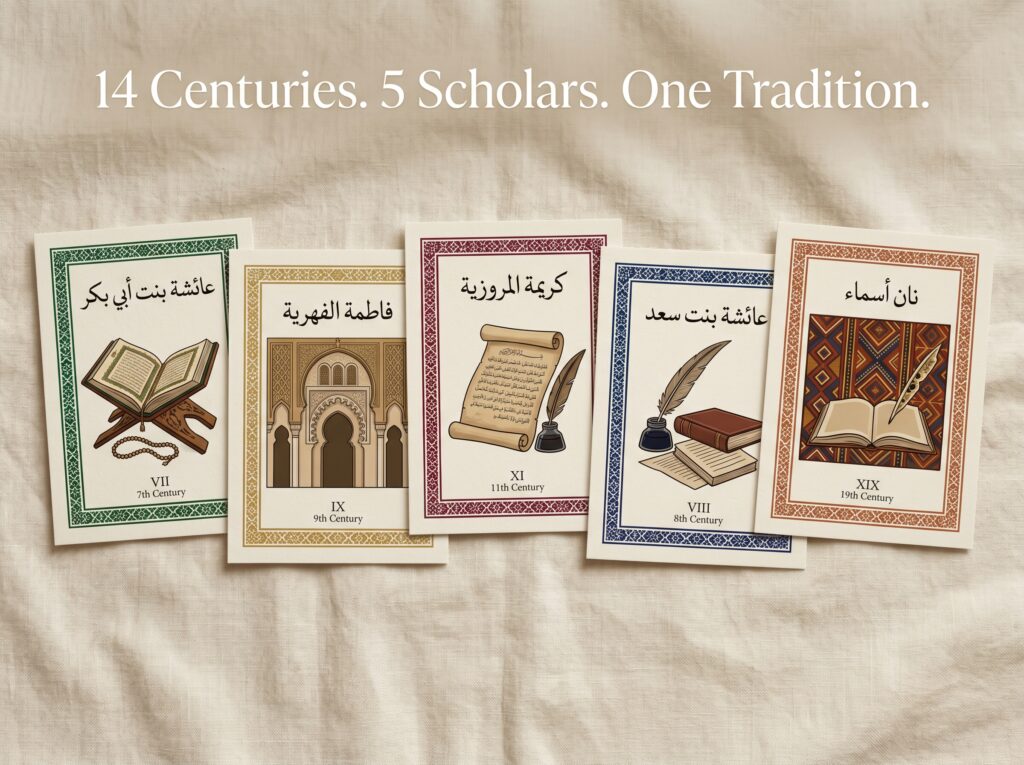
Why This History Has Been Forgotten — And Why It Matters
Before we meet the scholars themselves, there is something worth saying directly.
The narrative that Islam historically marginalized women’s intellectual contribution finds no support in the historical record. In fact, the record contradicts it — comprehensively, across fourteen consecutive centuries, in disciplines ranging from hadith and fiqh to architecture, education, and poetry.
The problem, therefore, is not that these women did not exist. Rather, their stories have been systematically undertaught — in Islamic schools, in Friday khutbahs, in the popular understanding of what Islamic history contains.
Consequently, correcting that gap is not revisionism. It is recovery. And it matters enormously — for Muslim women who deserve to see themselves in the tradition they belong to, for Muslim men who deserve an accurate understanding of their history, and for anyone who has been told that Islam and female intellectual authority are somehow in tension.
They have never been in tension. Here is the evidence.
📌 Ghost Callout Block — Timeline Card
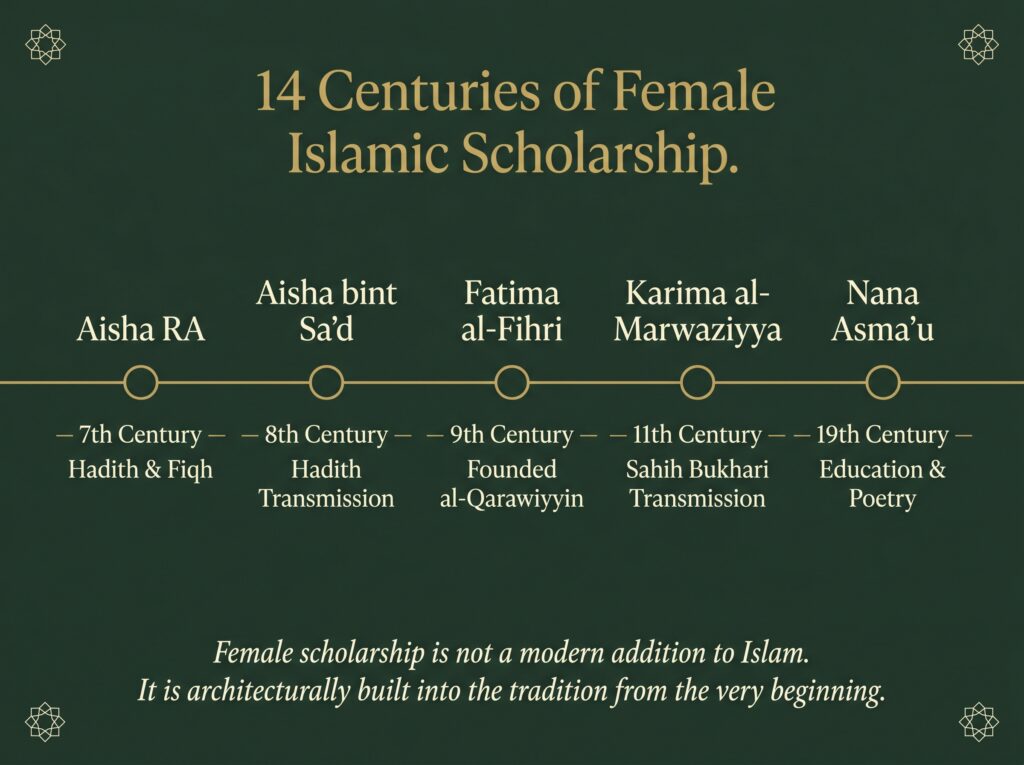
14 Centuries of Female Islamic Scholarship
| Scholar | Century | Primary Contribution |
|---|---|---|
| Aisha bint Abi Bakr RA | 7th Century | Hadith narration, fiqh, correction of Companions |
| Aisha bint Sa’d ibn Abi Waqqas | 8th Century | Hadith transmission, teaching in Medina |
| Fatima al-Fihri | 9th Century | Founded al-Qarawiyyin — world’s oldest university |
| Karima al-Marwaziyya | 11th Century | Most authoritative Sahih Bukhari transmission of her era |
| Nana Asma’u | 19th Century | Scholarship, poetry, female literacy movement in West Africa |
Female scholarship is not a modern addition to Islam. It is architecturally built into the tradition from the very beginning.
Scholar 1 — Aisha bint Abi Bakr RA
7th Century CE — Hadith, Fiqh, and the Knowledge Nobody Else Could Hold
Era: 614–678 CE — the foundational generation of Islam Discipline: Hadith narration, Islamic jurisprudence, Quranic exegesis
Aisha bint Abi Bakr RA stands, by any scholarly measure, as one of the most significant figures in the entire history of Islamic scholarship — male or female.
She narrated approximately 2,210 hadith, making her the third-highest narrator among all the Companions of the Prophet ﷺ. More significantly, however, she narrated the kind of hadith that no one else could narrate — knowledge of the Prophet’s ﷺ private life, his worship in the night hours, his character in the intimate space of the home, his physical practices that no one outside the household could have witnessed.
Furthermore, she did not simply transmit. She analyzed, corrected, and challenged.
Senior Companions — including Umar ibn al-Khattab RA and Abu Musa al-Ash’ari RA — regularly deferred to her rulings on questions of fiqh. She corrected hadith whose transmission conflicted with what she had personally witnessed, challenging narrators directly when the accounts diverged from her firsthand knowledge. On multiple occasions she corrected Abu Hurayrah RA himself — one of the highest-volume hadith narrators — and scholars recorded those corrections in the literature.
After the Prophet ﷺ passed, moreover, she continued teaching for nearly fifty years. Her home in Medina functioned as one of the earliest Islamic educational institutions — students, both male and female, came to learn from behind the curtain she maintained for modesty, and left carrying knowledge that shaped Islamic law for generations.
The detail that stays with you: The Companions used to say that if you wanted to know the Sunnah of the Prophet ﷺ in the most intimate and personal aspects of Islamic life, Aisha was the authority you went to. She was not a secondary source or a supporting narrator. In many of the most important areas of Islamic jurisprudence, she was the primary one.
Scholar 2 — Aisha bint Sa’d ibn Abi Waqqas
8th Century CE — The Successor Generation’s Trusted Transmitter
Era: Late 7th to mid-8th century CE — the generation of the Tabi’een Discipline: Hadith transmission, teaching
Aisha bint Sa’d ibn Abi Waqqas was the daughter of Sa’d ibn Abi Waqqas RA — one of the ten Companions promised Paradise — and she inherited both his scholarly seriousness and his proximity to the earliest sources of Islamic knowledge.
She narrated hadith directly from multiple Companions of the Prophet ﷺ, making her a first-generation Tabi’iyyah — a member of the generation that learned directly from the Companions. This placed her at an extraordinarily valuable point in the chain of Islamic transmission. In a tradition where scholars scrutinize the reliability and proximity of each narrator in a chain with remarkable precision, her position carried significant authority.
She taught in Medina for decades, and her students included both men and women of the subsequent generation. Notably, major hadith scholars of the following century cited her narrations in their collections, confirming her status as a trusted and relied-upon transmitter.
The detail that stays with you: Her story represents something important about the structure of Islamic scholarship — that female transmission was not exceptional or marginal, but woven into the ordinary fabric of how Islamic knowledge moved from generation to generation. She was one of hundreds of female transmitters in the first three centuries of Islam. In that sense, her story is not an exception. It is a pattern.
Scholar 3 — Fatima al-Fihri
9th Century CE — The Woman Who Built the World’s Oldest University
Era: Approximately 800–880 CE — the golden age of Islamic civilization Discipline: Islamic education, institutional architecture
In 859 CE, a Muslim woman in Fez, Morocco, used her entire inheritance to build an institution of learning.
That institution — the University of al-Qarawiyyin — still operates today. According to UNESCO and the Guinness World Records, it holds the distinction of being the oldest continuously functioning university in the world, having maintained educational operation for over 1,160 years.
Fatima al-Fihri was the daughter of a wealthy Tunisian merchant, Muhammad al-Fihri, who had migrated with his family to Fez. When her father died, Fatima and her sister Mariam each inherited a significant sum. Mariam used her inheritance to build a mosque. Fatima, meanwhile, directed hers toward building an educational institution attached to a mosque — the Mosque and University of al-Qarawiyyin.
By multiple historical accounts, furthermore, Fatima fasted throughout the entire construction period — from the laying of the first stone to the building’s completion. She vowed not to break her fast until the institution stood complete. When construction finished, she prayed two rak’ahs of gratitude in the space she had built.
The institution went on to educate some of the most significant scholars of the medieval world. Its curriculum covered Islamic jurisprudence, grammar, rhetoric, logic, and the sciences. Students who passed through its halls shaped Islamic scholarship, European philosophy, and the intellectual foundations of the Renaissance.
The detail that stays with you: The oldest university in the world — a Muslim woman built it, with her own money, as an act of worship. And it is still teaching students today.
Scholar 4 — Karima al-Marwaziyya
11th Century CE — The Gold Standard of Bukhari Transmission
Era: Died 1070 CE — the era of classical Islamic scholarship’s peak Discipline: Hadith transmission, specifically Sahih Bukhari
Karima al-Marwaziyya occupies a specific and extraordinary position in Islamic scholarly history: the scholars of her era recognized her as the most authoritative living transmitter of Sahih Bukhari — the hadith collection forming the bedrock of Sunni Islamic jurisprudence.
In the Islamic science of hadith, the reliability of a transmission depends not just on the content narrated but on the chain of narrators through whom it traveled. A scholar who had studied a text directly under a reliable teacher — in an unbroken chain reaching back to the original source — carried more authority than one whose chain was longer or less precise.
Karima’s chain of transmission for Sahih Bukhari stood, by the consensus of her generation, as the most reliable available. Consequently, scholars traveled from across the Islamic world — from Spain in the west to Central Asia in the east — specifically to hear her transmit the collection. Al-Khatib al-Baghdadi, one of the greatest hadith scholars of the medieval period, traveled to Mecca to study under her. Al-Humaydi considered her transmission the most authoritative of his time.
The detail that stays with you: In hadith transmission — a discipline where authority derives entirely from the reliability and precision of your chain and scholarly credentials — Karima al-Marwaziyya held the gold standard of her generation. Not among female scholars. Among all scholars. The gender of the transmitter carried no relevance to the question of scholarly authority.
Scholar 5 — Nana Asma’u
19th Century CE — The Scholar Who Built a Movement
Era: 1793–1864 CE — the Sokoto Caliphate in what is now northern Nigeria Discipline: Islamic scholarship, poetry, female education, social reform
Nana Asma’u was the daughter of Usman dan Fodio — the scholar and reformer who founded the Sokoto Caliphate in West Africa. By any measure, she stands as one of the most remarkable figures in 19th century Islamic history.
Fluent in four languages — Arabic, Fulfulde, Hausa, and Tamacheq — she produced poetry in all four. Her didactic verses, designed to teach Islamic knowledge in accessible and memorizable form, number in the hundreds and cover Quranic commentary, hadith, Islamic history, and the lives of the Companions.
Most significantly, however, she built a system. Working within the social constraints of 19th century West Africa, Nana Asma’u created and led a female literacy and education movement called the yan taru — a network of trained female teachers called jajis who traveled to villages teaching Islamic knowledge to women who could not leave their homes. The jajis learned from Asma’u directly, then spread across the caliphate bringing Islamic education to women who would otherwise have had no access to it.
At the peak of this movement, furthermore, she simultaneously managed the education of thousands of women across a vast geographic area, wrote new teaching poetry for the jajis to use, and advised her brother — the Sultan of Sokoto — on matters of governance and scholarship.
The detail that stays with you: In a century when most Western women had no access to formal education of any kind, a Muslim woman in West Africa had built a female educational movement that reached thousands — using Islamic scholarship as its foundation, poetry as its pedagogy, and the conviction that every Muslim woman deserves access to knowledge as its driving force.
What These Five Women Tell Us
Five scholars. Fourteen centuries. Five different disciplines, five different continents, five different kinds of contribution.
Together, however, they tell one story: that female scholarship is not a modern reinterpretation of Islam, not a feminist revision of the tradition, not an exception requiring explanation. Rather, it stands as one of the most consistent and well-documented features of Islamic intellectual history — present in the first generation, maintained through the classical period, and alive in the nineteenth century in forms that put contemporary educational movements to shame.
The tradition has always had these women. The tradition has always needed these women. The only thing that has changed, therefore, is whether we choose to teach their names.
→ Follow the Islamic History series on Instagram: [Link to Instagram] → Watch the Lost History series on YouTube: [Link to YouTube] → Follow on TikTok for daily Islamic history: [Link to TikTok]
Share This History
→ Share with the Muslim women in your life Every Muslim woman deserves to know that she stands in a tradition of extraordinary female scholarship. Send this to the women in your family, your study circle, and your community.
→ Subscribe for Islamic history Every week: one story, one scholar, one piece of the civilization that shaped this deen — delivered to your inbox before it hits the feed.
→ Follow on social for daily Islamic history posts One story at a time. One name at a time. Until the history belongs to everyone it belongs to.
May Allah have mercy on Aisha, Fatima, Karima, and Nana Asma’u — and on every woman whose knowledge built this deen in ways we are still discovering. And may He make us people who carry their names forward. Ameen. 🌙
