
5 Quranic Words With the Meanings Translation Cannot Capture
These 5 words appear in your salah every single day. Their full meaning in Arabic, however, goes far beyond any English translation you have ever read.
This is not a criticism of translators. In fact, translating the Quran is one of the most demanding intellectual and spiritual tasks a human being can undertake. The problem, rather, is structural. Arabic — particularly Quranic Arabic — is built on a root system so layered and precise that a single word routinely carries meanings that require an entire paragraph to convey in English. Every translation makes a choice. And in making that choice, it necessarily leaves something behind.
Here are five words that lose the most in translation. Specifically, five words you recite in every salah — whose root meanings, once understood, change how you experience your prayer permanently.
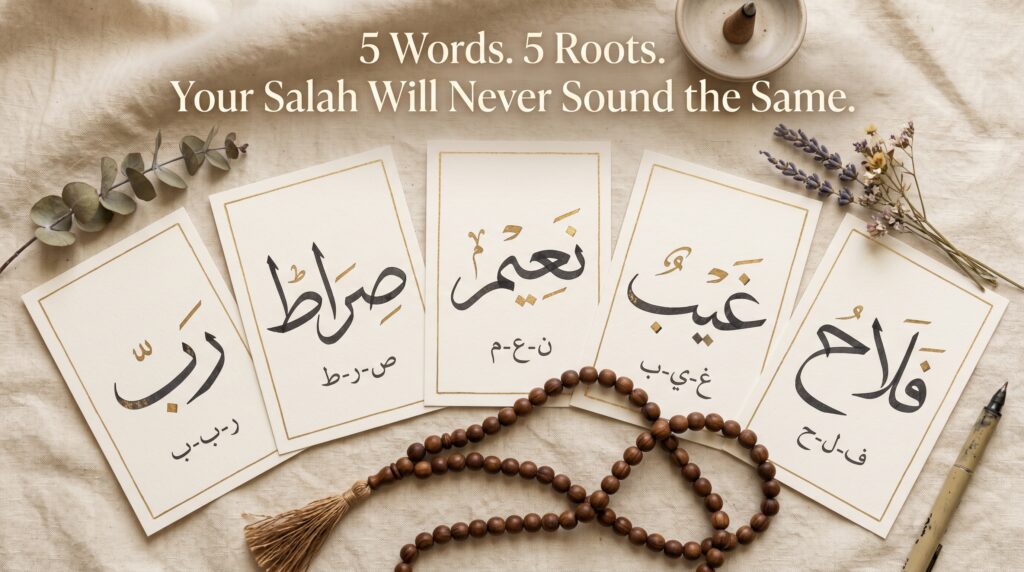
Word 1 — رَبّ (Rabb)
📌 Ghost Callout Block — Root Breakdown Card
Arabic: رَبّ Root letters: ر-ب-ب (ra-ba-ba) Common translation: Lord Deep root meaning: The One who takes something from its earliest, most incomplete state and tends it, nurtures it, and brings it gradually to its fullest possible completion
You open Al-Fatiha with it. Alhamdulillahi Rabb il-aalameen. All praise belongs to Allah, the Rabb of all the worlds.
Most translations render Rabb as Lord. This translation is not wrong. It is, however, significantly incomplete.
The root ر-ب-ب carries a meaning that is far more intimate and active than lordship in any political or feudal sense. It describes the sustained, attentive nurturing of something toward its fullest potential. A murabbee — from the same root — is a teacher who raises a student. A rabba — similarly — describes the raising of a child. The same root gives us tarbiyah, the word for education and upbringing in Islamic tradition.
So when you say Rabb il-aalameen, you are not simply acknowledging a Master above you. Rather, you are addressing the One who is perpetually, actively, tenderly tending your growth — from your most incomplete state toward your fullest possible becoming.
This changes Al-Fatiha. it changes every dua you make to your Rabb from this moment forward.
Word 2 — صِرَاط (Sirat)
📌 Ghost Callout Block — Root Breakdown Card
Arabic: صِرَاط Root letters: ص-ر-ط (sad-ra-ta) Common translation: Path, way Deep root meaning: A paved, engineered, deliberately constructed road — built specifically for travel, wide enough to walk without difficulty, cleared of all obstacles
Still in Al-Fatiha: Ihdinas-siratal mustaqeem. Guide us to the straight path.
The word most translations render as path or way is, in fact, far more specific than either English word suggests. A path can be a dirt track, a vague direction, an unmarked route through wilderness. The word صِرَاط, describes something structurally different.
The root carries the meaning of a constructed road — paved, intentional, engineered for passage. In classical Arabic usage, the sirat is not a trail you discover. It is a road that was built for you, cleared for you, and laid out specifically so that traveling it requires minimum difficulty.
The sirat is described in the Quran as mustaqeem — straight, upright, without deviation. Together, siratal mustaqeem is not a vague spiritual direction. It is a precision-engineered road, built by the One who knows exactly where you need to go and exactly how to get you there.
When you ask Allah to guide you to it, you are consequently asking to be placed on something that already exists — already built, already clear, already leading exactly where you are meant to arrive.
Word 3 — نَعِيم (Na’eem)
📌 Ghost Callout Block — Root Breakdown Card
Arabic: نَعِيم Root letters: ن-ع-م (nun-ayn-meem) Common translation: Bliss, blessing, bounty Deep root meaning: Softness, tenderness, and ease experienced from the inside — the sensation of something yielding, gentle, and enveloping rather than hard or resistant
Surah At-Takathur ends with the question: Thumma latus’alunna yawma’idhin ‘aninnaeem — Then on that day you will surely be asked about the na’eem.
Most translations give na’eem as bliss, blessing, or bounty. Each of these is accurate. None of them, captures the physical, tactile quality that the root ن-ع-م carries.
The root describes softness — specifically the softness of something that yields to touch, that has no hardness or resistance, that surrounds and envelopes rather than pushes back. From the same root comes nu’umah (softness, tenderness), na’im (soft, gentle, tender), and ana’ama (to bestow ease and softness upon someone).
Na’eem, is not simply abundance or reward in an abstract sense. It is a specific quality of ease — the experience of a reality that has no roughness, no resistance, no hardness anywhere in it. It describes the texture of Paradise as much as its content.
This is why the question at the end of Surah At-Takathur carries such weight. You will be asked not just about what you had — but about the softness, the ease, the enveloping tenderness that surrounded your life. And what you did in response to it.
Word 4 — غَيْب (Ghayb)
📌 Ghost Callout Block — Root Breakdown Card
Arabic: غَيْب Root letters: غ-ي-ب (ghayn-ya-ba) Common translation: The unseen, the hidden Deep root meaning: That which has been deliberately concealed — absent not by accident but by design, beyond the boundary of created perception by the will of the One who placed it there
Alif Lam Meem. Dhalikal kitabu la rayba feeh. Hudan lil muttaqeen. Alladhina yu’minoona bil ghayb. — This is the Book in which there is no doubt. A guidance for those who are mindful of Allah. Those who believe in the ghayb.
The second surah of the Quran introduces the believers immediately through their relationship with the ghayb. Translation gives us “the unseen” or “the hidden.” Both are accurate. Nevertheless, neither captures the deliberate, designed quality that the root غ-ي-ب carries.
The root describes an absence that is not accidental. Specifically, it describes something that has been placed beyond the reach of created perception — not because it does not exist, but because it has been concealed by deliberate divine will. A gha’ib is one who is absent, gone from sight, withdrawn. The root also gives us maghib — the setting of the sun, the moment it passes beyond the horizon of sight.
The ghayb, is not simply everything you cannot see. Rather, it is everything that Allah has specifically chosen to place beyond the boundary of created knowledge. Belief in the ghayb consequently means trusting not just in what is hidden from you — but in the wisdom and will of the One who chose to conceal it.
Word 5 — فَلَاح (Falah)
📌 Ghost Callout Block — Root Breakdown Card
Arabic: فَلَاح Root letters: ف-ل-ح (fa-lam-ha) Common translation: Success, prosperity, salvation Deep root meaning: The breaking open of hard, resistant soil — the farmer’s word for ploughing through resistance to create the conditions in which growth becomes possible
Five times a day, the adhan calls every Muslim: Hayya ‘alal falah — Come to falah. Come to success.
Most translations render falah as success, prosperity, or salvation. All three capture something real. Yet all three miss the agricultural root that gives this word its most precise and powerful meaning.
The root ف-ل-ح is a farmer’s word. Specifically, a fallah is a farmer — one who works the land. The primary meaning of the root is the breaking open of hard soil: the act of ploughing through compacted, resistant earth to create the conditions in which a seed can take root, break through, and grow.
Falah, therefore, is not achievement in the way the modern world understands success. It is not status, recognition, or accumulation. It is the specific kind of breakthrough that comes only after sustained effort breaks through resistance — the moment hard ground opens and something living can finally emerge.
When the adhan calls you to falah five times a day, it is consequently calling you to something deeper than worldly success. It is calling you to the breakthrough — to the kind of persistent, ground-breaking effort through which something real and living can grow in you and through you.
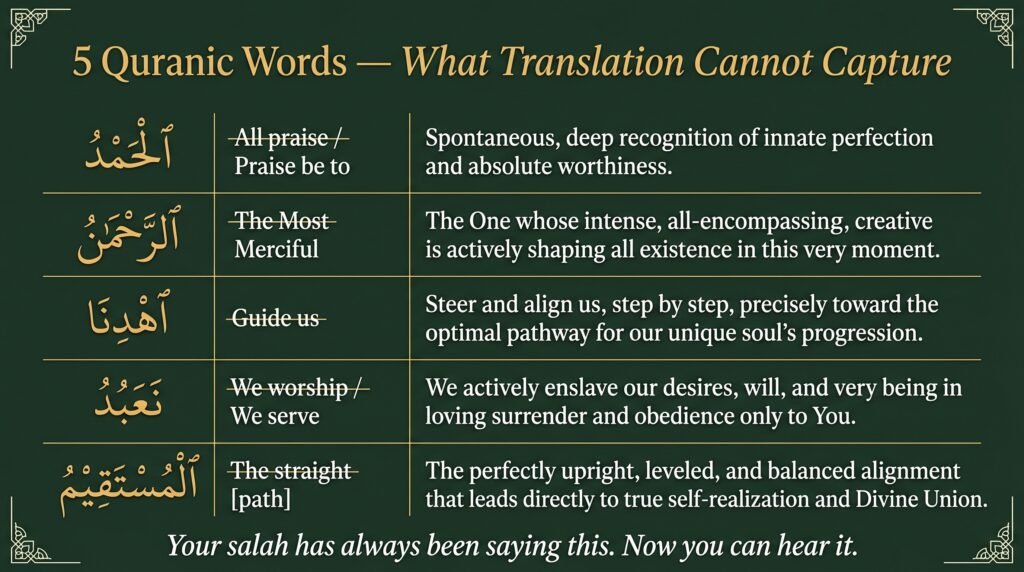
What Happens When You Learn to Read the Roots
These five words are a beginning, not a complete picture.
The Quran contains 77,430 words. Each one was chosen with the same extraordinary precision — each carrying root meanings that translation can gesture toward but never fully deliver. Each root connects to dozens of other words across the Quran, creating a web of meaning that deepens every time you encounter a familiar root in a new context.
This is why root-based Arabic learning transforms the experience of salah so completely. When you understand the roots beneath the words you recite, your prayer stops being a ritual you perform. Instead, it becomes a conversation you are genuinely inside — one in which every word carries weight, every phrase lands with precision, and every salah leaves you with something you did not have before.
→ See the full Arabic root system explained — and why 30 roots unlock 70% of the Quran: Al-Zalzalah Educational Game: A Fun ‘Find the Match’ Activity for Learning Quranic Vocabulary.
→ Explore the Instagram word spotlight carousel for weekly root breakdowns: Iqra.
Your Next Steps
→ Download the Free 50-Word Quranic Vocabulary PDF Fifty of the highest-frequency root families in the Quran — including all five words from this post and forty-five more — laid out simply, beautifully, and ready to use in your daily reading and salah. No prior Arabic knowledge required. Completely free.
→ Join the June Arabic Roots Course Waitlist The free PDF gives you the seeds. The June course, moreover, gives you the complete system — structured root learning, pattern recognition, applied Quranic reading, and a community of Muslims building the same understanding together. Built for non-Arab Muslims, beginners, and busy adults. Be first to know when enrollment opens.
→ Share With Someone Who Wants to Understand Their Prayer You know exactly who came to mind while reading this. The person who prays faithfully but sometimes wonders what they are truly saying. Send this to them. Understanding the Quran passed between Muslims is, after all, its own form of sadaqah jariyah.
May Allah make the words of our salah alive in our hearts — not sounds we produce but meanings we inhabit, conversations we are genuinely inside, every single day. Ameen. 🌙
