
Bismillah Roots: Three Roots, One Habit
You say it before you eat. Before you drive. Before you open a book, start an exam, or begin to recite. Bismillah ir-Rahman ir-Raheem is probably the most repeated phrase in your life, and it is built on just three roots.
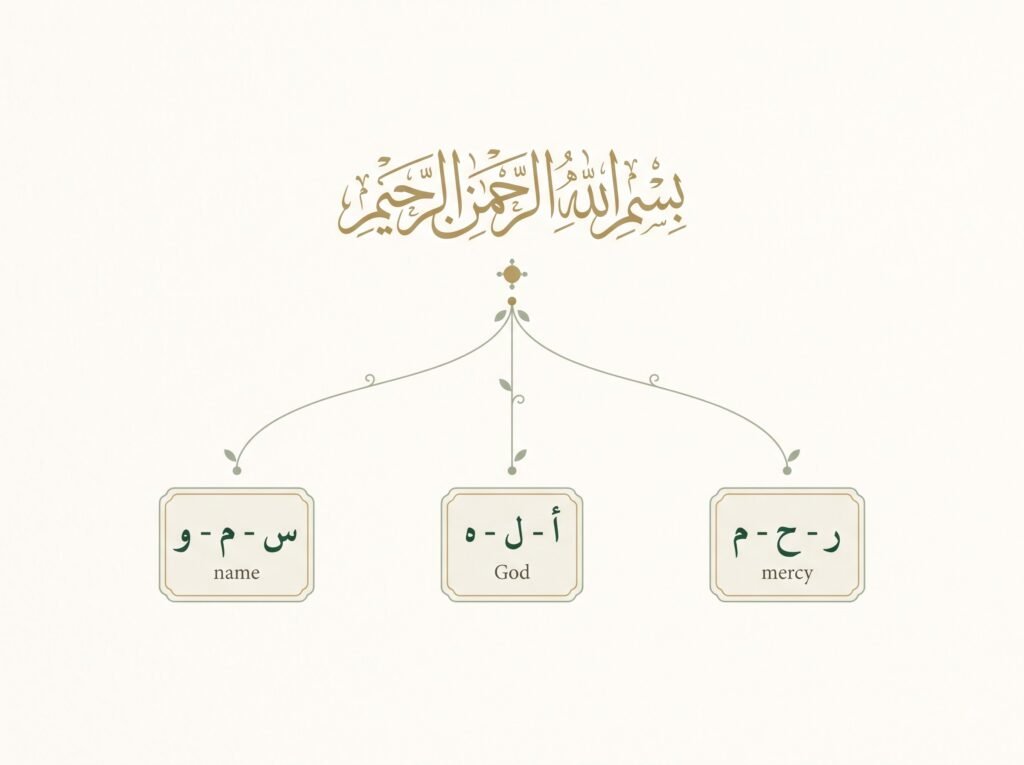
Once you see them, you stop hearing a familiar sound and start reading a sentence. That is the first real step in Quranic Arabic for beginners.
Count the three roots
Here is the whole phrase, root by root:
| Word | Root | Core idea |
|---|---|---|
| Ism (name) | س-م-و | height, being raised |
| Allah | أ-ل-ه | the one worshipped |
| Ar-Rahman / Ar-Raheem | ر-ح-م | mercy |
Bi (“with, by”) is a small preposition, not a root. So the bismillah meaning in Arabic comes down to this: with the name of God, the Most Merciful, the Especially Merciful.
Why one root can fill two names
Ar-Rahman and ar-Raheem share the root ر-ح-م, which is also behind rahim (womb), an image of protection and care. The difference is the pattern:
- Rahman is on the pattern fa’lan, which suggests mercy that is vast and all-encompassing.
- Raheem is on the pattern fa’eel, which suggests mercy that is constant and lasting.
Arabic does not add unrelated words to shift meaning. It keeps the root and changes the pattern. That one idea explains most of how the language works.
A quick note on scholarly nuance
Accuracy matters, so two honest caveats:
- Classical grammarians differ on the root of ism. The Basran school derives it from س-م-و (height), while the Kufan school proposes و-س-م (a mark). Both agree on the meaning of the word.
- Some scholars treat Allah as a proper name that is not derived from any root. Others connect it to ilah. Either way, the meaning is the same.
You do not need to resolve these debates to benefit from the method. Just know they exist.
The three-step habit for reading any verse
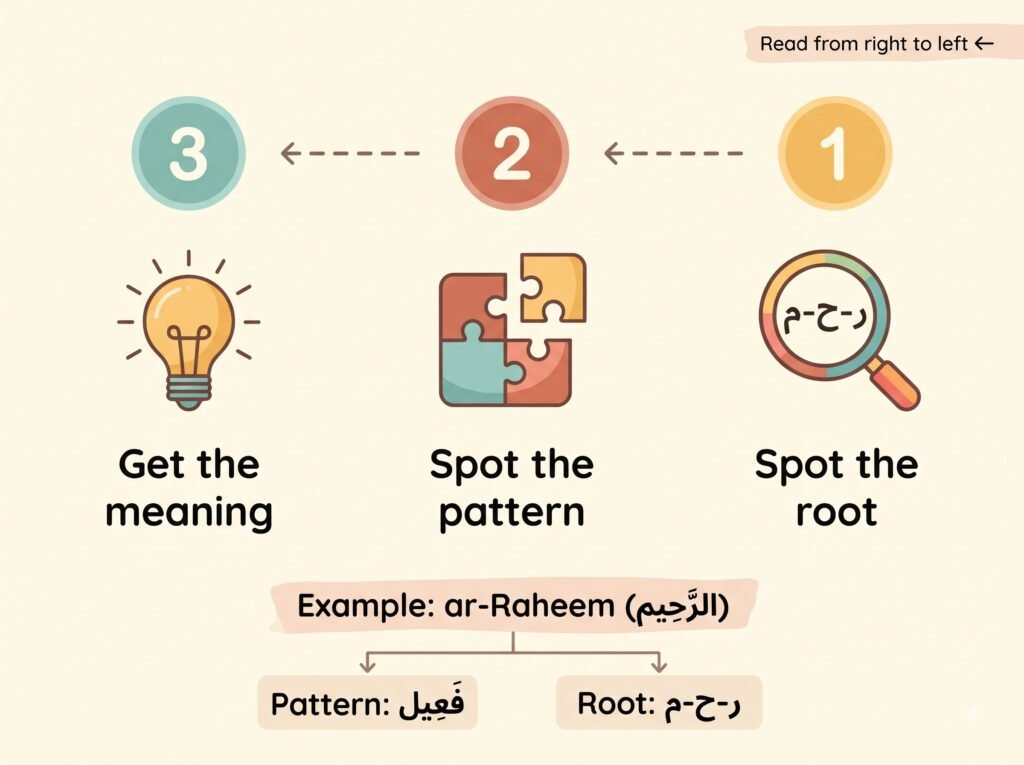
This is the real takeaway. Every bismillah word by word breakdown becomes a template you can reuse:
- Spot the root. Strip away prefixes and endings to find the three core letters.
- Spot the pattern. Ask whether the word is a doer, a place, an intensifier, or something else.
- Get the meaning. Combine the two and check it against the context.
Try it on the next verse you hear. You may be surprised how many words you already half recognize.
Make it stick
Roots are learned by repetition, not memorization drives. Since you already say Bismillah dozens of times a day, you have a built-in practice session. Next time, pause on one word and name its root.
Keep going:
- See how this phrase opens the surah in The Meaning of Surah Al-Fatiha: A Simple Tafseer.
- Follow another root through the Quran in From Alhamdu to Muhammad: Arabic Root Hamd.
Try it now: Open the free Al-Fatiha reader and tap any word to see its root: roots-muslimschool.com/fatiha
