
Ruku’ and Sujud Meaning: What Your Prayer Positions Say
Your Body Is Speaking Arabic, Too
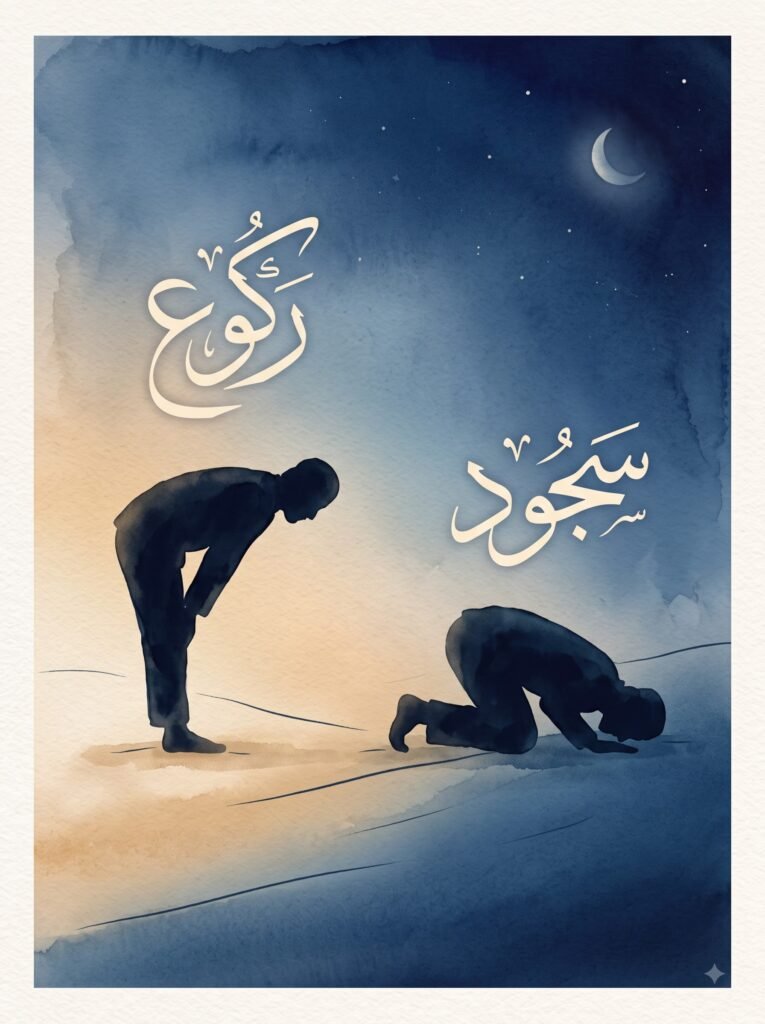
You know the rhythm by heart: stand, bow, rise, prostrate, sit, prostrate again. But did you know each movement has a name with its own root and meaning?
In this guide, we’ll unpack the ruku’ and sujud meaning in plain English, so the next time you bow or lower your forehead to the ground, you’ll know exactly what you’re saying and doing.
What Does Ruku’ (ركوع) Mean?
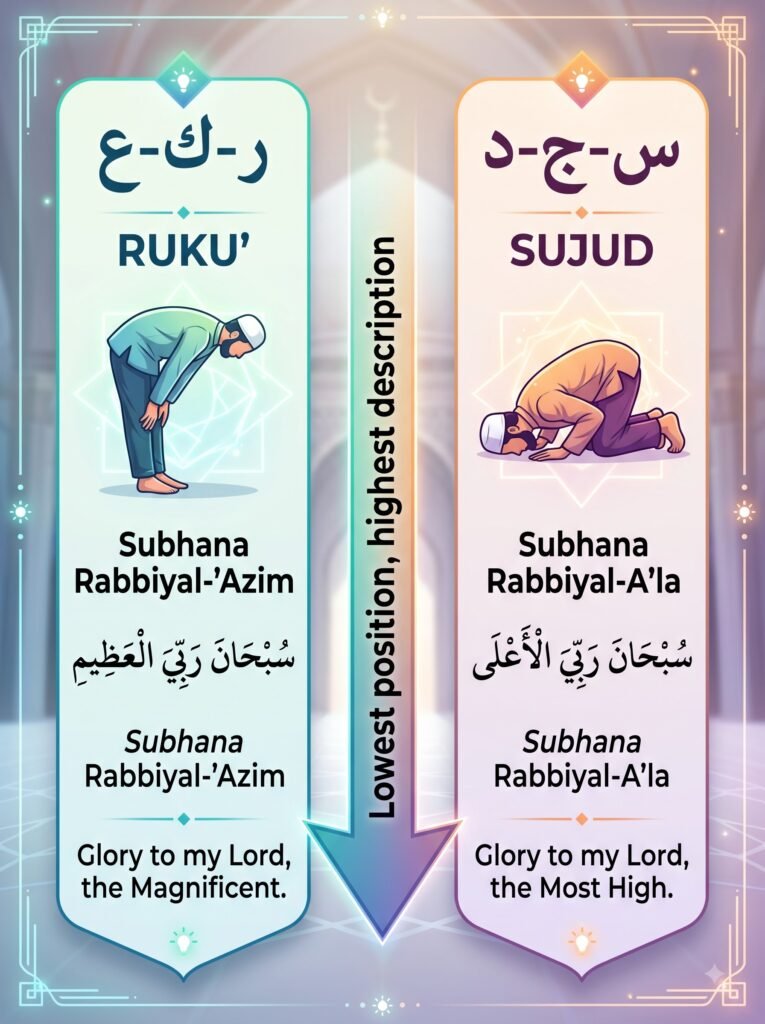
Ruku’ comes from the Arabic root ر-ك-ع (r-k-‘), which means to bow or to bend down. In salah, it’s the position where you bend at the waist, hands on your knees, back straight.
What you say here is:
Subhana Rabbiyal-‘Azim (سبحان ربي العظيم)
“Glory to my Lord, the Magnificent.”
Let’s break it down:
- Subhana (from س-ب-ح): declaring Allah free from any flaw or limitation
- Rabbi (from ر-ب-ب): my Lord, the One who creates, nurtures, and sustains me
- Al-‘Azim (from ع-ظ-م): the Magnificent, the Supremely Great
When you bow, you’re acknowledging that Allah is greater than anything you face, including your deadlines, your worries, and your ego.
What Does Sujud (سجود) Mean?
Sujud comes from the root س-ج-د (s-j-d), meaning to prostrate or to submit completely. In salah, your forehead, nose, palms, knees, and toes touch the ground.
What you say here is:
Subhana Rabbiyal-A’la (سبحان ربي الأعلى)
“Glory to my Lord, the Most High.”
Here, A’la comes from the root ع-ل-و, meaning height or being above.
Bonus word: the Arabic word for mosque, masjid (مسجد), comes from this same root. It literally means “a place of prostration.” Every time you enter a masjid, you’re entering a place named after this exact act.
The Beautiful Pairing: Lowest Position, Highest Description
Here is the detail that makes this section stand out. Look at the pairing:
| Position | Your body | What you say |
|---|---|---|
| Ruku’ | Bowed | Glory to my Lord, the Magnificent |
| Sujud | At the lowest point | Glory to my Lord, the Most High |
The lower your body goes, the higher your words go. At the moment you are physically closest to the ground, you declare Allah’s highness. It’s a built-in reminder that humility isn’t weakness. It’s closeness.
The Prophet ﷺ taught that a servant is closest to their Lord while in sujud, which is why it’s the best time to make heartfelt dua (Sahih Muslim). The Quran says it too: “Prostrate and draw near” (96:19).
Quick Tips to Pray These Positions With Meaning
- Slow down. Give each phrase a full breath, not a rushed whisper.
- Pick one word per day. Today focus on ‘Azim in ruku’. Tomorrow, A’la in sujud.
- Connect the words to your life. Facing something heavy? Let “Al-‘Azim” remind you who is greater.
- Make dua in sujud. Speak to Allah in your own language about anything on your heart.
- Learn the roots. One three-letter root unlocks dozens of words in the Quran.
Why Learning This Matters
Learning the meaning of even a handful of salah words changes prayer from routine to relationship. Roots like ر-ك-ع, س-ج-د, and س-ب-ح appear across the Quran, so every word you learn here pays off in your recitation too. That’s the heart of Quran Arabic for Muslims: small, steady steps that make the Book come alive.
Keep learning:
- 🎥 Watch: How Long Until You Understand Quran Without Translation
- 📖 Read: Learn Arabic Prayer
- 🎓 Join: Salah Arabic Course
Next prayer, when you go into ruku’ and sujud, remember: you’re not just moving, you’re speaking. And now you know what you’re saying.
