
From Algebra to Algorithm: The Arabic Roots of Your Math Words
You use two Arabic-born words every time you do homework or open an app.
Say “algebra” in a classroom or “algorithm” in a tech meeting, and you are speaking Arabic without knowing it. These are some of the most famous Arabic loanwords in English, and their stories are more surprising than any textbook lets on.
Let’s trace them back to their roots.
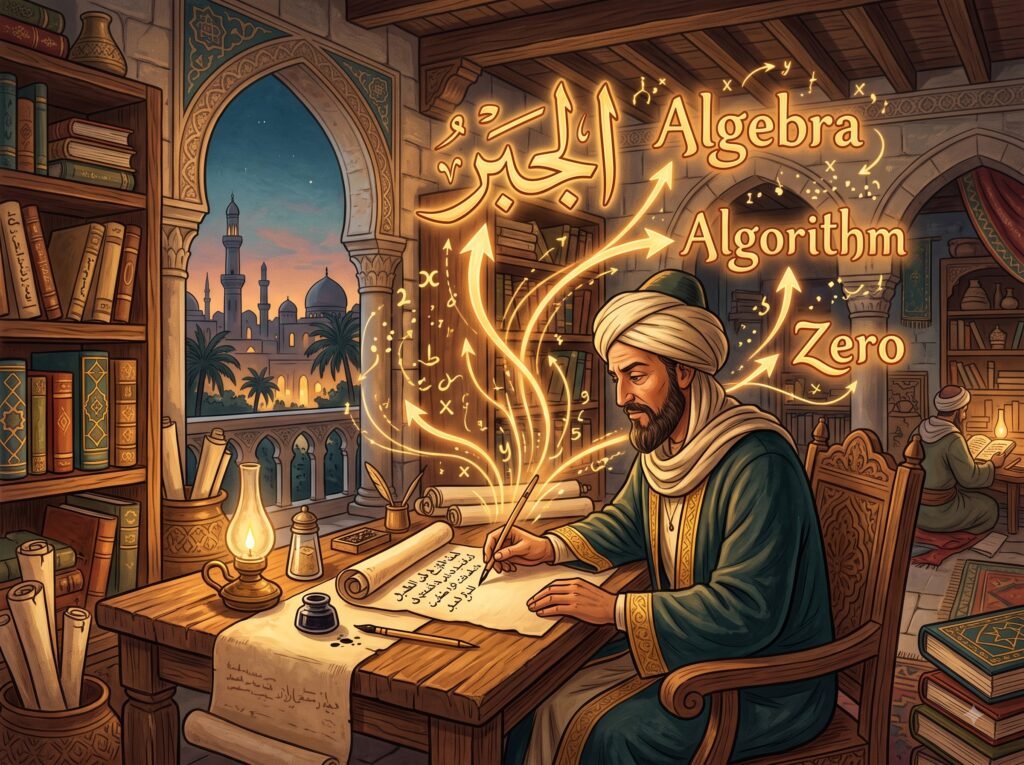
Algebra: The Math Word That Once Meant “Bone-Setting”
Algebra comes from al-jabr (الجبر), a term from the title of a book written around 820 CE by the Baghdad scholar Muhammad ibn Musa al-Khwarizmi.
The word grows from the Arabic root ج-ب-ر (j-b-r), which carries ideas of restoring, reuniting, and setting. In equations, al-jabr described moving a subtracted term to the other side to “restore” balance.
Here is the fun part. The same word was used for setting broken bones. When algebra entered European languages, it sometimes meant exactly that. In old Spanish, an algebrista was a bonesetter, and a barber-surgeon might proudly display the title.
The takeaway: algebra started as the art of putting broken things back together, whether equations or arms.
Algorithm: A Scholar’s Name, Turned Into a Word
Algorithm has no ordinary meaning behind it. It comes from a person.
Al-Khwarizmi’s name was Latinized in medieval Europe as Algoritmi. When his writings on Indian-Arabic numerals were translated into Latin, the opening words announced what “Algoritmi” had said. Over centuries, the name came to mean any step-by-step method for calculating.
Today, every search result, every social feed, and every GPS route runs on algorithms. Each time, a ninth-century mathematician is quietly getting credit.
Zero and Cipher: Two Words From One Arabic Term
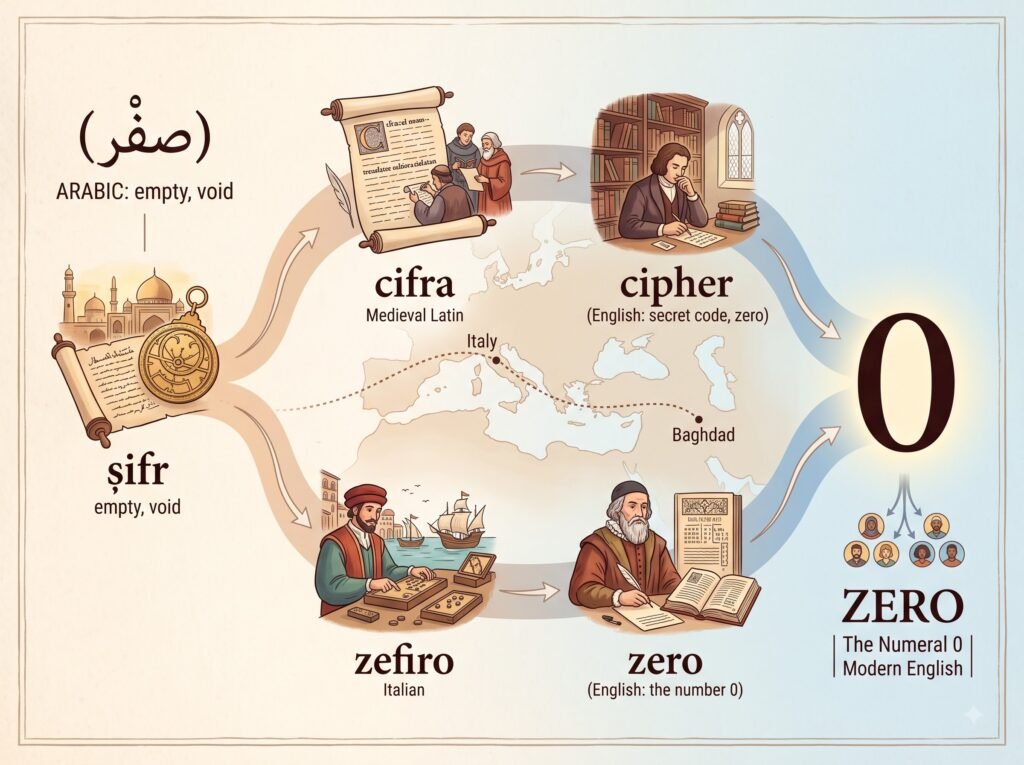
The Arabic word ṣifr (صفر) means “empty.” It named the placeholder that made the decimal number system possible.
Two English words came from it:
- Cipher came into English through Medieval Latin cifra, first meaning zero, and later any numeral or secret code.
- Zero came through Italian, likely a shortened form of an earlier Latinized version of ṣifr.
So when you write a code, or the number 0, you use the same Arabic word for “nothing.”
Why the Roots Matter
Arabic builds words from three-letter roots. Once you know the root, the hidden meaning appears. ج-ب-ر gives you “restore” and “set,” which is exactly how algebra works. ص-ف-ر gives you “empty,” which is exactly what zero holds.
That is the real magic of Arabic root history: each loanword carries a small story in its bones.
Quick Recap
| English word | Arabic source | Root meaning |
|---|---|---|
| Algebra | al-jabr (الجبر) | To restore, to set |
| Algorithm | Al-Khwarizmi (via Algoritmi) | A scholar’s name |
| Zero / Cipher | ṣifr (صفر) | Empty |
Want to see this in action? Watch our “Algebra Is Arabic” video for a visual walkthrough of al-Khwarizmi’s ideas.
Enjoyed this list? Save it and follow for weekly Arabic root facts.
