
7 Arabic Roots Should Learn Before Ramadan
Getting your family ready for Ramadan starts earlier than you think — here are 7 roots to learn together before Taraweeh begins.

Most Ramadan prep lists focus on the physical: stocking the pantry, planning suhoor meals, prepping the kids’ school schedules around late nights. All necessary. All important. But there’s a kind of prep that often gets skipped entirely — the kind that determines whether your family hears Ramadan this year, or just moves through it.
That’s where roots come in.
Every night of Taraweeh, your children are going to hear the same handful of Qur’anic themes over and over: mercy, forgiveness, patience, gratitude, closeness to Allah. If they can recognize the root letters behind those themes, something shifts. The recitation stops being background sound and starts being something they’re actually following — even if just a word or two at a time.
This isn’t about turning your living room into a classroom. It’s about spending a few minutes together, once a week, before Ramadan arrives, so that by the time Taraweeh starts, your family walks in with a head start.
Why Learning Roots Together Builds Shared Ramadan Excitement
There’s a quiet problem with a lot of family Islamic education: it happens to kids, not with the family. One parent quizzes, the child answers, and the whole thing feels like homework wearing a religious costume.
Root learning flips that dynamic — especially before Ramadan, when there’s already a natural sense of anticipation in the house. When everyone, parents included, is learning the same seven roots at the same pace, it stops being a lesson and starts being a countdown. A shared one.
There’s also a practical payoff. When a child hears a root they recognize during Taraweeh, they don’t stay quiet about it. They lean over and whisper, “That’s the word we learned!” That single moment of recognition does more for a child’s connection to the Qur’an than an entire semester of passive listening — and it does the same for parents who assume they’re “too old” or “too rusty” to notice these patterns too.
Learning together also removes the pressure of expertise. Nobody in the family needs to be the Arabic teacher. Everyone is simply building the same short list of tools, side by side, before the month that matters most.
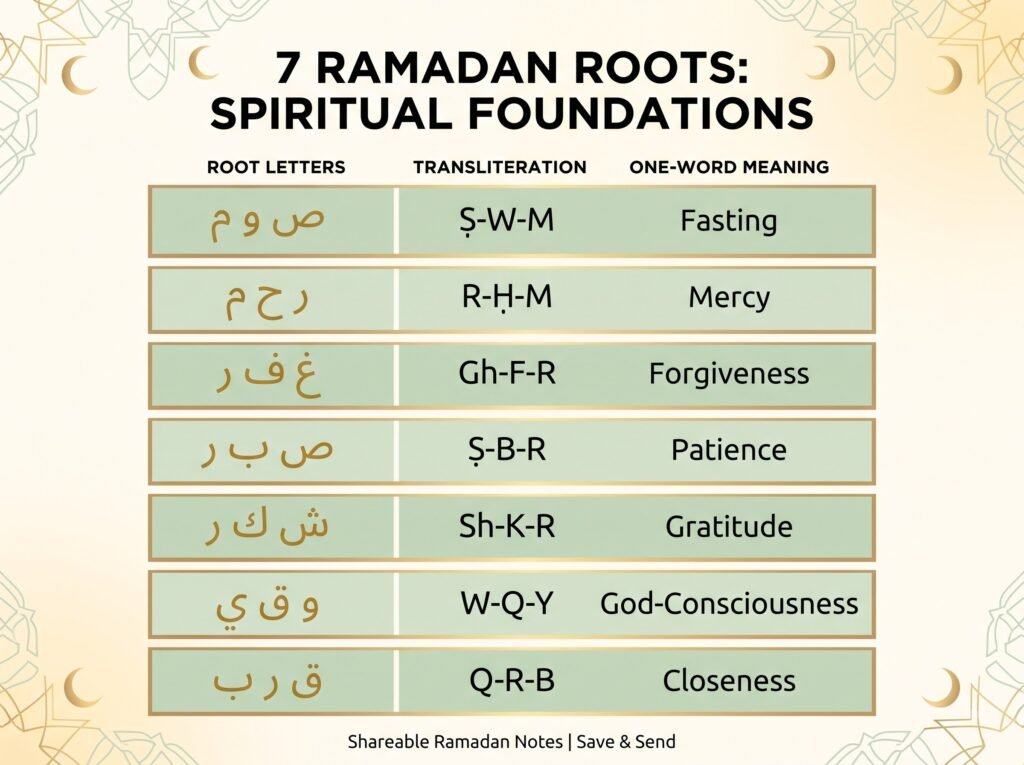
The 7 Roots to Learn Before Taraweeh Begins
Each of these roots ties directly to language your family will hear constantly during Ramadan — much of it drawn from the very verses that discuss fasting itself. Under each one is a simple way to introduce it to your kids, no teaching background required.
1. ص-و-م (ṣ-w-m) — Fasting
This is the root of sawm (fasting) and ṣā’im (one who is fasting) — words your children will hear before they’ve even had their first sip of suhoor water. It’s also the very word that names the month’s central act of worship. How to introduce it: Write the three letters on a sticky note and put it on the fridge the week before Ramadan. Every time someone opens the fridge, they say the root out loud. By day three, it’s automatic.
2. ر-ح-م (r-ḥ-m) — Mercy
The root behind Ar-Raḥmān and Ar-Raḥīm, two of Allah’s names recited at the start of nearly every surah, and a word that appears throughout Taraweeh recitation. How to introduce it: Ask your child, “Can you think of a time someone showed you mercy — being kind to you even when they didn’t have to?” Then tell them that’s the feeling behind this root.
3. غ-ف-ر (gh-f-r) — Forgiveness
This root gives us ghafūr (Most Forgiving) and istighfār (seeking forgiveness) — a concept woven through nightly Ramadan duas. How to introduce it: Practice saying “astaghfirullah” together as a family before bed during the week leading up to Ramadan, and explain simply that it means “I’m asking Allah to forgive me.”
4. ص-ب-ر (ṣ-b-r) — Patience
The root of ṣabr, one of the most repeated themes in the Qur’an — and a word your family will personally relate to by the third day of fasting. How to introduce it: Next time a sibling has to wait their turn or a child is asked to be patient for something small, name it: “That’s sabr. That’s the same root we’re learning.”
5. ش-ك-ر (sh-k-r) — Gratitude
This root gives us shukr (gratitude) and shākir (one who is grateful) — the natural companion to patience, and a common thread in verses about fasting. How to introduce it: At iftar, go around the table and have everyone say one thing they’re grateful for, then remind them: “That feeling has a name in Arabic — shukr.”
6. ت-ق-و (t-q-w) — God-Consciousness
This is the root behind taqwā, and it appears in one of the most well-known verses about fasting itself, where fasting is described as a path toward developing this quality. How to introduce it: Explain it simply to kids as “the little voice that reminds you Allah is watching, even when no one else is.” Ask them where they think that voice gets stronger during Ramadan.
7. ق-ر-ب (q-r-b) — Closeness
This root gives us qarīb (near/close) — including in a verse where Allah describes Himself as close to those who call upon Him, a verse many families recite together during Ramadan. How to introduce it: Ask your child, “When do you feel closest to Allah?” Then tell them the Arabic word for that closeness — qurb — comes from this same root.
A Simple Family Routine: One Root a Week
You don’t need a curriculum for this — just a calendar. Here’s a routine that works well for most families, starting roughly seven weeks before Ramadan:
- Week 1: ص-و-م (fasting) — introduce with the fridge sticky note.
- Week 2: ر-ح-م (mercy) — one short conversation at dinner.
- Week 3: غ-ف-ر (forgiveness) — practice the bedtime dua together.
- Week 4: ص-ب-ر (patience) — catch it in daily moments as it happens.
- Week 5: ش-ك-ر (gratitude) — start the “one thing I’m grateful for” table habit early.
- Week 6: ت-ق-و (God-consciousness) — a short reflective conversation, best suited for slightly older kids.
- Week 7: ق-ر-ب (closeness) — a gentle wrap-up conversation right before Ramadan begins.
By the time Taraweeh starts, your family isn’t walking in cold. They’re walking in with seven small keys already in hand — and every time one of those roots surfaces in the recitation, it’s a moment of recognition instead of a moment of tuning out.
Keep the Momentum Going
If this kind of root-based learning resonates with your family, you’ll likely enjoy our “The Root of Rahma” Instagram carousel — a quick, visual breakdown of how the root ر-ح-م unfolds across the Qur’an, perfect for sharing with older kids or reviewing together as a family.
And if you want to take this beyond seven roots and build a real, lasting relationship with Qur’anic vocabulary as a family, now — before the Ramadan rush hits — is the best time to start. Join our root-based Qur’an course before the rush, and give your family a Ramadan where the Qur’an isn’t just recited around them, but understood with them.
Getting ahead of Ramadan really does start earlier than you think. Seven roots. Seven weeks. One family, learning together.
