
The 10-Minute Arabic Root Method
Your child doesn’t need a linguist for a parent — they need 10 minutes and the right method.
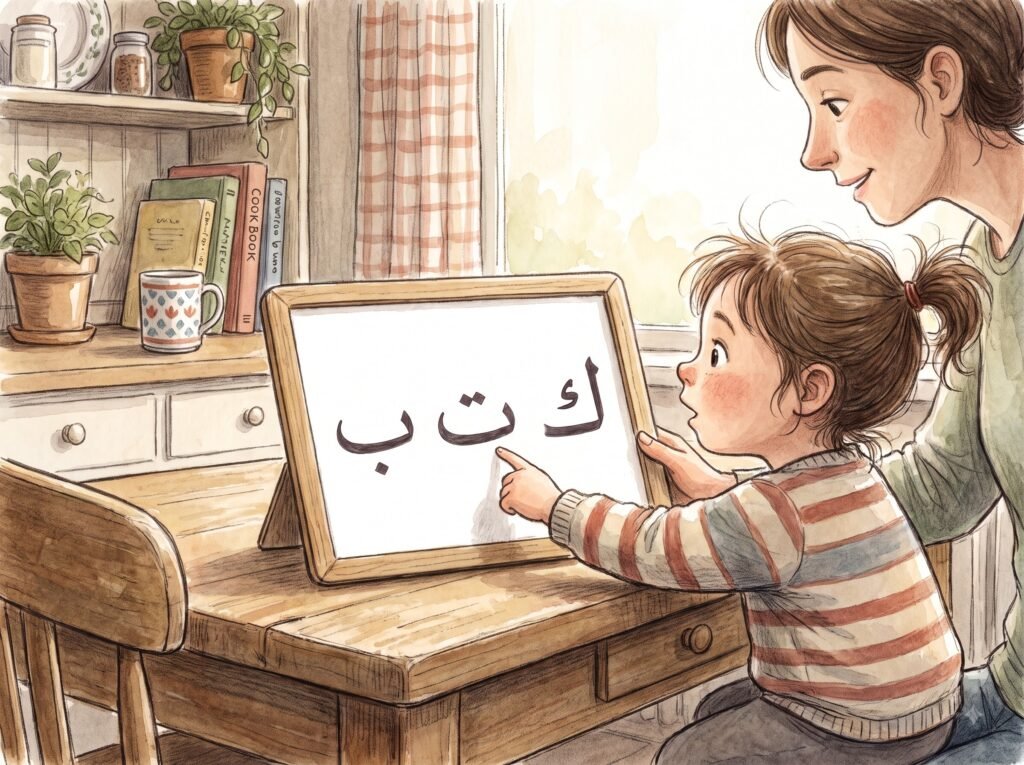
If you’ve ever tried to carve out a full “Arabic hour” in your homeschool day, you already know how that story usually ends. The dishes pile up. Younger siblings need a snack. Your child gets restless by minute fifteen, and the lesson dissolves into frustration on both sides. By the time everyone regroups, the actual learning that happened is minimal — and the guilt that follows is not.
Here’s the good news: teaching Arabic roots at home was never supposed to require an hour. It requires consistency, not duration. And consistency is something a 10-minute window, used the right way, can deliver far better than an occasional 60-minute marathon ever will.
This guide walks you through exactly how to run that 10-minute session — what to say, what to skip, and how to structure a full week so your child actually retains what they learn.
Why 10 Minutes Beats an Hour of Forced Study
Arabic root learning isn’t about memorizing vocabulary lists. It’s about pattern recognition — teaching your child to see the three-letter skeleton (the jidhr, or root) underneath related words, so that once they know ك-ت-ب, they can recognize kitab (book), maktaba (library), and kātib (writer) as members of the same family instead of unrelated words to memorize one by one.
Pattern recognition is built through repetition spaced over time, not through intensity in a single sitting. Cognitive science backs this up: short, frequent exposure to a concept strengthens memory retention far more effectively than long, infrequent sessions, because the brain consolidates information between exposures, not just during them.
There’s also the reality of who’s teaching. Most parents using an arabic root method for kids at home are not trained Arabic teachers. A 10-minute session is low-stakes enough that you don’t need lesson plans, teaching credentials, or perfect pronunciation. You need a repeatable structure — and ten minutes is short enough that you’ll actually do it tomorrow, and the day after that.
An hour-long lesson depends on willpower. A 10-minute one depends on habit. Habits win.
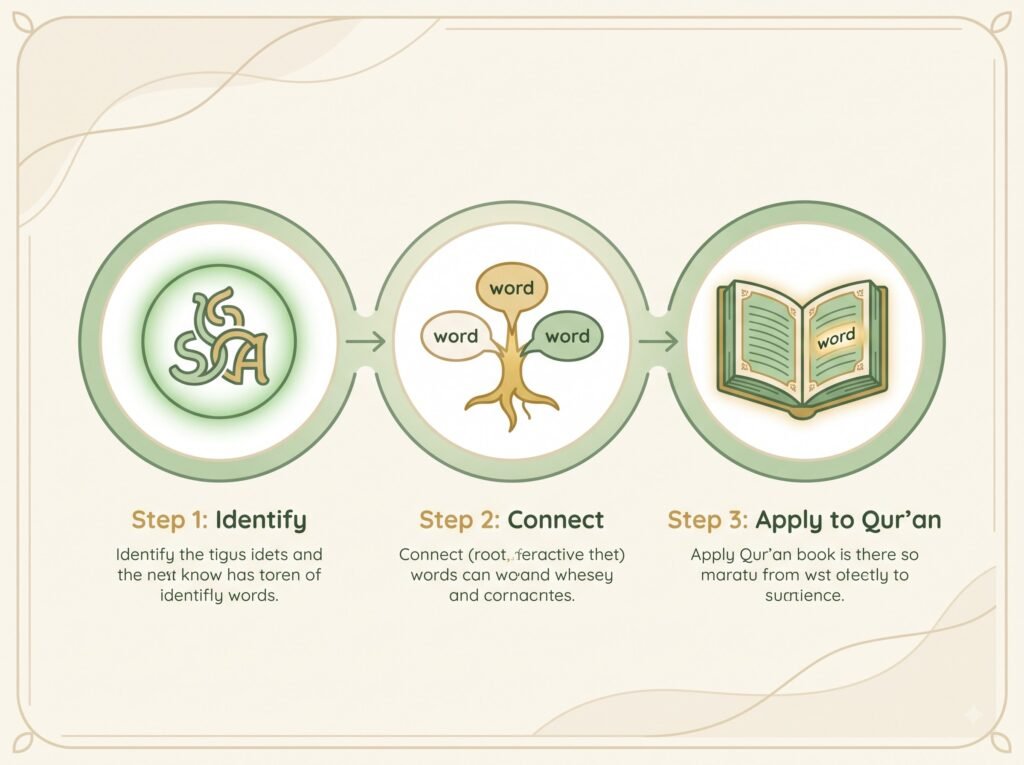
The 3-Step Root Drill: Identify → Connect → Apply
This is the core method, and it’s designed to be run in under ten minutes once your child is used to it. Each step takes roughly three minutes.
Step 1: Identify (2–3 minutes)
Pick one root. Write it on a whiteboard, index card, or even the back of a receipt — the tool doesn’t matter. Say the three root letters aloud together, slowly, and have your child repeat them.
Ask: “What do you think this root might be about?” Don’t correct guesses harshly. The goal here isn’t accuracy yet — it’s engagement. A child who guesses wrong and gets curious is doing exactly what this method needs.
Step 2: Connect (3–4 minutes)
Now introduce two or three words built from that root. Say each word, point to or draw a quick picture if helpful, and ask your child to spot the shared letters.
For example, with the root ع-ل-م:
- ‘ilm (knowledge)
- ‘ālim (a knowledgeable person / scholar)
- ta’līm (teaching)
Have your child physically point out the shared root letters in each word if you’re writing them down. This is the step where the “click” happens — where roots stop being an abstract idea and start being a visible pattern.
Step 3: Apply to Qur’an Vocabulary (2–3 minutes)
This is what separates a general homeschool arabic quran approach from a generic vocabulary drill. Take one of the words from Step 2 and locate it — or a close relative of it — in a short, familiar verse or surah your child already knows by heart, like Al-Fatiha or one of the short surahs.
Say the ayah aloud, pause on the word, and ask: “Do you hear our root in there?”
This step is what makes the method sticky. You’re not teaching Arabic as an isolated school subject — you’re teaching your child to hear their own Qur’an differently. That emotional and spiritual payoff is often what keeps kids motivated long after the vocabulary-list approach would have lost them.
A Sample Week’s Schedule
Here’s what this can look like spread across a realistic week, assuming you’re doing this most days but not being rigid about it:
- Saturday: New root introduced (e.g., ر-ح-م). Full 3-step drill.
- Sunday: Same root, new example word. Quick review of Saturday’s root before adding the new one.
- Monday: Rest day — or a 2-minute “can you remember yesterday’s root?” check-in over breakfast.
- Tuesday: New root introduced (e.g., س-ل-م). Full 3-step drill.
- Wednesday: Same root, new example word.
- Thursday: Review day — mix both roots from the week, ask your child to sort words into the correct root family.
- Friday: Light day. Read a short surah together and simply ask, “Can you spot any roots we’ve learned?”
By the end of one week, your child has been meaningfully exposed to two roots and roughly four to six related words — not through memorization, but through recognition. Multiply that across a school year, and the vocabulary base becomes substantial, all in ten-minute increments.
Common Mistakes Parents Make When Short on Time
Even with a simple method, busy parents tend to fall into a few predictable traps. Watching for these will save you months of frustration.
Mistake 1: Trying to cover too many roots at once. When time is tight, it’s tempting to “make up for it” by cramming three or four roots into one session. This defeats the purpose. One root, done well, beats four roots done in a rush.
Mistake 2: Skipping the Qur’an connection step because it feels “extra.” Step 3 is often the first thing cut when a session runs long — but it’s actually the step that gives the method its staying power. Without it, root learning becomes just another vocabulary exercise, and motivation fades fast.
Mistake 3: Treating inconsistency as failure. Missing a day, or even a week, isn’t the end of the method — it’s normal. The mistake is quitting altogether after a missed streak instead of simply picking the next root back up. This method is built for real, busy family life, not a perfect record.
Mistake 4: Waiting to “know enough” Arabic before starting. This is the most common — and most limiting — mistake among parents. You are not being asked to teach Arabic grammar or fluency. You’re guiding a pattern-recognition game. If you can read three letters off a card and sound out a familiar ayah, you have everything you need to begin.
Where This Fits Into Your Bigger Homeschool Picture
Ten minutes a day is a starting point, not a ceiling. Once this rhythm feels natural, many families find it naturally expands into a broader homeschool Arabic routine — pairing root learning with reading practice, Qur’an memorization review, or basic grammar. If you’re mapping out how Arabic fits into your child’s overall homeschool year, our guide, Back to School Arabic: The Complete Guide for Muslim Families, walks through exactly that — from scheduling to curriculum choices to setting realistic goals for the year ahead.
But if you’re just getting started, don’t overthink it. Pick one root today. Ten minutes. That’s the whole assignment.
See the Method in Action
Reading about the root method is one thing — watching a child light up when they hear their own root inside a surah they’ve memorized is another. If you’d like to see how this works with a trained instructor guiding the session, book a free trial class to see the method in action and get a feel for how it could work for your child.
Your child doesn’t need a linguist for a parent. They need ten minutes, the right method, and a parent willing to show up for it — day after day, root after root.
