
1 Rabi al-Awwal 1448: The Prophet’s Month Guide
Today the month of the greatest Arabic speaker who ever lived begins.
Here is how to honor him in it — not just by celebration, but by learning to understand the language he was given.
The Month That Arrives With the Most Weight
1 Rabi al-Awwal 1448 marks the beginning of the Islamic month that carries more emotional weight for most Muslims than almost any other time in the year — outside of Ramadan.
It is the month of the Prophet Muhammad’s ﷺ birth. The ummah pauses collectively to remember the man the Quran describes as a mercy to all the worlds. Many Muslims find themselves wanting to do something — to honor him, to draw closer, to feel his presence more tangibly in daily life.
But most Muslims do not know what the month’s name actually means. And fewer still know that the name itself tells a story about why this month was chosen to carry the weight it carries.
Here is the complete guide. Three things: the meaning of the name, the significance of the twelfth day, and three specific practices for honoring the Prophet ﷺ that go deeper than celebration alone.
What Rabi al-Awwal Actually Means — The Root
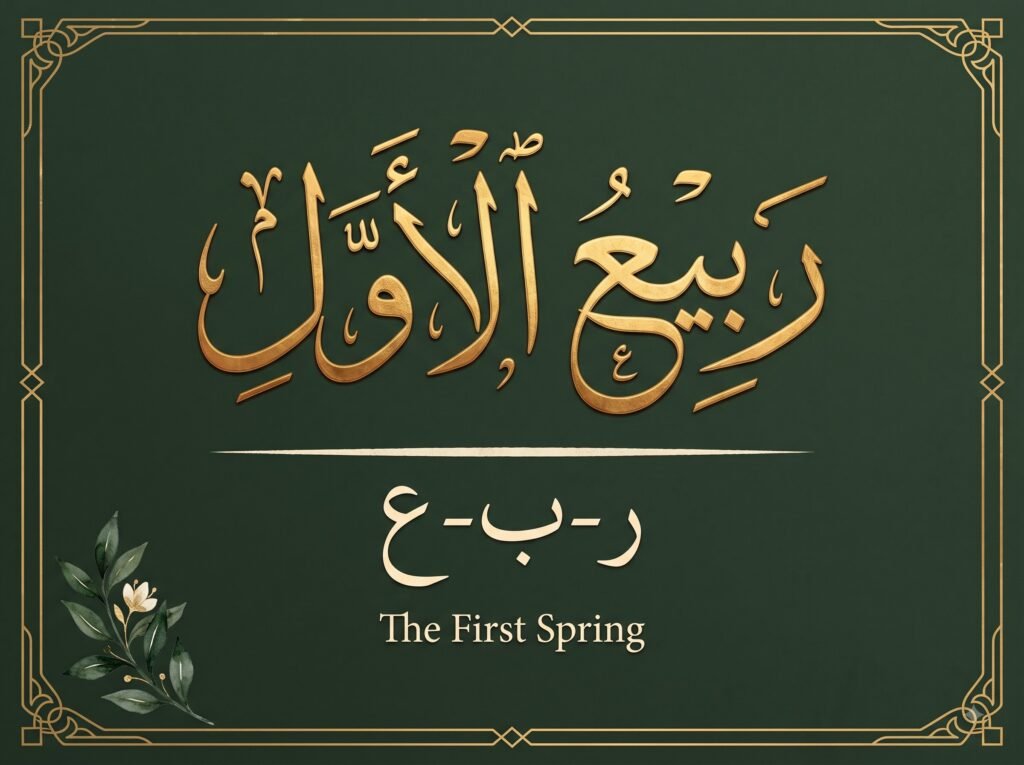
The name رَبِيعُ الأَوَّل (Rabi al-Awwal) contains a root that most Muslims have never explored — and it reveals something beautiful about the month’s character.
📌 Ghost Callout Block — Root Breakdown Card
رَبِيعُ الأَوَّل | Root: ر-ب-ع (Ra-Ba-Ayn)
Core meaning: Spring. The first quarter. The season of new growth, fresh rain, and life returning after dormancy.
| Arabic | Meaning |
|---|---|
| رَبِيع | spring — the season of fresh growth and rain |
| رُبُوع | spring pastures — places where life returns |
| رُبْع | a quarter — one fourth |
| أَرْبَعَة | four — the number of seasons |
| رَبِيعَة | a name meaning spring abundance |
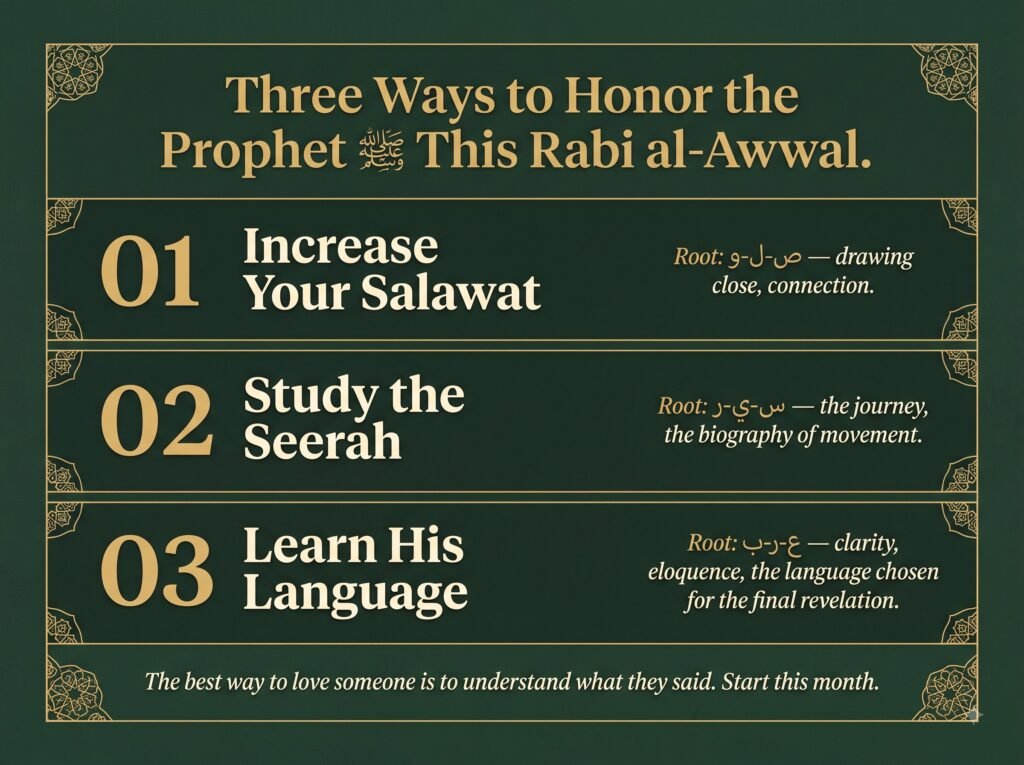
The Three Practices for Rabi al-Awwal:
01 — Increase Your Salawat | Root: ص-ل-و — drawing close, connection
02 — Study the Seerah | Root: س-ي-ر — the journey, the biography of movement
03 — Learn His Language | Root: ع-ر-ب — clarity, eloquence, the language of the final revelation
The best way to love someone is to understand what they said. Start this month.
The root ر-ب-ع carries the image of spring. Specifically, it describes rain arriving after dryness. It describes green things growing where there was aridity. It describes life returning to dormant earth.
This naming is not arbitrary. The Prophet ﷺ arrived in the month the Arabic language associates with new growth — with mercy descending on dry ground. And the most celebrated description of his mission in the Quran aligns precisely with this image:
“We did not send you except as a mercy to all the worlds.”
— Surah Al-Anbiya, 21:107
He arrived as a spring — as mercy sent to a world that had grown spiritually arid. And the Arabic calendar named his month after the season that most resembles what his arrival brought: fresh growth, returning life, the first spring of a new era in human history.
Furthermore, رَبِيعُ الأَوَّل means the first spring — al-Awwal, the first, the one that comes before all others. The Prophet ﷺ was not simply a mercy. He was the first spring of the final mercy — the opening of a season that the Quran says will last until the Day of Judgment.
The Twelfth Day — What Most Scholars Say
The twelfth of Rabi al-Awwal is the date most widely cited across Islamic scholarly tradition as the date of the Prophet’s ﷺ birth.
This date carries significant historical support. Ibn Ishaq — the earliest biographer of the Prophet ﷺ — recorded the twelfth of Rabi al-Awwal as the birth date. The majority of classical scholars and the traditions of most Muslim communities across the world have followed this dating. Some scholars, however, cite the ninth of Rabi al-Awwal based on other historical analyses — a minority position that has gained academic attention in recent centuries.
What is not in dispute: the Prophet ﷺ was born in Rabi al-Awwal. The exact date carries some scholarly difference of opinion, and that difference has never been considered a matter of creed. What Muslims across all traditions agree on is that this month holds the memory of the most significant birth in human history after that of Isa ibn Maryam ﷺ.
The twelfth, consequently, is observed by the largest portion of the ummah globally as the day of remembrance, gathering, and increased salawat — regardless of the scholarly discussion around the precise date.
How to Honor Him — Three Practices, Three Roots
The question most Muslims carry into Rabi al-Awwal is sincere and straightforward: how do I honor him?
The answer is not primarily about the Mawlid debate. Rather, it is about three practices whose recommendation in the Quran and Sunnah has broad consensus — and whose Arabic roots, once understood, reveal exactly why each one is the form of honor it is.
Practice 1 — Increase Your Salawat
Root: ص-ل-و (Sad-Lam-Waw)
The root of connection, of drawing close, of moving in the direction of the one you are orienting toward.
Allah commands this directly in the Quran:
“Indeed, Allah and His angels send blessings upon the Prophet. O you who believe — send blessings upon him and greet him with a worthy greeting.”
— Surah Al-Ahzab, 33:56
The word صَلَّى (salla — to send blessings, to pray) comes from the same root as صَلَاة (salah — prayer). Sending salawat is therefore not a simple formula of well-wishing. Rather, it is the same root act as standing in salah. It is the act of drawing close — of turning toward the one you address.
When you say اللَّهُمَّ صَلِّ عَلَى مُحَمَّد (Allahumma salli ala Muhammad), you are performing an act of connection — drawing close to him through the same root act that connects you to Allah in prayer.
This month: Set a daily salawat intention — a specific number said after each salah, or a fixed time each day. Many scholars recommend at minimum 100 salawat daily in Rabi al-Awwal.
Practice 2 — Study the Seerah
Root: س-ي-ر (Sin-Ya-Ra)
The root of journeying, of biography, of the account of a life in motion.
السِّيرَة (al-seerah) — the biography of the Prophet ﷺ — comes from the root that means the way one travels, the account of a journey. A seerah is literally “the account of how someone moved through life.” Studying the seerah, therefore, is not simply learning historical facts. It is following the tracks of a journey — understanding how the Prophet ﷺ moved through the world, what he chose, what he endured, and what he left behind.
The Prophet ﷺ said: “Teach your children three things — the love of your Prophet, the love of his household, and the recitation of the Quran.” Loving the Prophet ﷺ requires knowing him — and knowing him requires following the account of his journey.
This month: Choose one seerah book and commit to reading one chapter per day throughout Rabi al-Awwal. The Sealed Nectar (Al-Raheeq al-Makhtum) by Safi ur-Rahman Mubarakpuri is widely recommended as an accessible and comprehensive starting point.
→ Read more about understanding the seerah through Arabic roots: [Link to Seerah Arabic Post]
Practice 3 — Learn the Language He Was Given
Root: ع-ر-ب (Ayn-Ra-Ba)
The root of clarity, eloquence, and the specific quality of expression that the Arabic language was named for.
The Prophet ﷺ was described as the most eloquent of the Arabs — and the Arabs of his time were among the most eloquent speakers in human history. He was given jawami al-kalim — the ability to express the deepest meanings in the fewest words. AndThe Quran he carried was revealed specifically in Arabic. He spent twenty-three years transmitting it. The root meaning of Arabic itself is clarity and eloquence of expression.
To learn Arabic, therefore, is not simply a linguistic endeavor. It is the act of accessing the language that the Prophet ﷺ was given — the language in which his most complete Alhamdulillah was said, in which his duas were made, in which the words that will be on his tongue on the Day of Intercession exist.
Furthermore, when you understand the Arabic words of your salah — the words he taught you to say — you are no longer reciting what he prescribed. You are saying what he said, in the way he said it, with the meaning he intended.
This month: Start with the free vocabulary PDF — fifty of the highest-frequency root families in the Quran. Use one root per day throughout Rabi al-Awwal. By the 30th of the month, you will have thirty roots — enough to recognize approximately 60–70% of the words in the most common Quranic surahs.
→ Explore the complete Arabic root method: [Link to Arabic Roots Method Article]
What the Month Is Asking of You
Rabi al-Awwal asks the same question every year: how well do you know the man whose month this is?
The answer is not measured in celebration attended or posts shared. It is measured in salawat sent, in seerah studied, and in the language learned — the language that was his, that is still his, that the Quran he carried is still waiting to speak to you in directly.
This month, he deserves the kind of honor that outlasts the month. He deserves the Muslim who carries something forward into Rabi al-Thani, and Jumada al-Ula, and Rajab — who began in this spring month a relationship with his language that keeps growing.
→ Learn more about Mawlid — its history, its scholarly positions, and its spiritual significance: [Link to Mawlid Article]
→ Explore our complete Rabi al-Awwal guide for families: [Link to Rabi al-Awwal Guide]
Start Learning His Language
→ Free Trial Class at roots-muslimschool.com
The Prophet ﷺ was given the most eloquent language in human history — and then given the most eloquent expression of that language ever produced. Root-based Arabic learning gives you access to both.
Start this month. One root per day. Five minutes after Fajr. By the end of Rabi al-Awwal, something will have changed — and it will keep changing, every month, every root, every ayah, for as long as you continue.
His language has been waiting for you. This is the month to begin.
May Allah make this Rabi al-Awwal the month we begin something we carry for the rest of our lives — a relationship with his language, his words, and the Quran he was sent with that deepens every year this month returns to find us. Ameen. 🌙
