
Arabic Classes for Muslim Kids: What 10 Summer Weeks Achieve
Arabic classes for Muslim kids in summer raise one question above all others — and Muslim parents ask it every June: is ten weeks long enough to make a real difference in my child’s Arabic?
Here is the honest, phase-by-phase answer — with specific milestones and realistic expectations built for parents who want the truth before they commit.
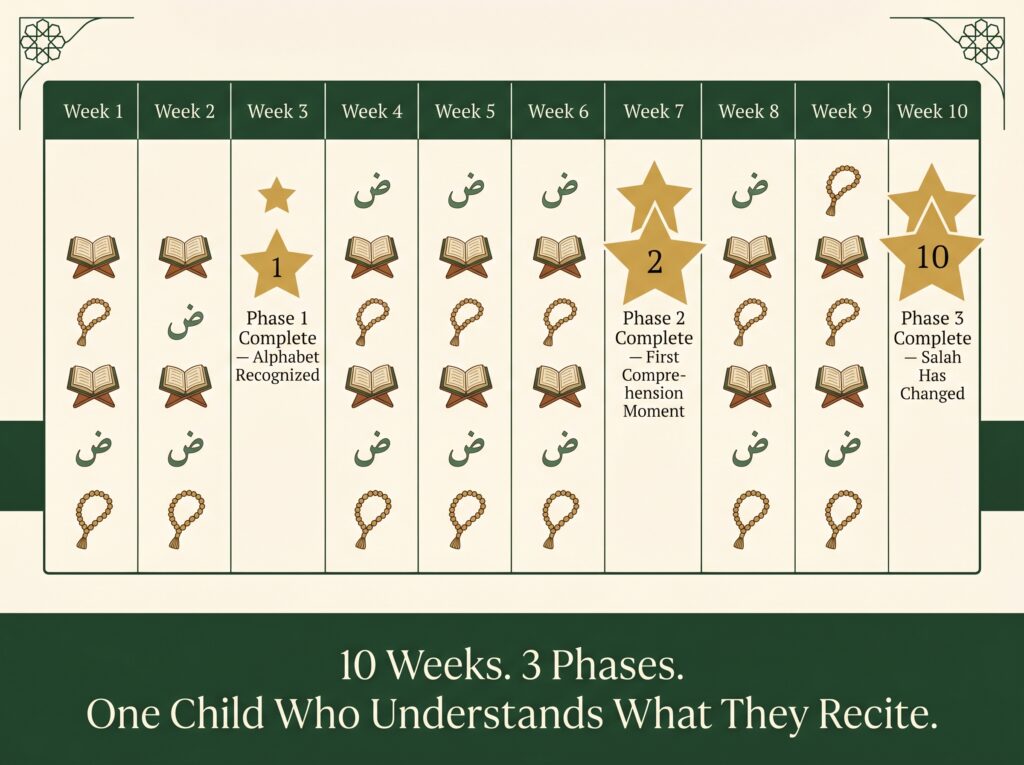
The Promise and the Honest Limit
Before the phases, there is something worth saying clearly.
Ten weeks of consistent summer Arabic lessons will not make your child fluent. It will not give them conversational Arabic. It will not produce a child who can read any page of the Quran independently with full comprehension by September.
What ten weeks will do — with the right method, consistent practice, and live teaching — is something more immediately meaningful than any of those things.
It will give your child a different relationship with their salah and their Quran than they had in June.
Specifically, it will give them the experience of recognizing something — of sitting in prayer and suddenly knowing what a word means, of reading an ayah and feeling it speak rather than simply sound. That experience, furthermore, changes everything. A child who has had one genuine moment of Quranic comprehension has crossed a threshold that changes how they relate to the language permanently.
That is the goal of ten summer weeks. And it is entirely achievable — with a realistic, phase-based approach.
Here is exactly what that looks like.
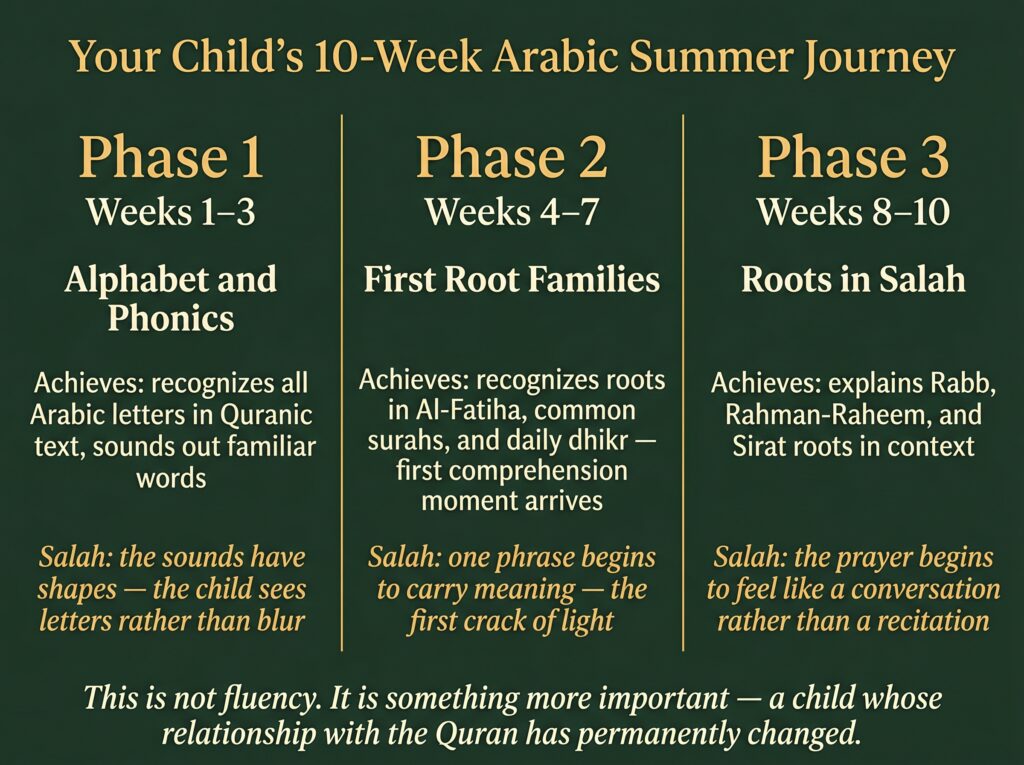
📌 Ghost Callout Block — Three-Phase Milestone Summary Card
Your Child’s 10-Week Arabic Summer Journey
| Phase 1 | Phase 2 | Phase 3 | |
|---|---|---|---|
| Weeks | 1–3 | 4–7 | 8–10 |
| Focus | Alphabet and Phonics | First Root Families | Roots in Salah |
| Child achieves | Recognizes all Arabic letters in Quranic text, sounds out familiar words | Recognizes roots in Al-Fatiha, common surahs, and daily dhikr — first comprehension moment arrives | Explains Rabb, Rahman-Raheem, and Sirat roots in context |
| Salah starts to feel like | The sounds have shapes — the child sees letters rather than blur | One phrase begins to carry meaning — the first crack of light | A conversation rather than a recitation |
This is not fluency. It is something more important — a child whose relationship with the Quran has permanently changed.
Phase 1 — Weeks 1 to 3: The Alphabet and the Sounds
What the child is learning: Arabic letter recognition and phonics
What success looks like by Week 3: The child can identify every Arabic letter in running Quranic text — slowly, with effort, but accurately
The Arabic alphabet has 28 letters. Most of them have four forms depending on their position in a word. Several share similar shapes and are distinguished by dots. This sounds more complex than the experience of learning it actually is — and for children specifically, the pattern recognition required for Arabic letters is well within the cognitive range of a seven-year-old with consistent practice.
In Phase 1, the child is not yet reading for meaning. Rather, they are learning to see Arabic as a system of recognizable shapes rather than an undifferentiated visual blur. For most Muslim children who have been attending Islamic school or Sunday classes, furthermore, this phase moves faster than parents expect — because years of exposure to Quranic text have already laid a foundation of visual familiarity, even where explicit instruction was absent.
What live classes do in Phase 1: A qualified teacher introduces letters in clusters based on shape families — grouping visually similar letters so that the learning leverages visual pattern recognition rather than working against it. Phonics practice connects each letter to its sound in familiar Quranic words. Consequently, the child is not learning the alphabet in the abstract. They are learning it through the words they already know by sound.
What the daily home practice does: Five minutes after Fajr — one letter family reviewed, one familiar word traced, one Arabic letter found in a surah the child already knows. The repetition compounds rapidly with children.
What salah starts to feel like at the end of Phase 1: The sounds the child produces in prayer now have visual shapes attached to them. They see letters rather than blur. This is the first shift — and it is more significant than it sounds. A child who can see the Arabic letters they are reciting has a fundamentally different relationship with the words than one for whom the written form is inaccessible.
Phase 2 — Weeks 4 to 7: The First Roots
What the child is learning: Root-based Quranic vocabulary — starting with the highest-frequency root families
What success looks like by Week 7: The child recognizes several roots in Al-Fatiha and common surahs — and has experienced at least one genuine comprehension moment
This is where everything changes.
Phase 2 introduces the method that makes Quranic Arabic uniquely accessible — the root system. The Quran is built on three-letter root families, and the most frequent 30 root families account for approximately 70% of all word occurrences in the text. A child who begins learning these roots in Phase 2 is not memorizing isolated vocabulary items. Rather, they are learning generative seeds — each root unlocking a family of related words across hundreds of ayahs.
The roots introduced in Phase 2 are chosen specifically for their presence in the content the child already knows: Al-Fatiha, Surah Al-Ikhlas, Surah Al-Falaq, Surah An-Nas, and the daily dhikr phrases the child has been hearing since birth.
The first comprehension moment — the event that Phase 2 is designed to produce — typically arrives somewhere between Week 5 and Week 7. It looks different for every child but follows the same pattern: a root is introduced in class, the child recognizes it in a surah they know by heart, and they stop and say something like: “Wait — so that’s what that word means?”
This moment is not simply educational. It is, moreover, a spiritual event — the first time the Quran has spoken to this child in meaning rather than only in sound. Research on language learning consistently shows that this kind of intrinsic reward — discovering meaning in something previously opaque — produces a motivational effect that external rewards cannot replicate. After the first comprehension moment, children typically become self-motivating in their Arabic practice. The discovery becomes the motivation.
What live classes do in Phase 2: The teacher introduces roots through the specific ayahs the child already knows — using the child’s existing memorization as the context for the new learning. This is pedagogically powerful: meaning is attached to something already emotionally significant rather than to something unfamiliar.
What salah starts to feel like at the end of Phase 2: One phrase in Al-Fatiha — perhaps Rabb il-aalameen, perhaps Ar-Rahman Ar-Raheem — begins to carry weight. Not fully. Not perfectly. But the first crack of light has appeared.
Phase 3 — Weeks 8 to 10: Roots in Salah
What the child is learning: Applying root knowledge to the specific phrases of Al-Fatiha and daily salah
What success looks like by Week 10: The child can explain the meaning of several key Al-Fatiha phrases using their root knowledge
Phase 3 is where the summer’s work becomes visible to everyone in the household — because the evidence is audible in the child’s prayer.
In Phase 3, the teacher explicitly connects the roots learned in Phase 2 to the specific phrases of salah. The child now learns not just what رَبّ (Rabb) means in the abstract, but what it means in the specific phrase Alhamdulillahi Rabb il-aalameen — and why that meaning transforms the opening of Al-Fatiha from a formula into an address. They learn the root of الرَّحْمَن الرَّحِيم — the ر-ح-م root of enveloping mercy — and why both names appear in the same ayah. They learn that صِرَاط (sirat) is not a vague spiritual direction but a constructed road — built, paved, specifically engineered for travel.
What a child can do by Week 10:
They can tell you what Rabb il-aalameen means — not just translate it but explain the root meaning of nurturing toward completeness. They can explain why there are two mercy names in Al-Fatiha and what the root ر-ح-م carries. They can tell you that the siratal mustaqeem they ask for in every prayer is a constructed road — and that they are asking Allah to place them on something that was built specifically for them.
They cannot yet tell you the meaning of every phrase in every salah. That is not the goal of ten weeks. The goal, rather, is that they now have a working relationship with the language of their prayer — one that will deepen with every week of continued practice and every root they add.
What This Is — And What It Is Not
This is worth stating clearly, because honest expectations build the trust that sustainable learning requires.
By the end of 10 weeks, your child will have:
- Full Arabic alphabet recognition in Quranic text
- Understanding of several high-frequency root families
- The ability to explain key Al-Fatiha phrases in their own words
- A different experience of salah than they had in June
- The intrinsic motivation that comes from a genuine comprehension moment
By the end of 10 weeks, your child will not have:
- Conversational Arabic fluency
- Full Quran comprehension
- The ability to read any Arabic text independently with understanding
- Mastery of Arabic grammar
The ten weeks, consequently, are not the destination. They are the beginning of a relationship with the language that, if continued, compounds indefinitely. A child who leaves summer with the three phases completed is a child who will find every subsequent Arabic lesson easier, every subsequent root more familiar, and every subsequent year of Islamic education more deeply connected to meaning.
That is the investment. And summer is the best window available to make it.
→ Read the complete guide to the best online Arabic classes for Muslim children in summer 2026: [Link to Anchor Summer Arabic Post]
→ Find out when to start Arabic for kids — the research-backed age guide: [Link to When to Start Arabic for Kids Article]
Book Your Child’s Free Trial Class
→ Book a Free Trial Class for Your Child at Roots Muslim School
One session. Live. Root-based. Designed for children at exactly the starting point your child is at right now — whether they know the Arabic alphabet or are beginning from scratch.
By the end of that first session, you will know whether this is the right fit. And your child will have had their first experience of Arabic as something that belongs to them — not as a foreign language they are studying, but as the language of their prayer, their Quran, and their relationship with Allah.
Summer is ten weeks. The first session is free.
May Allah make this summer the beginning of a relationship with His words that our children carry for the rest of their lives. Ameen. 🌙
