
Eid Al-Adha Meaning in Arabic: The Roots Behind the Celebration
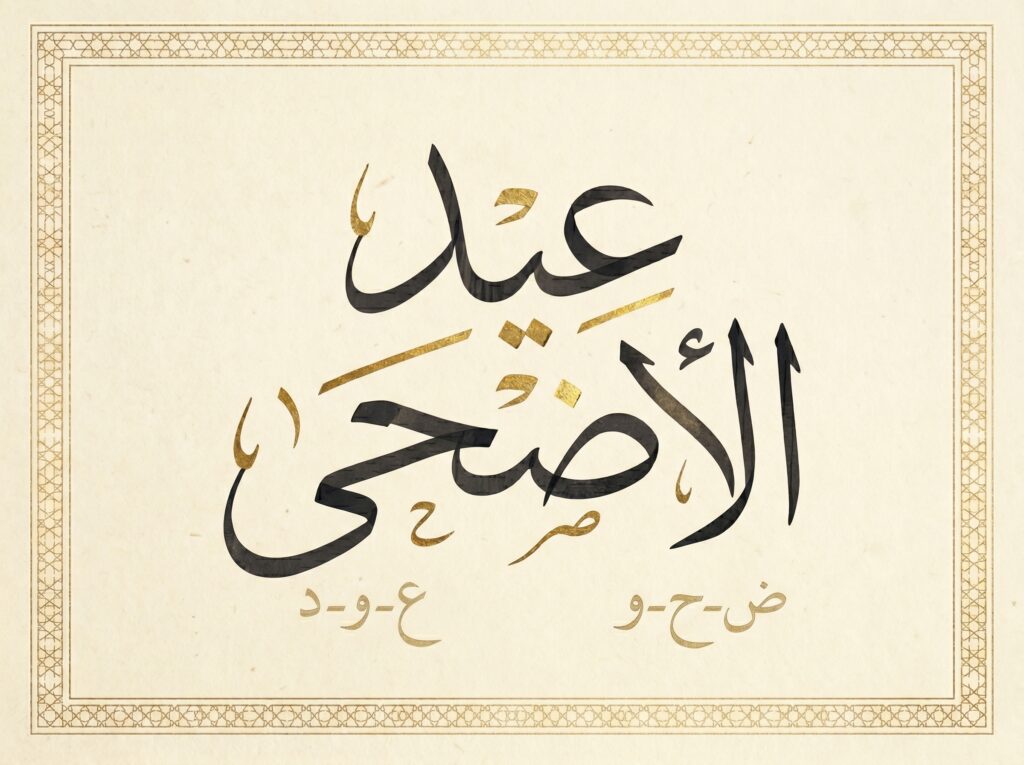
The Eid Al-Adha meaning in Arabic goes far deeper than any translation of the celebration captures.
Eid Al-Adha just passed. You celebrated it, prayed it, and perhaps sacrificed for it. You said the words — Eid Mubarak, Eid Al-Adha — dozens or hundreds of times over the course of the day. You heard them said back to you. You sent them in messages, posted them, and received them in return.
But do you know the full depth of what those two Arabic words actually mean?
The Paradox of Familiar Words
Here is something worth sitting with for a moment.
Billions of Muslims celebrate Eid Al-Adha every year. They say the name of the celebration hundreds of times over the Eid period — in greetings, in prayers, in conversations, in posts. The words are among the most frequently spoken Arabic words in the entire Muslim world during Dhul Hijjah.
And yet the vast majority of those billions have never been shown what the two words actually mean in Arabic. Not the surface translation — most Muslims know Eid means something like celebration and Adha something like sacrifice. Rather, the root meanings — the linguistic architecture beneath the words that reveals what Eid Al-Adha is architecturally designed to be.
The root meanings, moreover, carry a depth that transforms the entire experience of the celebration retrospectively. Not just for next year. For right now — in the days immediately after this Eid — when the celebration is recent enough to still be felt but distant enough to be reflected on.
Here is what you were actually saying.
The First Word — عِيد (Eid)
📌 Ghost Callout Block — Root Breakdown Card
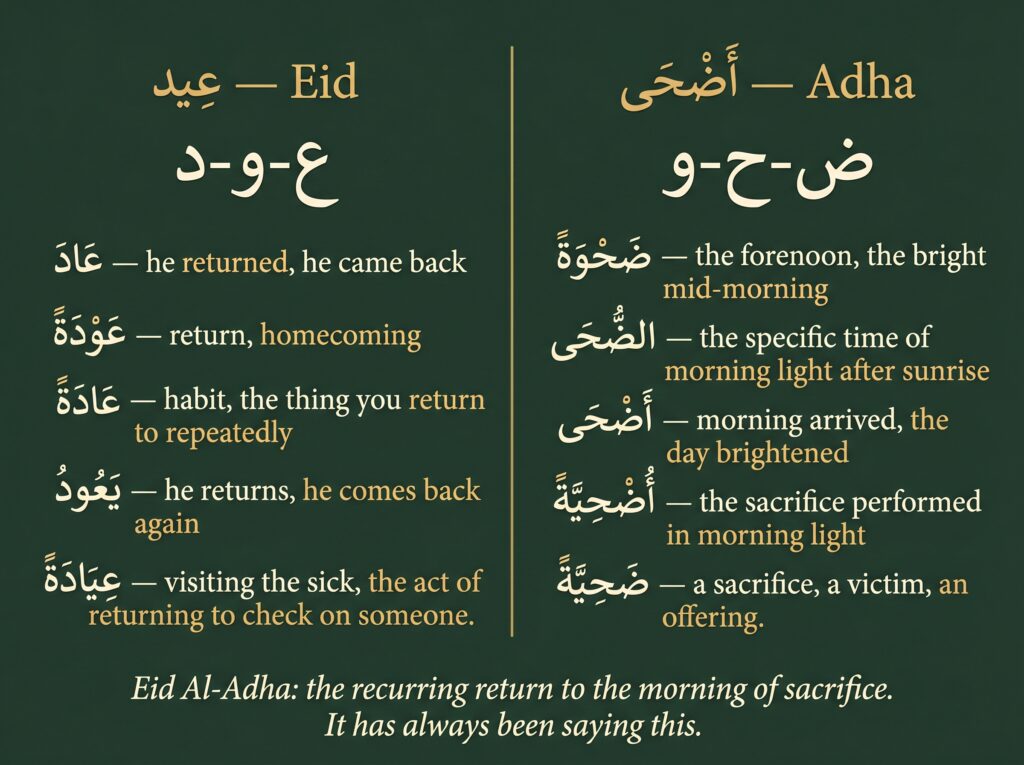
عِيد — Eid | Root: ع-و-د (Ayn-Waw-Dal) Core meaning: To return. To come back. To revisit. The act of recurring — of coming back to a place, a person, or a sacred appointment.
| Arabic | Meaning |
|---|---|
| عَادَ | he returned, he came back |
| عَوْدَة | return, homecoming |
| عَادَة | habit — the thing you return to repeatedly |
| يَعُود | he returns, he comes back again |
| عِيَادَة | visiting the sick — the act of returning to check on someone |
أَضْحَى — Adha | Root: ض-ح-و (Dad-Ha-Waw) Core meaning: The forenoon — the specific quality of bright morning light after sunrise when the day has fully arrived but not yet reached its peak.
| Arabic | Meaning |
|---|---|
| ضَحْوَة | the forenoon, the bright mid-morning |
| الضُّحَى | the specific morning light after sunrise |
| أَضْحَى | morning arrived, the day brightened |
| أُضْحِيَّة | the sacrifice performed in morning light |
| ضَحِيَّة | a sacrifice, a victim, an offering |
Eid Al-Adha: the recurring return to the morning of sacrifice. It has always been saying this.
Most translations render عِيد as celebration, festival, or holiday. All three are accurate in the sense that Eid is indeed a day of celebration and communal joy. None of them, however, captures what the Arabic root reveals about the nature of that celebration.
The root ع-و-د is the root of returning. Specifically, it describes the act of coming back to something — revisiting a place, a person, or an appointment. Furthermore, it gives us عَادَة (aadah) — the Arabic word for habit, the thing you return to so regularly that it becomes part of who you are — and عِيَادَة (iyada) — the act of visiting someone who is ill, returning to check on them.
عِيد, therefore, is not simply a celebration. Rather, it is a recurring sacred appointment — one that comes back to find the Muslim each year, like a tide that was appointed to arrive. Allah did not give the Muslim community a single celebration or a holiday that happens once and passes. He gave them two celebrations that return — Eid Al-Fitr and Eid Al-Adha, each coming back annually to the same Muslim at a different point in their spiritual journey.
Consequently, when you say Eid Mubarak, you are not simply saying happy celebration. You are, in the root meaning of the words, saying: blessed is this returning — blessed is the sacred appointment that has come back to find you.
And this year, it found you. Next year, it will return. It will keep returning for as long as you live — each time at a different point in your life, each time asking the same questions with new urgency.
The Second Word — أَضْحَى (Adha)
The second word carries a surprise that most Muslims never encounter.
أَضْحَى is typically understood to mean sacrifice — and the Eid is consequently understood as the Festival of Sacrifice. This understanding is entirely correct. The deeper root meaning, however, reveals something that transforms the quality of that sacrifice in a way that no translation has captured.
The root ض-ح-و carries the core meaning of the forenoon — the specific time of day after sunrise when the sun has fully risen and the day’s light is bright, clear, and direct. This time is called الضُّحَى (al-duha) — and it is so significant in Islamic tradition that Allah named an entire surah after it: Surah Ad-Duha, the surah of the morning light, revealed as a reassurance to the Prophet ﷺ that Allah had not abandoned him.
The أُضْحِيَّة (udhiyyah) — the sacrificial animal of Eid Al-Adha — is literally the morning-light sacrifice. And أَضْحَى — the name of the Eid itself — is literally the time when morning has fully arrived, when the light is clear and bright and unhesitating.
This root connection reveals something extraordinary about the sacrifice of Ibrahim ﷺ — the event that Eid Al-Adha commemorates.
Ibrahim’s act of obedience — raising his hand to sacrifice his son in compliance with Allah’s command — was performed not in darkness, not in ambiguity, not in the uncertain light of dusk or the hidden hours before dawn. It was performed in the clear, bright, fully-arrived light of the forenoon. In full visibility. With complete clarity. With the kind of unhesitating brightness that makes hiding impossible and ambiguity unnecessary.
The Arabic root of the sacrifice, therefore, encodes the manner of Ibrahim’s obedience as much as the act itself. His sacrifice was a clear-morning act — unambiguous, fully visible, performed in the light of complete resolve.
And every Muslim who performs the udhiyyah — the morning-light sacrifice — in the forenoon hours of Eid Al-Adha is, linguistically and spiritually, participating in that same clear-morning obedience.
What the Two Roots Reveal Together
Read together, the two roots of عِيد الأَضْحَى reveal a complete theological statement about what this celebration is architecturally designed to be.
عِيد — the recurring appointment, the sacred return — tells us that this is not a one-time historical commemoration of something Ibrahim did once in the past. Rather, it is an appointment that comes back every year to find the Muslim in their present moment, at their current level of faith, with their current capacity for obedience.
أَضْحَى — the morning light, the time of clear-morning sacrifice — tells us what that appointment is asking each time it returns: the same thing it asked Ibrahim. Not the same object. The same quality. What are you willing to place before Allah in the bright, clear, unambiguous light of full obedience — with no darkness to hide in and no ambiguity to retreat into?
Together, therefore, Eid Al-Adha is the recurring return to the morning of sacrifice — the divinely appointed meeting point between the Muslim and the memory of Ibrahim’s obedience that comes back every single year to ask: What would you sacrifice? And would you do it in the clear light of morning, with nothing hidden?
The Question the Celebration Leaves Behind
Eid Al-Adha has just passed. The prayer has been prayed. The sacrifice has been performed or observed. The greetings have been exchanged.
And now the root meanings of the two words reveal something about what this Eid was actually doing — and what it will do again next year when it returns.
It was not simply marking a date on the Islamic calendar. Rather, it was returning — عَادَ — to find you at this specific point in your life. It was arriving in the clear morning light — الضُّحَى — and asking you in that light what you are willing to place before Allah.
You do not need to have the answer fully formed. The appointment will return next year. And the year after. Every Eid Al-Adha that finds you alive is asking the same question with the same root meanings — and the asking is itself the gift.
Go Deeper — One Root at a Time
These two roots — ع-و-د and ض-ح-و — are two of the hundreds of root families that carry the meaning of Islamic life in their three letters. Each root connects to dozens of other words across the Quran and the daily vocabulary of Muslim life.
Understanding them does not require years of Arabic study. It requires the right method — one that starts with roots, builds from meaning, and fits into daily life.
→ Read what the Arabic root behind Hajj reveals about the nature of the pilgrimage: [Link to What Does Hajj Mean in Arabic Post] → Explore the complete Arabic root method — and how 30 roots unlock 70% of the Quran: [Link to Root Words Article]
Your Next Step
→ Explore our Arabic Vocabulary Course for Muslims at roots-muslimschool.com
Root-based Arabic learning designed specifically for Muslim adults — built to deliver Quranic comprehension and the kind of linguistic depth that makes every Eid, every prayer, and every ayah carry more than it did before.
The next Eid Al-Adha will return. When it does, you will know exactly what it is saying.
May Allah accept the sacrifices, the prayers, and the intentions of this Eid Al-Adha from every Muslim who observed it — and may He make the recurring return of this blessed appointment find us each year more worthy of what it is asking. Ameen. 🌙
