
Islamic Identity in Kids: What Arabic Words for Family Really Mean
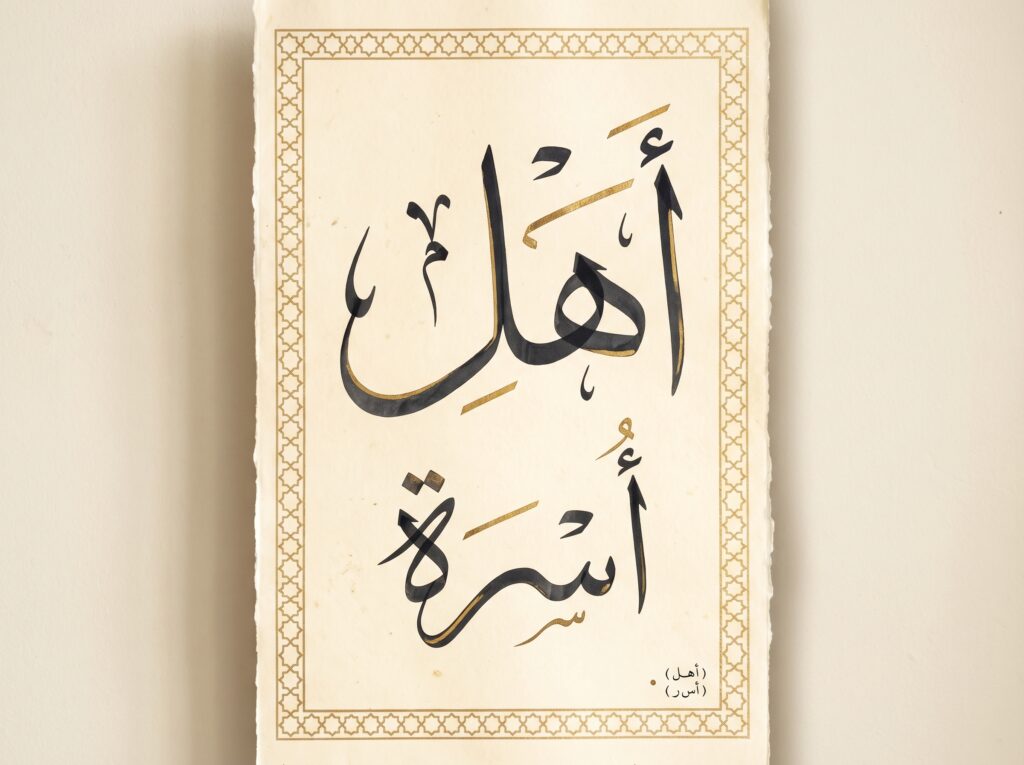
The Arabic word for family in the Quran is not just a label.
In fact, its root reveals an entire Islamic philosophy of what a family is for. Once you see it, everything changes — every parenting decision, every dinner table conversation, and every moment you invest in your children’s Muslim identity.
Ultimately, this is what the Quran’s language has been saying about family since the beginning. Most of us, however, were simply never shown how to read it.
The Word You Already Know — And What You Have Not Yet Seen in It
You know the word أَهْل.
Specifically, you have heard it in greetings — ahlan wa sahlan, welcome, you belong here. You have also heard it in the Quran — Ahl al-Kitab, the People of the Book. And in the seerah — Ahl al-Bayt, the household of the Prophet ﷺ, those who belonged to his circle of purpose.
But have you ever looked at what lives inside the root itself?
The root of أَهْل is أ-ه-ل. Crucially, its core meaning is not simply family in the biological sense. Instead, it carries the meaning of belonging to a place, belonging to a purpose, being the rightful inhabitant of something. To be أَهْل of something, therefore, means to be worthy of it — to be the one who fits, who belongs, whose presence there is right and proper.
This is precisely why the same root that gives us the word for family also gives us:
- أَهْلًا — welcome: you belong here, you are among your people
- أَهْلِيَّة — worthiness, the state of being fit for a responsibility
- أَهْل الجَنَّة — the people of Paradise, those who belong there and are worthy of it
Now, read Surah At-Tahrim with this root in mind:
“O you who believe — protect yourselves and your families from a fire.” — Surah At-Tahrim, 66:6
The word used for families here is أَهْلِيكُم — your ahl, your people, those whose belonging with you carries mutual responsibility. This is not, therefore, a bureaucratic family listing. Rather, it is a covenant. In other words, the Quran is telling Muslim parents directly: your family is a purposeful circle — and your role within it is to be worthy of that circle.
The Second Word — And the Root That Changes Everything
Arabic also has a second word for family: أُسْرَة — usrah.
This is the word used in Islamic schools, tarbiyah frameworks, and parenting circles across the Muslim world. Interestingly, its root is extraordinary in what it reveals.
The root of أُسْرَة is أ-س-ر — and its core meaning is to bind, to hold with strength, to chain. Specifically, the primary verb أَسَرَ means to take captive, to hold someone by bonds that do not break. From this single root, consequently, comes:
- أَسِير — a captive, one held by unbreakable bonds
- إِسَار — a binding cord, a tie that holds firm
- أُسْرَة — the family unit — literally, the circle of people bound together by ties that hold
So the Arabic language chose, for the word describing the family as a unit, a root that means bonds that do not break under pressure.
This is not accidental. In fact, Classical Arabic carries extraordinary semantic precision. As a result, the choice of this root for this word is a deliberate statement: a family is not a soft, optional gathering of related people. Rather, it is a structure of binding strength — a circle whose bonds are designed to hold precisely when life applies the most pressure.
Consider, then, what this means practically for Muslim parenting.
When you build daily routines with your children — Quran after Fajr, identity-forming conversations at dinner, shared Islamic practices that mark your home as distinctly Muslim — you are not simply imposing rules. Instead, you are strengthening the أُسْرَة. In doing so, you are tightening the bonds that the Arabic language itself defined as the essential feature of what a family is.
أَهْل and أُسْرَة Together — A Complete Islamic Family Philosophy
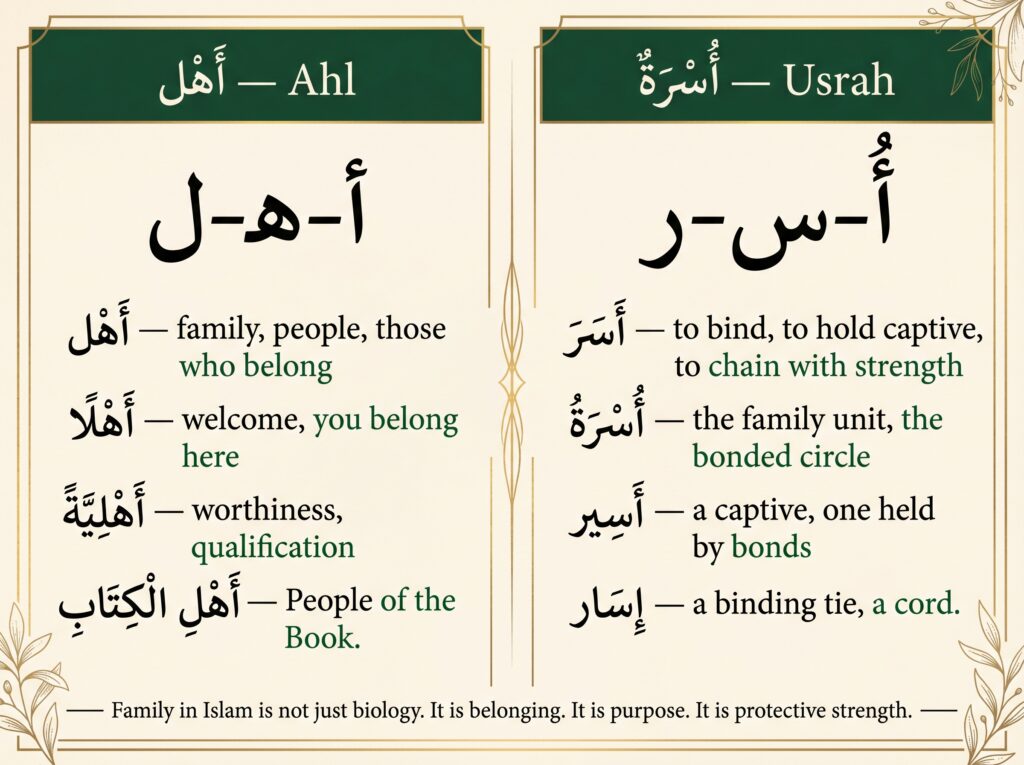
Read side by side, these two root families give us something remarkable: a complete architectural philosophy of the Islamic family, encoded directly into the language of the Quran.
On one hand, أَهْل tells us the family is about belonging and worthiness. The Muslim family is a circle of people who belong to each other — and whose belonging carries a mutual obligation. Specifically, each member is responsible for protecting the others’ path toward Allah. To call someone your أَهْل is, in essence, to say: you belong in my circle of purpose.
أُسْرَة, on the other hand, tells us the family is about bonds that hold under pressure. The Muslim family is not a loose association. Rather, it is a structure of binding ties — ties that are meant to hold precisely when the world pulls family members in different directions.
Together, therefore, the Islamic family is a purposeful circle of belonging, held by bonds of strength, whose members are mutually responsible for each other’s worthiness before Allah. Ultimately, this is the philosophy beneath Islamic parenting — not rules, not control, but purposeful belonging and protective bonds.
What This Means at Your Dinner Table Tonight
Muslim parents who ask their children identity-forming questions — What did you learn today? What are you grateful for? What did you do that pleased Allah? — are doing something deeply significant. Specifically, they are not simply borrowing habits from a Western self-help framework.
In fact, they are enacting the أَهْل principle entirely. They are creating a circle in which every member belongs to a shared purpose. As a result, the conversations themselves reinforce worthiness — the sense that we are people who think about these things, who talk about these things, who belong to a family that takes its relationship with Allah seriously.
At the same time, they are strengthening the أُسْرَة bonds. These are the ties that will hold their children when outside pressure pulls hardest. Moreover, a child who grows up inside a family where Islamic identity is spoken and explored at the table carries those bonds into adulthood. Consequently, those bonds hold precisely when they are needed most.
The Arabic language encoded this wisdom into the concept of family from the beginning. The Quran then activated it in how it addresses believing parents. And crucially, it is available to every Muslim family starting tonight — at whatever table they gather around, however imperfect the evening is.
One Root at a Time — Going Deeper
This post has shown you two root families and two words. Through them, however, you have accessed an entire Islamic philosophy of family and parenting. Most Muslim parents have never had this access — not because it was hidden, but simply because nobody taught them how to read the roots.
This is precisely what Quranic Arabic root learning does across every surah, every dua, and every phrase of Islamic life. It does not simply add information. Rather, it adds depth to things you already knew and loved — depth that, ultimately, changes how you experience them permanently.
→ Read the full introduction to how the Arabic root system works: [The Arabic Root System Explained — Link to Anchor Post]
Your Next Steps
→ Download the Free 50-Word Quranic Vocabulary PDF Fifty of the highest-frequency root families in the Quran — including roots like أ-ه-ل and أ-س-ر — laid out simply and beautifully. No prior Arabic knowledge required. Completely free.
→ Join the June Arabic Roots Course Waitlist If this post has shown you what becomes possible when you understand roots beneath words, then the June course takes you through the complete system. Built specifically for non-Arab Muslims, busy parents, and anyone who wants the Quran to speak to them in meaning, not just in sound.
→ Share and Follow With a Muslim Parent Who Loves This Depth You know someone who would stop mid-scroll at the word أُسْرَة and need to know more. Send this to them. After all, knowledge about the Quran passed between Muslim parents is its own form of community tarbiyah.
May Allah make our families true أَهْل of one another — circles of purposeful belonging and worthy companionship on the path to Him. And may He strengthen our أُسْرَة bonds — binding us together with ties that hold firm in every season, through every pressure, all the way home. Ameen. 🌙
