The Arabic Root System Explained
Most Arabic learners waste years on the wrong approach.
They memorize vocabulary lists. They work through grammar tables. They study verb conjugations in isolation from meaning. They accumulate knowledge about Arabic without ever arriving at the experience of understanding it — of sitting with a Quranic ayah and knowing, in their own mind and heart, what Allah is actually saying.
Here is the method that actually works. And the linguistic evidence behind it.
This post is the most important thing you will read if you are a Muslim who wants to understand the Quran — whether you have been trying for years or have not yet known where to begin.
The Paradox at the Heart of Muslim Arabic Learning
There are an estimated 1.8 billion Muslims in the world.
The vast majority recite Arabic every single day — in Fajr, in Dhuhr, in every salah, in their duas, in the phrases woven into the fabric of daily Islamic life. Arabic is the language of their worship, their scripture, their most intimate conversations with Allah.
And yet the overwhelming majority of those 1.8 billion Muslims — including vast numbers who have formally studied Arabic — cannot tell you the meaning of what they recite.
This is one of the most profound disconnects in contemporary Islamic life. And it is not — it has never been — the fault of the learners.
The fault is architectural. The method most Muslims were taught was designed for the wrong purpose, applied to the wrong population, and built on a fundamental misunderstanding of how Quranic Arabic actually works.
The learners were given vocabulary lists when they needed root architecture.
What the Trilateral Root System Actually Is
To understand why roots change everything, you first need to understand what the Arabic root system actually is — not as a teaching tool, but as the literal structural foundation of the language itself.
Classical Arabic — the language of the Quran — is built almost entirely on a system of three-letter roots. Linguists call these trilateral roots. Almost every word in the Arabic language, and virtually every word in the Quran, can be traced back to one of these three-letter combinations.
The root itself is not a word. It is a core of meaning — a concentrated semantic seed from which an entire family of related words grows through a predictable system of patterns.
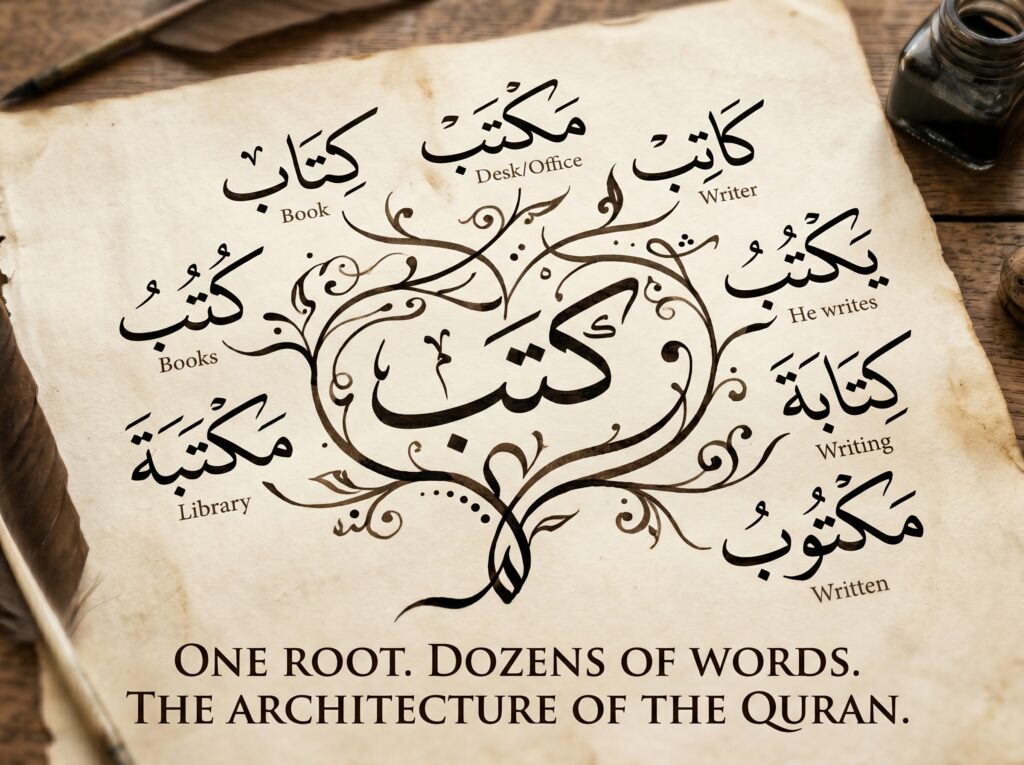
Take the root ك-ت-ب (kaf-ta-ba). This root carries the core meaning of writing, recording, and inscription. From this single three-letter seed, the Arabic language generates:
- كَتَبَ — he wrote
- كِتَاب — a book, a written record
- كَاتِب — a writer, a scribe
- مَكْتُوب — something written, a letter, that which is destined
- كُتِبَ — it was written, it was decreed
- مَكْتَبَة — a library, a place of writing
Every single one of these words lives in the Quran. Every single one of them shares the same three-letter root. And every single one of them carries the fingerprint of that root’s core meaning — writing, recording, the act of inscription — into its specific usage.
When you know the root, you do not just know one word. You know a family. And that family appears across hundreds of ayahs, connecting meaning to meaning across the entire Quran in ways that a vocabulary list can never reveal.
The 70% Statistic — And the Frequency Evidence Behind It
This is not a motivational claim. It is a linguistic and statistical one.
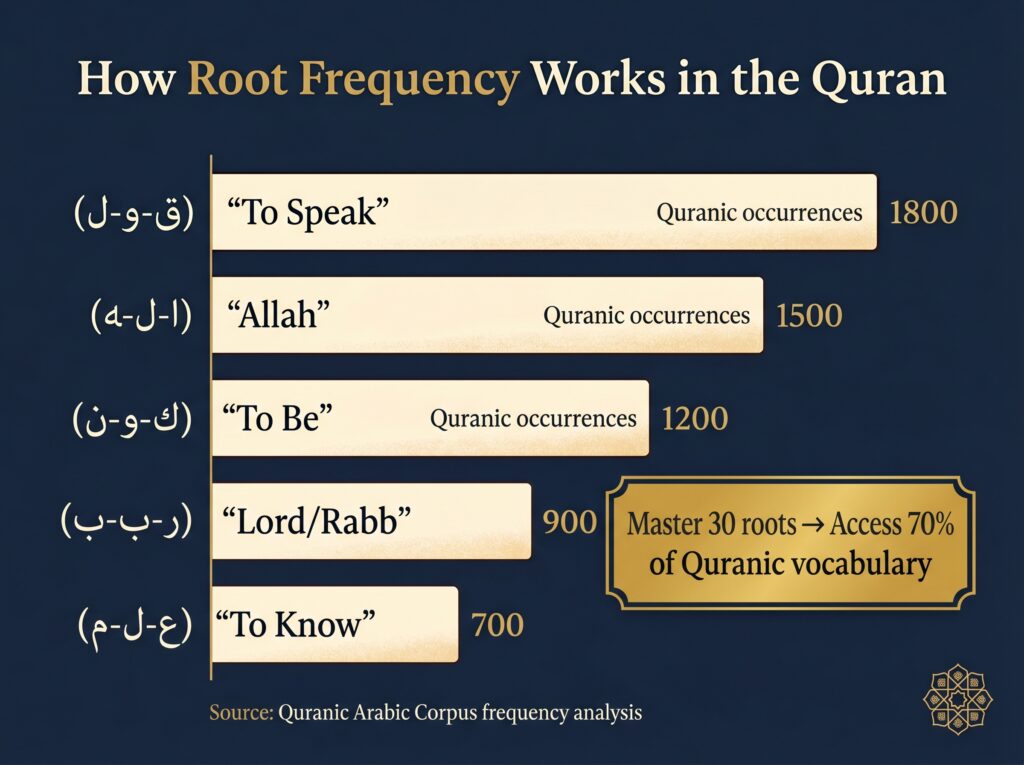
Researchers studying the Quranic Arabic Corpus — a detailed morphological and syntactic annotation of every word in the Quran — have analyzed the frequency distribution of root families across the entire text. Their findings are remarkable in their implications for learners.
The Quran contains approximately 77,430 words. When analyzed by root family rather than individual word form, the distribution is extraordinarily concentrated. A relatively small number of root families account for a disproportionately large percentage of total word occurrences throughout the text.
The practical implication of this frequency data is striking: a learner who masters the 30 most frequent root families in the Quran — learning not just the root but its core meaning and its most common derivatives — gains meaningful recognition access to approximately 70% of the words they will encounter across the entire Quran.
Not 70% of the roots. 70% of the actual words on the page.
“Master 30 roots. Access 70% of the Quran. This is not a shortcut — it is the architecture of the language itself.”
This changes the learning equation completely.
The traditional approach asks a learner to accumulate Arabic vocabulary one word at a time — a process that requires memorizing thousands of individual entries before any meaningful comprehension becomes possible. At 10 new words per day, reaching a basic reading threshold takes years. Most learners abandon the effort long before they arrive.
The root approach inverts this entirely. Instead of accumulating individual words, you learn the generative seed from which dozens of words grow. Thirty roots. Dozens of derivatives per root. Hundreds of ayahs suddenly accessible. And the comprehension compounds with every new root you add.
How Quranic Arabic Was Designed Around This System
Here is what makes the Arabic root system more than a clever pedagogical approach — it is the actual design logic of the language Allah chose to reveal His final message in.
The Quran itself draws attention to the linguistic precision of its Arabic repeatedly. The word choices in the Quran are not arbitrary. They are architecturally deliberate — chosen not just for their surface meaning but for the root resonance they carry, the family of meanings they activate, the connections they draw across the text.
Consider the root ر-ح-م (ra-ha-meem) — the root of mercy, compassion, and the womb. From this root comes:
- الرَّحْمَن — Ar-Rahman, the Most Merciful — the name that opens every surah
- الرَّحِيم — Ar-Raheem, the Especially Merciful — the name that follows it
- رَحْمَة — rahmah, mercy as a living, flowing reality
- أَرْحَام — arham, the wombs — used in the Quran in the context of family bonds and creation
- يَرْحَم — he shows mercy, he has compassion
The Quran opens with Bismillah — and in the opening line alone, this root appears twice. Allah introduces Himself first through this root. Through mercy. Through compassion so deep it shares its linguistic DNA with the physical origin of human life.
This is not visible in a translation. It is not accessible through a vocabulary list. It lives entirely in the root — and it changes how you experience the Basmala forever.
This is what understanding roots does. It does not just help you read the Quran. It changes what the Quran says to you.
The Most Common Mistake Arabic Learners Make
Understanding why the root system works also requires understanding clearly why the alternative fails.
The standard Arabic learning approach — textbooks, grammar tables, vocabulary memorization — was designed to teach Modern Standard Arabic to educated adult speakers of related Semitic languages or to advanced students in structured academic programs with years to invest.
It was never designed for the non-Arab Muslim who wants to understand the Quran they recite five times a day.
The mismatch produces a specific and recognizable failure pattern. The learner begins with motivation and discipline. They work through the alphabet. They start a vocabulary list. They encounter the verb conjugation tables — the past tense, the present tense, the dual forms, the broken plurals — and the system suddenly becomes enormously complex before it has delivered any meaningful comprehension reward.
The motivation drains. The vocabulary list grows and then stops growing. The Quran remains as opaque as it was before.
The learner concludes that Arabic is simply too difficult for them.
This conclusion is false. Arabic is not too difficult. The method was wrong.
Where to Start — Right Now
The entry point into root-based Quranic Arabic learning is not a grammar course. It is not a year-long program. It is a single, simple act: learn your first root today.
Open your Quran. Find Surah Al-Fatiha. Look at the word الرَّحْمَن. You now know its root — ر-ح-م. You now know what it shares with الرَّحِيم and رَحْمَة and يَرْحَم.
You have just taken the first step of a journey that changes your relationship with the Quran permanently.
Your Two Next Steps
→ Download the Free 50-Word Quranic Vocabulary PDF Fifty of the highest-frequency root families in the Quran, laid out simply and beautifully with core meanings, key derivatives, and example ayahs for each. No prior Arabic knowledge required. This is your starting point — the first 50 roots of a reading life that compounds with every page.
→ Join the June Arabic Roots Course Waitlist The free PDF gives you the seeds. The June course gives you the complete system — structured root learning, pattern recognition training, applied Quranic reading practice, and a community of non-Arab Muslims building the same comprehension together. Designed for beginners. Built for real life. Be first to know when enrollment opens.
→ Watch: Arabic From Zero — Episode 4 See the root system in action with live Quranic examples, explained from scratch for complete beginners. The fastest way to understand what this post has described before you read another word.
May Allah make the Quran the light of our hearts, the rest of our chests, and the departure of our sorrows. And may He make its words — in all their root depth and linguistic beauty — alive and speaking to us, every day, for the rest of our lives. Ameen. 🌙