
How to Keep Your Quran Connection After Ramadan
Because nobody ever explained the real reason Ramadan habits collapse — or gave them a system specifically built to survive it.
Research shows exactly why this happens. And exactly how to stop it.
This guide brings together what behavioral science has discovered about lasting habit formation and what the Prophet ﷺ taught us about consistency, intention, and the honest nature of the human soul. By the time you finish reading, you will have a clear, practical, and deeply grounded system to maintain your Quran connection — not just through Shawwal, but through every quiet ordinary month of the year that follows.

Why Ramadan Habits Almost Always Collapse
Before solutions, we need honest diagnosis.
Most post-Ramadan content skips this step entirely. It moves straight to tips and challenges without ever explaining why the same motivated, sincere Muslim who read Quran every morning in Ramadan cannot open the mushaf two weeks after Eid without it feeling like a struggle.
There are three specific root causes. Each one has a name, a mechanism, and a targeted solution. Understanding all three is what makes the difference between advice that sounds good and a system that actually works.
Root Cause 1 — You Lost the External Structure
Ramadan is one of the most brilliantly designed behavioral systems ever constructed.
Fasting creates a physiological state that reduces mental noise and increases spiritual focus. Taraweeh provides a nightly community anchor that shows up whether your motivation does or not. Suhoor and iftar organize your entire day around acts of worship. The social environment — your household fasting together, your community gathered in the masjid, your entire feed oriented toward Islamic content — creates what behavioral researchers call a high-friction environment for distraction and a low-friction environment for worship.
Ramadan does most of the motivational work for you. Quietly, structurally, invisibly.
When Eid arrives, that entire scaffolding disappears in a single afternoon. And the habits that were never fully internalized — never truly yours yet — have nothing left to lean on.
This is not a personal failing. It is structural physics.
Root Cause 2 — The Return of Shaytan
The Prophet ﷺ told us:
“When Ramadan begins, the gates of Paradise are opened, the gates of Hell are closed, and the devils are chained.” — Sahih Bukhari, 1899
This is not poetic metaphor. The spiritual conditions of Ramadan are genuinely, structurally different from the rest of the year. The internal resistance that makes consistent worship difficult in ordinary months — the whispers, the procrastination, the sudden heaviness that settles over you when you try to sit with the Quran — is actively reduced during Ramadan.
When the month ends, those conditions change.
This is not an excuse for inconsistency. It is essential self-knowledge for every Muslim who wants to build something real. The person who understands that post-Ramadan spiritual resistance is both real and spiritually sourced will approach their habits with the right tools — sincere dua, daily istiadhah, and crucially, a system designed to function even when internal motivation is low.
Because motivation is always temporary. A well-designed system is not.
Root Cause 3 — The All-or-Nothing Mindset Trap
This is the most quietly destructive of the three causes — because it disguises itself as high standards and genuine commitment.
It sounds like this: “If I cannot pray Tahajjud and read a full juz and make 30 minutes of dhikr every single day, then I have already failed this. I will reset properly next Ramadan.”
Behavioral researchers Janet Polivy and C. Peter Herman identified this pattern in their work on self-regulation and named it the “what-the-hell effect.” Once we perceive that we have violated a commitment — even slightly — we tend to abandon it entirely rather than simply course-correct and continue. The partial failure becomes total abandonment.
In Islamic terms, this is a precise trap of the nafs. And the Prophet ﷺ addressed it with remarkable directness:
“The most beloved deeds to Allah are those done consistently, even if they are small.” — Sahih Bukhari, 6464 & Sahih Muslim, 783
One missed day is not failure. It is one missed day. The habit is only truly broken when you decide — consciously or through inaction — that it is.
The System: Three Layers That Work Together
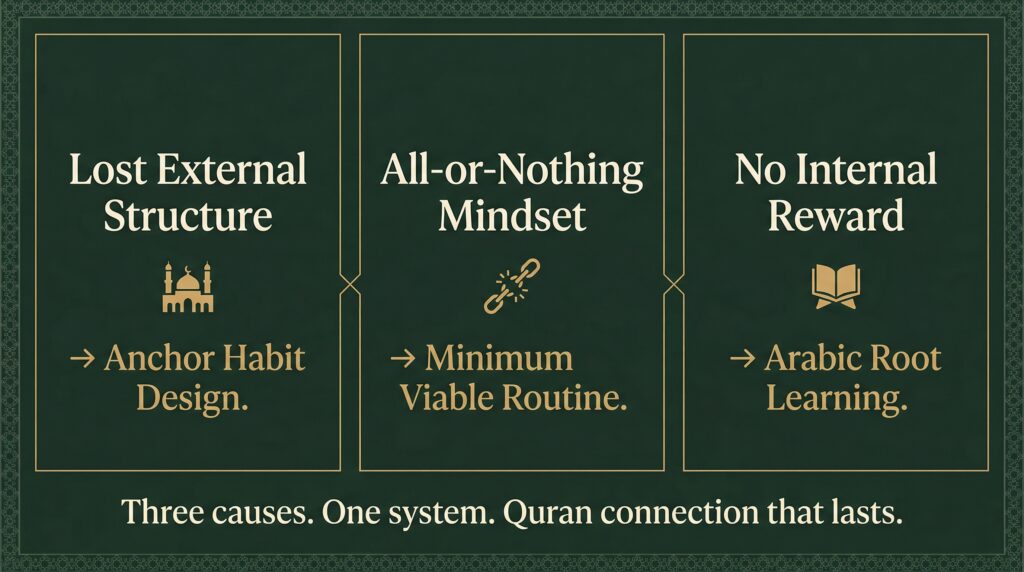
Each layer below directly addresses one of the three root causes above. They are designed to be used together as an integrated system, not picked apart as individual tips.
Layer 1 — The Anchor Habit
Addressing: Loss of External Structure
An anchor habit is a new behavior deliberately attached to an existing one you already perform automatically — without decision, without motivation, without thinking.
The most powerful Quran anchor available to every Muslim is this: Quran immediately after Fajr, before your phone is unlocked.
Not after breakfast. Not sometime during the morning. Immediately after the final salam of Fajr, before your screen lights up with the world’s demands.
This works because Fajr is the one Islamic practice that survived Ramadan intact. You still pray it. By attaching your Quran habit directly to it, you inherit Fajr’s existing consistency without needing to generate new motivation from scratch.
James Clear’s widely applied framework on identity-based habits describes this as “habit stacking” — the deliberate linking of a desired behavior to an established one, so the established behavior becomes the automatic trigger. The formula is elegantly simple:
“After I [existing habit], I will [new habit].”
After I pray Fajr, I will open my Quran. Every day. Even for five minutes. Without negotiation.
→ See exactly how to structure those five minutes: [The 5-Minute Quran Habit That Actually Sticks After Ramadan]
Layer 2 — The Minimum Viable Routine
Addressing: The All-or-Nothing Mindset Trap
A study published in the European Journal of Social Psychology tracked habit formation across 96 participants over 12 weeks. The average time for a behavior to become automatic was 66 days — not the commonly repeated 21. More significantly, the research found that missing one day had no statistically significant impact on long-term habit formation, provided the person returned the following day.
The enemy of your Quran habit is not a missed day. It is the narrative you construct about the missed day.
Your minimum viable routine is the smallest version of your Quran practice that you commit to protecting regardless of how full, tired, or distracted your day becomes. Not your ideal session. Your non-negotiable floor.
For most people, that floor is: one ayah, one root word, two minutes of quiet reflection, one short dua. Five minutes total.
On good days — and there will be many — you go longer. On the hard days, the overwhelmed days, the days when life crowds everything out, you do your five minutes and you have kept the chain unbroken.
The chain is everything. Protect it above all else.
Layer 3 — Arabic Root Learning as Internal Reward
Addressing: The Return of Shaytan / Absence of Intrinsic Motivation
Here is the honest truth that most Quran habit guides never say:
If your daily Quran time feels like a duty rather than a conversation — if it feels like obligation rather than discovery — then willpower and discipline alone will not sustain it through the ordinary months when Ramadan’s spiritual atmosphere is gone.
You need the habit to generate its own reward. You need intrinsic motivation, not just external accountability.
This is precisely where Arabic root learning changes everything — and why it is the third and most important layer of this system.
The Quran is architecturally built on a three-letter root system. Every word in the Quran traces back to a root that carries a core, living meaning. When you learn that root, you do not just understand one word. You unlock a family of words across hundreds of ayahs that you have been reciting for years.
Consider the root ص-ب-ر — the foundation of the word sabr, which we translate as patience. But the root carries a more physical, visceral meaning: to bind something tightly, to hold a shape under sustained pressure, to endure without breaking at the point of greatest strain.
Now return to every ayah that contains this root — “Inna Allaha ma’a al-sabireen” — and feel what shifts. This is not patience as passive resignation. This is patience as active, muscular, chosen holding. The kind that takes strength. The kind Allah is specifically with.
When you understand roots, you stop reading the Quran as a recitation. You begin reading it as a living address — words chosen with extraordinary precision, speaking directly to your exact situation.
That experience is its own reward. It does not require Ramadan’s atmosphere to feel meaningful. It does not need a community fast to feel worth returning to. It lives entirely inside your relationship with the text.
This is the internal motivation system that outlasts every external condition.
→ Explore the full Arabic Roots approach: [Link to Homepage / Program Introduction]
The Complete System at a Glance
The three layers are not independent tips. They are one integrated structure:
The anchor habit guarantees you show up every day by borrowing the consistency of a practice you already have. The minimum viable routine guarantees that showing up is always possible — that no day is too hard, too busy, or too far gone for the chain to survive. Arabic root learning guarantees that showing up feels genuinely rewarding — that the habit feeds itself through discovery and meaning rather than depending on discipline alone.
Hold all three together and you have built something that Ramadan alone — for all its extraordinary power — was never designed to give you: a Quran connection that is entirely, sustainably yours.
Your Two Next Steps
→ Join the June Arabic Roots Course Waitlist If this post has shown you that understanding Quranic Arabic is the missing layer in your post-Ramadan system — the June course was built precisely for you. Designed for non-Arab Muslims, complete beginners, busy parents, and anyone who has ever wanted to understand what they recite. Be first to know when enrollment opens and receive early access.
→ Share This With One Person Who Needs It You know exactly who came to mind while reading this. The friend who mentioned feeling disconnected after Eid. The parent who wants more for their children than beautiful recitation alone. The person whose Ramadan was full and whose Shawwal has gone quiet.
Send it to them today. Knowledge passed at the right moment is its own form of sadaqah jariyah.
May Allah make us among those whose connection to His words does not live and die with the crescent moon of Ramadan — but takes root quietly, grows in the ordinary months, and bears fruit in every season of the year. Ameen. 🌙
