
Who Is Prophet Muhammad ﷺ?
You know his name.
But do you know what his name means in Arabic — and how the root behind it shaped the identity of the man who carried it?
The Name Every Muslim Says — And Almost None Understand
Prophet Muhammad Arabic roots offer one of the most profound yet overlooked entry points into the seerah.
Here is the paradox worth sitting with. Every Muslim who prays says the Prophet’s name in the tashahhud. Every Muslim who hears the adhan hears it called from the minaret. Every Muslim who sends salawat speaks the name that the Quran says Allah Himself elevated:
“And We raised high your mention.”
— Surah Al-Inshirah, 94:4
His name ranks among the most spoken names in human history. It has crossed fourteen centuries, every language Islam has touched, and five daily prayers in every time zone simultaneously.
And yet the vast majority of those who say it have never been shown what it means. Not the surface meaning — some Muslims know it relates to praise. Rather, the root meaning — the linguistic architecture beneath the name that reveals why Allah chose it and what it describes. Furthermore, it connects to two other names that together give the most complete picture of who the Prophet ﷺ was.
Here are those three names. Here are their roots.
📌 Ghost Callout Block — Three-Name Root Breakdown Card
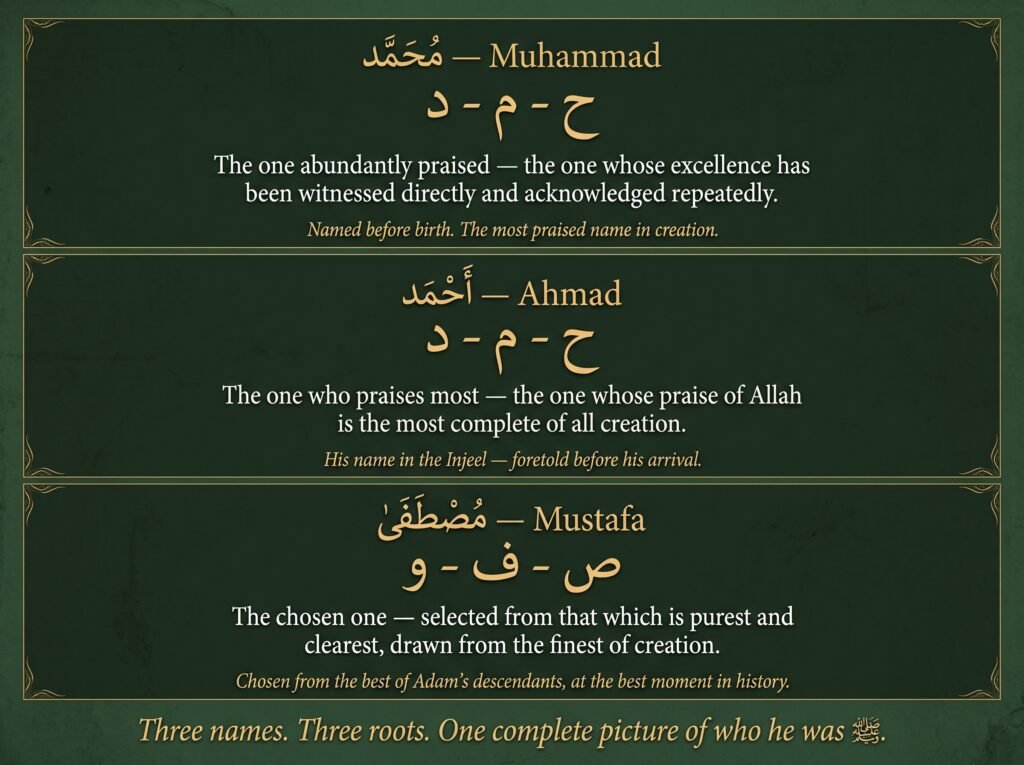
Three Names. Three Roots. One Complete Picture.
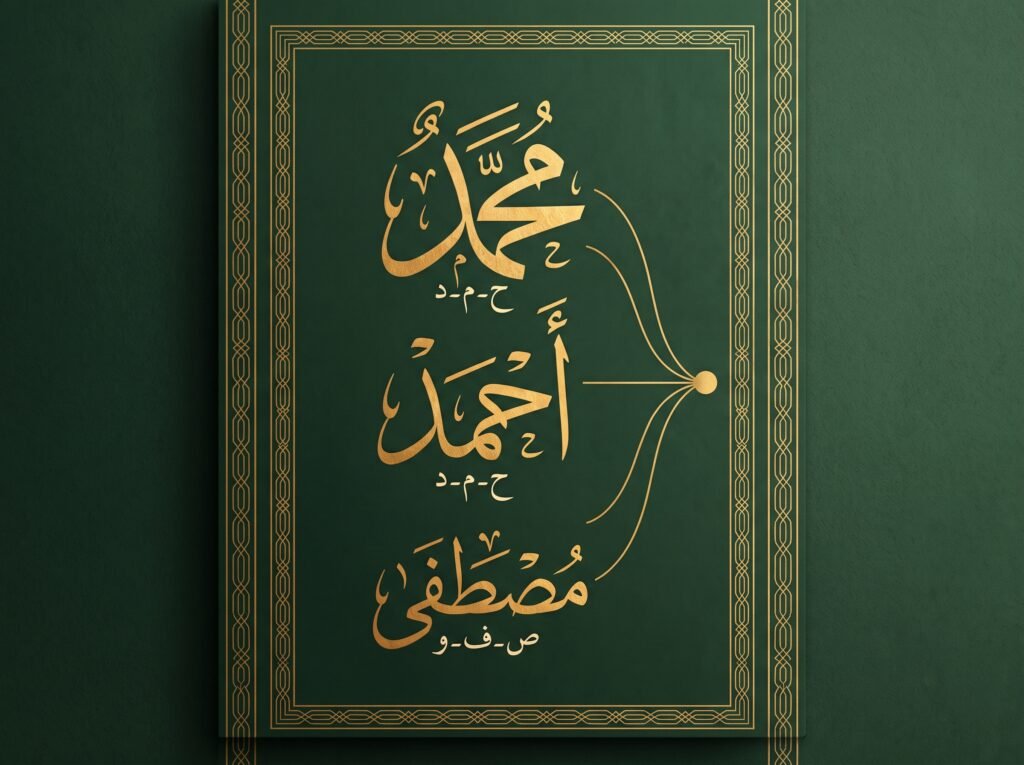
مُحَمَّد — Muhammad | Root: ح-م-د
The one abundantly praised — the one whose excellence witnesses have seen directly and acknowledged repeatedly.
Theological significance: Named before birth. The most praised name in creation — elevated by Allah Himself in the Quran.
أَحْمَد — Ahmad | Root: ح-م-د
The one who praises most — the one whose praise of Allah surpasses all of creation.
Theological significance: His name in the Injeel, foretold by Isa ﷺ before his arrival.
مُصْطَفَى — Mustafa | Root: ص-ف-و
The chosen one — selected from the purest and clearest, drawn from the finest of creation.
Theological significance: Chosen from the best of Adam’s descendants at the best moment in history.
Three names. Three roots. One complete picture of who he was ﷺ.
The First Name — مُحَمَّد (Muhammad)
The root ح-م-د is not the root of generic praise. This distinction matters enormously.
In Arabic, several roots describe different types of praise. The root م-د-ح (madh) describes flattery — praise given for social reasons regardless of genuine excellence. The root ث-ن-ي (thana) describes general commendation. ح-م-د, in contrast, is specifically the root of praise arising from direct witness. It is the acknowledgment of excellence by someone who encountered it personally and felt moved to declare it.
الحَمْد (al-hamd) — the praise that opens Al-Fatiha — is therefore not generic. It is witness-based. When a Muslim says Alhamdulillah, they are saying: “I have witnessed His excellence directly, and this is my acknowledgment of what I have seen.”
مُحَمَّد (Muhammad) is the intensive passive participle of this root. Grammatically, it means “the one who is praised abundantly and repeatedly by many who have witnessed his excellence directly.” It does not simply predict that people will think well of him. Rather, it describes the response of anyone who actually encounters him — they praise him, because witnessing his excellence makes praise the only adequate response.
Furthermore, his grandfather Abd al-Muttalib selected this name before his birth. When asked why he chose a name uncommon among the Arabs, Abd al-Muttalib said he hoped his grandson would be praised by those in the heavens and on earth. In this, he was guided to a name that described his grandson’s identity with extraordinary precision.
The Second Name — أَحْمَد (Ahmad)
أَحْمَد (Ahmad) comes from the same root — ح-م-د — but in a different grammatical form carrying a different dimension of meaning.
Where مُحَمَّد describes the Prophet ﷺ as the one who receives the most praise, أَحْمَد describes him as the one who gives the most praise. Specifically, it is the elative form — the superlative of حَامِد (one who praises). It means “the one who praises most completely — the one whose praising of Allah surpasses all of creation.”
Together, consequently, Muhammad and Ahmad capture a complete relationship. He is simultaneously the one who praises Allah most perfectly and the one praised most abundantly by those who know him. The Prophet ﷺ who said the most complete Alhamdulillah is also the Prophet ﷺ whose very name is the most complete expression of being praised.
Ahmad, moreover, is the name by which the Prophet ﷺ was foretold in the Injeel — the revelation given to Isa ﷺ. The Quran records:
“And when Isa son of Maryam said: O Children of Israel, I am the messenger of Allah to you — confirming what came before me of the Torah and bringing good news of a messenger who will come after me, whose name is Ahmad.”
— Surah As-Saf, 61:6
The Gospel of the previous prophet announced the coming one not by Muhammad but by Ahmad — the praiser. Before any description of his character or mission, his arrival was announced by the quality of his worship. This is significant. It tells us that what distinguished him above all else — even before his prophethood — was the completeness of his praise of Allah.
The Third Name — مُصْطَفَى (Mustafa)
مُصْطَفَى (Mustafa) comes from a completely different root — ص-ف-و (sad-fa-waw) — and it reveals the third dimension of his identity.
The root ص-ف-و carries the core meaning of clarity, purity, and the selection of the finest from what has already been purified. The verb اصْطَفَى (istafa) describes the act of drawing out the clearest and finest. Think of pure honey rising from the honeycomb, or clear water clarifying as sediment settles. From this same root come صَفَاء (safa — purity and clarity), صَفْوَة (safwah — the cream, the finest part), and الصَّفَا (as-Safa) — the hill in Mecca where Hajar RA ran, named for its clarity and purity.
المُصْطَفَى (Al-Mustafa) therefore describes not simply the act of being chosen from among equals. Instead, it describes selection from a prior process of purification — being drawn from what was already the finest, clearest, and most excellent.
The Prophet ﷺ described this selection process himself:
“Allah chose Ismail from the sons of Ibrahim, and He chose Kinana from the sons of Ismail, and He chose Quraysh from the sons of Kinana, and He chose Banu Hashim from Quraysh, and He chose me from Banu Hashim.”
— Sahih Muslim, 2276
Al-Mustafa is therefore not simply the one who was picked. He is the culmination of a chain of choosing that began with Ibrahim ﷺ — the one toward whom every prior selection was building.
Three Names — One Coherent Identity
Read together, the three names give a complete theological portrait.
Ahmad tells us about his relationship with Allah. Of all creation, his praise of Allah is the most complete. He is the servant who worships most perfectly.
Muhammad, in contrast, tells us about his relationship with those who encounter him. Of all creation, he is the most praised by those who witness him. He is the person whom knowing changes you.
Mustafa, finally, tells us about his origin. Of all creation, he was the most carefully selected — drawn from the finest lineage at the finest moment for the finest purpose.
Together, they answer the question at the heart of the seerah: who was he? He was the one who praised Allah most, the one witnesses praised most, and the one chosen most carefully from the finest of what existed.
Go Deeper — One Root at a Time
The root ح-م-د that gives us Muhammad and Ahmad also gives us Alhamdulillah — the phrase every Muslim says dozens of times every day. Understanding this root does not simply change what you know about the Prophet ﷺ. It changes what you experience every time you open Al-Fatiha, every time you send salawat, and every time you witness something of Allah’s beauty and feel the praise rise in your chest.
This is what root-based Arabic learning gives — not just knowledge, but a fundamentally different relationship with words you already know and love.
→ Explore the complete Arabic root method — and how 30 roots unlock 70% of the Quran: [Link to Arabic Roots Method Article]
→ Read about the Arabic words the Prophet ﷺ used most — and what their roots reveal: [Link to Arabic Words the Prophet Used Article]
Learn the Prophet’s ﷺ Language
→ Free Trial Class at roots-muslimschool.com
The Prophet ﷺ carried jawami al-kalim — the ability to express the deepest meaning in the fewest words. Every word he chose, every name he carried, and every phrase he repeated grew from a language whose architecture carries meaning at a depth that translation cannot reach.
Root-based Arabic learning gives you access to that depth. Start with the names you already say every day. Then expand outward into the Quran he was sent to deliver.
The first class is free. His language has been waiting.
May Allah make us among those who truly know his name — in its root, in its meaning, and in the love that deepens every time we understand something new about the one who carried it. Ameen. 🌙ot, in its meaning, and in the love that deepens every time we understand something new about the one who carried it. Ameen. 🌙
