
Muslim. Islam. Salaam. Why These Three Words Share the Same Arabic Root
The Arabic root SLM — three letters that contain an entire religion — connects the most fundamental words in Islam in a way most Muslims have never been shown.
Muslim. Islam. Salaam. All three come from the same three letters — س-ل-م. Understanding that connection, moreover, changes how you experience all three forever.
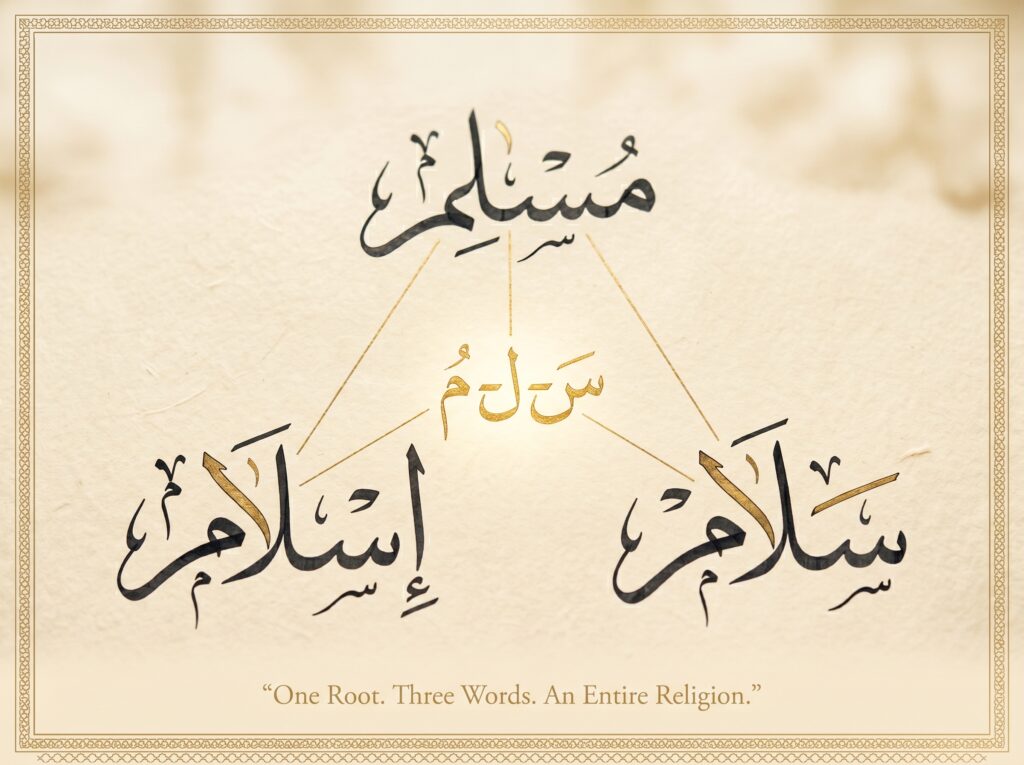
The Paradox That Most Muslims Never Notice
Here is something worth sitting with for a moment.
Billions of people — across every continent, in every language, in every generation since the seventh century — use the words Muslim, Islam, and Salaam every single day. They say them in prayer. They say them in greeting. They say them in introduction. They build their identity around them.
And yet the vast majority of those billions have never been shown that all three words are, in fact, the same word — the same three-letter root, expressing the same core meaning, simply manifested in three different grammatical directions.
This is not an obscure linguistic footnote. Rather, it is the single most revealing fact about the internal architecture of this deen. Once you see it, furthermore, you cannot unsee it. And everything you thought you knew about these three words quietly deepens into something far more extraordinary.
The Root — س-ل-م (Sin-Lam-Meem)
📌 Ghost Callout Block — Root Breakdown Card
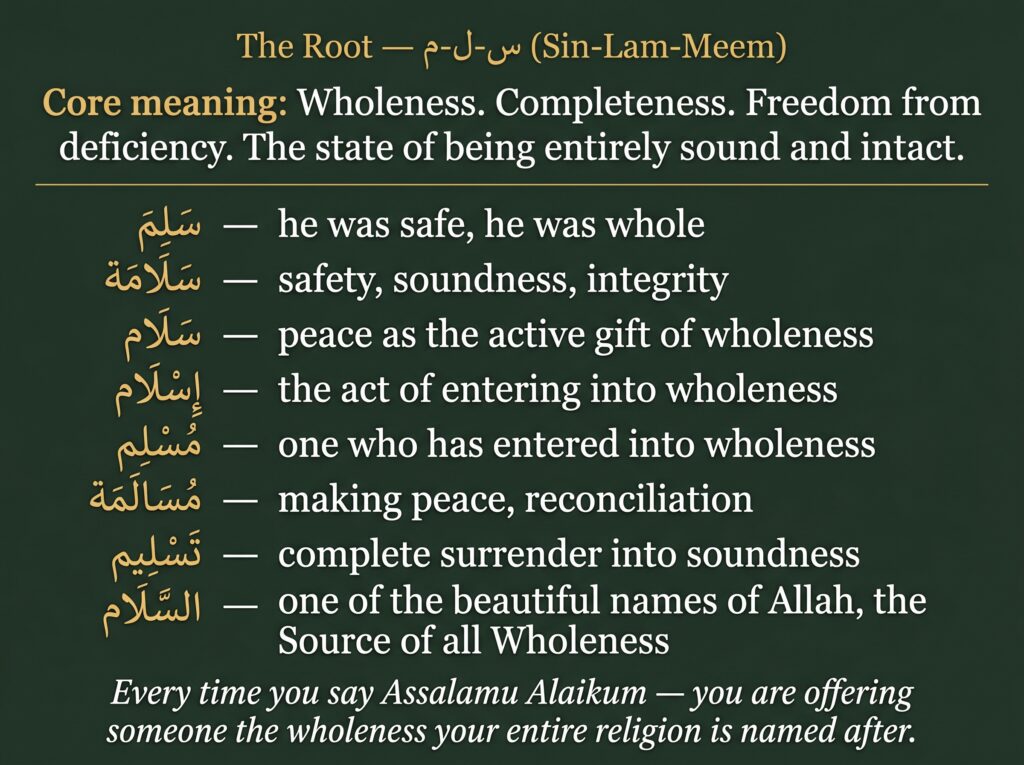
The Root — س-ل-م (Sin-Lam-Meem)
Core meaning: Wholeness. Completeness. Freedom from deficiency. The state of being entirely sound and intact — with nothing missing, nothing broken, nothing compromised.
| Arabic | Meaning |
|---|---|
| سَلِمَ | he was safe, he was whole |
| سَلَامَة | safety, soundness, integrity |
| سَلَام | peace as the active gift of wholeness |
| إِسْلَام | the act of entering into wholeness |
| مُسْلِم | one who has entered into wholeness |
| مُسَالَمَة | making peace, reconciliation |
| تَسْلِيم | complete surrender into soundness |
| السَّلَام | one of the beautiful names of Allah — the Source of all Wholeness |
Every time you say Assalamu Alaikum — you are offering someone the wholeness your entire religion is named after.
The root س-ل-م carries a meaning that English has no single word for. Specifically, it describes a state of being that is complete in every direction — whole, sound, free from deficiency, undamaged, intact. It is the opposite not simply of conflict, but of brokenness in any form.
From this single three-letter seed, consequently, the Arabic language generates an entire family of words — each one expressing a different facet of that same core wholeness. Three of those derivatives, in particular, became the foundation of an entire world religion and the daily vocabulary of 1.8 billion people.
The First Word — إِسْلَام (Islam)
Most people translate Islam as submission or surrender. Both translations are accurate. Neither, however, captures what the root reveals about what kind of submission Islam actually describes.
In English, submission carries connotations of defeat — of being forced into compliance, of reluctant yielding to a superior power. The root س-ل-م, however, carries no such connotation. Instead, it describes something fundamentally different: the voluntary act of placing oneself into a state of wholeness by aligning entirely with the One who is the source of that wholeness.
The specific verb form that gives us Islam is أَسْلَمَ (aslama) — to enter into salaam, to place oneself into soundness, to arrive at the condition of being complete. It is the act of a traveler who has been fighting the road, expending energy against the direction of travel, and who finally stops fighting and simply walks — not in defeat, but in the relief of alignment.
Islam, therefore, is not surrender in the sense of giving up. Rather, it is the act of choosing completeness over fragmentation — of placing the self into the wholeness that the self was designed for. Consequently, every time someone says I am a Muslim, they are saying: I am someone who has made that choice.
The Second Word — مُسْلِم (Muslim)
If Islam is the act of entering into wholeness, then a Muslim is the one who has made that act — and who continues to make it.
The word مُسْلِم is the active participle of the same verb. In Arabic grammar, an active participle describes not a completed past action but an ongoing present state — the one who is currently in the act of doing something, the one for whom the action is a defining characteristic.
A Muslim, therefore, is not simply someone who performed an act of submission at some point in the past. Rather, a Muslim is the one who is perpetually, actively, presently choosing wholeness — the one for whom entering into salaam is an ongoing identity, not a single historical moment.
This is why, furthermore, the Quran uses this word not just for the followers of Muhammad ﷺ but for the Prophets who came before him. Ibrahim ﷺ is described as a Muslim. Musa ﷺ prays to die as a Muslim. Yusuf ﷺ asks Allah to take his soul as a Muslim. In each case, the word is not describing a religious affiliation. Instead, it is describing an orientation — the ongoing, active choosing of wholeness and alignment with Allah over fragmentation and self-direction.
To call yourself a Muslim is consequently to claim something far more dynamic than a label. It is to say: I am, right now, in this moment, the one who keeps choosing this.
The Third Word — سَلَام (Salaam)
Of the three words, Salaam is perhaps the most familiar — and the most profoundly misunderstood in its depth.
Most people understand Salaam as a greeting meaning peace. This is accurate. It is, however, significantly incomplete — because peace in English typically means the absence of conflict. The word سَلَام, by contrast, describes something active, positive, and structural.
Specifically, Salaam is the noun form of the root س-ل-م — and it therefore carries the full weight of that root’s meaning: not merely the absence of war or conflict, but the presence of wholeness. The active, complete, deficiency-free state of being entirely sound and intact.
When you offer Salaam to another person, therefore, you are not simply saying I am not hostile toward you. Rather, you are saying something far more generous: I offer you wholeness. I offer you soundness. I offer you the state of being free from all deficiency and harm.
Furthermore, the full phrase reveals even more: Assalamu Alaikum — the wholeness be upon you. The definite article ال (al) before Salaam is not incidental. It specifies a particular wholeness — the wholeness, the complete and total soundness. You are not offering a generic good feeling. Rather, you are offering the specific, complete, total wholeness that the root describes.
And crucially, this is the same wholeness that Islam is named after. The same wholeness that a Muslim is defined by. The same wholeness that Allah embodies in His name Al-Salaam — the Source and Reality of all Salaam.
The Theological Constellation — Al-Salaam, Islam, Muslim, Salaam
When you step back and look at all four together, something extraordinary emerges.
Allah is Al-Salaam — the Source and Reality of all wholeness. He is not simply peaceful. Rather, He is the Origin from which all wholeness proceeds.
Islam is the path of entering into that wholeness — the act of aligning with the Source by placing the self entirely in His direction.
A Muslim is the one who walks that path — the ongoing, active, present-tense chooser of that wholeness over everything else.
Salaam is what Muslims offer each other as they walk it — the gesture of passing the wholeness forward, of giving to the person in front of you the same gift that defines your entire relationship with your Creator.
This is not four separate concepts. It is one concept — one root, one core meaning — expressed in four related directions. The religion, the believer, the greeting, and the divine name are, consequently, all facets of the same three letters.
Assalamu Alaikum, therefore, is not a casual hello. It is, in the fullest linguistic sense, a Muslim offering another Muslim the core gift of the entire deen — the wholeness that Allah embodies, that Islam is the path toward, and that every Muslim is defined by the choice to pursue.
What This Means Every Time You Open Your Mouth
Consider, for a moment, how many times you say Assalamu Alaikum in a single day.
To your spouse in the morning. To your children before they leave for school. To your colleagues. To the person you pass in the masjid corridor. To the WhatsApp group. At the end of every salah.
Each one of those moments, in the root meaning of the words, is an act of offering. You are not simply acknowledging another person’s presence. Rather, you are actively giving them something — the wholeness, the soundness, the state of being free from deficiency that your religion is built upon and named after.
The Prophet ﷺ instructed his Companions to spread salaam widely — afshu al-salaam baynakum — spread salaam between yourselves. In the root meaning of those words, he was instructing his community to spend their days offering each other wholeness. To make every greeting an act of giving the most fundamental thing one human being can give another.
This is what Arabic root learning does. It does not simply teach you vocabulary. Instead, it reveals that the words you have been using all your life were always carrying more meaning than you knew — and that the language of the Quran has been saying something deeper than translation could reach, every single time you opened your mouth.
Go Deeper — One Root at a Time
The root س-ل-م is one of the thirty highest-frequency root families in the Quran. Master thirty roots like this one, and furthermore, you unlock access to approximately 70% of the words you will encounter across the entire Quran.
→ Watch the Arabic Word Mystery series on TikTok — see roots like this one come alive with live Quranic examples: [Link to TikTok] → Follow the Instagram Arabic roots carousel — one root, one family, every week: [Link to Instagram] → Watch Arabic From Zero on YouTube — the complete beginner’s guide to root-based Quran learning: [Link to YouTube]
Your Next Steps
→ Share With a Friend Learning Arabic You know someone who would stop mid-scroll at the connection between Muslim, Islam, and Salaam. Send this to them. A root understood is a gift that stays — every salah, every greeting, every time they open the Quran for the rest of their life.
→ Follow for Daily Arabic Roots Every day: one root, one family, one revelation from the language the Quran was revealed in. Follow so you never miss one.
May Allah — Al-Salaam, the Source of all wholeness — make us true Muslims: people who keep choosing wholeness, who walk the path of Islam with their whole selves, and who offer genuine Salaam to everyone we meet along the way. Ameen. 🌙
