
Islamic Habits Consistency:A 5-Minute Daily Islamic Home Routine
Islamic habits consistency begins with something smaller than most Muslims expect.
Five minutes. One anchor. Three practices. Here is the daily home routine that behavioral science says will outlast every weekend seminar you have ever attended — and that the Sunnah has been recommending for 1,400 years.

Why Five Minutes Is Not a Compromise — It Is the Strategy
Before we get to the routine itself, there is one mindset shift that makes everything else work.
Most Muslim households approach Islamic home education the same way. They aim for the ideal — daily Quran reading, regular Islamic discussions, consistent Arabic learning — and when life gets busy, the ideal collapses entirely.Nothing happens at all. The all-or-nothing trap closes, and another week passes without any consistent Islamic practice in the home.
Behavioral science has a clear answer to this pattern. BJ Fogg, a researcher at Stanford whose work on habit formation has influenced the field for two decades, found in his research that habits form most reliably when they are made as small as possible — small enough that the question of whether to do them never arises. The habit becomes, in his framework, non-negotiable precisely because it is never demanding.
This aligns precisely with the most repeated principle in Islamic habit literature:
“The most beloved deeds to Allah are those done consistently, even if they are small.” — Sahih Bukhari, 6464 & Sahih Muslim, 783
Five minutes is therefore not a reduced version of the ideal. Rather, it is the ideal — specifically because it is the version that survives every type of day, every season of life, and every level of spiritual energy you will ever have.
The Anchor — Why Fajr Is the Key to Everything
Every habit needs an anchor — an existing behavior that automatically triggers the new one.
In behavioral science, this is called habit stacking: the deliberate linking of a new behavior to an established one so that the established behavior becomes the automatic trigger. The formula is simple: after I do X, I will do Y.
For a Muslim household, the most powerful anchor available is already present in every home: Fajr prayer.
Fajr is the one Islamic practice most Muslims already perform consistently — even in the hardest seasons. It happens at a fixed time. It creates a natural moment of stillness and presence. And immediately after the final salam of Fajr, before phones are unlocked and the day’s noise begins, there is a window of approximately five minutes that belongs entirely to whatever you choose to place inside it.
Place your Islamic home routine inside that window. Specifically, immediately after Fajr, before anything else. Not after breakfast. Not sometime in the morning. Immediately — while the stillness is still there.
This single decision removes the need for motivation, scheduling, or willpower. After I pray Fajr, I do the routine. Every day. Without negotiation.
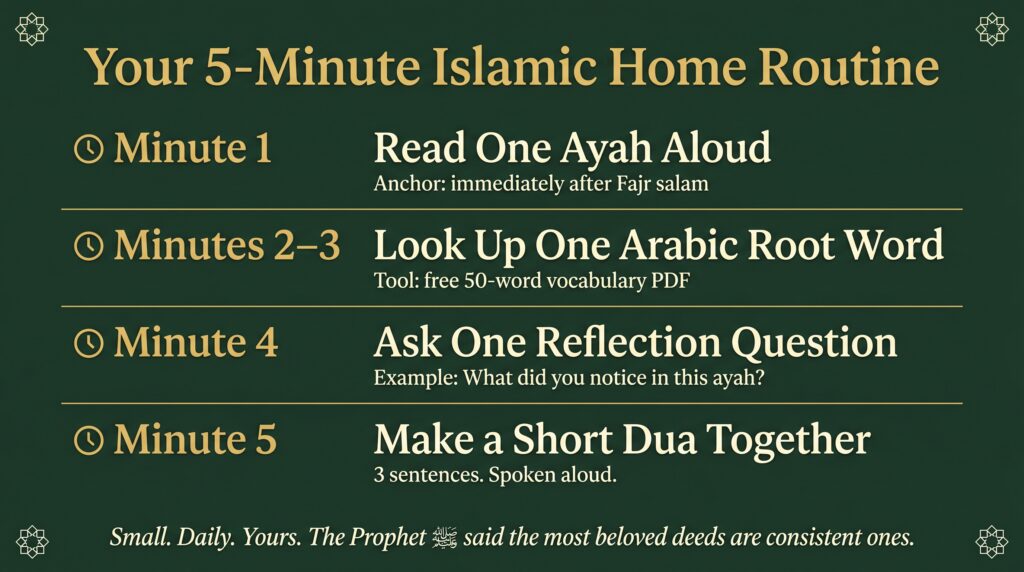
The Complete 5-Minute Routine
⏱ Minute 1 — Read One Ayah Aloud
What you do: Open your Quran to wherever you left off. Read one single ayah — aloud, slowly, in Arabic. If you are with family, one person reads while others listen. If you are alone, read to yourself or to the quiet room.
The behavioral science: Auditory encoding — hearing yourself produce language — creates stronger neural pathways than silent reading alone. Reading aloud in a household with children creates an environmental cue that signals: in this home, Quran is spoken out loud. Over time, that cue becomes part of the home’s identity.
The Sunnah it reflects: The Prophet ﷺ regularly recited Quran after Fajr. Surah Al-Isra (17:78) specifically references the Quran of Fajr — inna qur’anal fajri kana mashhuda — indeed the Quran of Fajr is witnessed. Even one ayah, recited consistently at this time, is therefore an act of profound alignment with prophetic practice.
The one rule: Do not skip this minute because the ayah feels too short or too familiar. Consistency, not volume, is the entire point.
⏱ Minutes 2–3 — Look Up One Arabic Root Word
What you do: Take one word from the ayah you just read. Open the free 50-word Quranic vocabulary PDF. Find the root. Read the core meaning aloud. If you are with family, discuss it briefly — one or two sentences is enough.
The behavioral science: This step activates what researchers call elaborative encoding — the process of connecting new information to existing knowledge rather than storing it in isolation. When you connect an Arabic root to an ayah you already know, the meaning becomes structurally embedded rather than surface-level memorized. The discussion component — even a single exchange — doubles retention through social encoding.
The Sunnah it reflects: The Companions of the Prophet ﷺ were famously careful to understand what they recited. Ibn Mas’ud reported that a group of them would not move on from ten ayahs until they had understood their meaning and acted upon them. The root word step, moreover, is the minimum viable version of this practice — understanding one word, one root, one morning at a time.
The one rule: Use the free PDF as your reference. It removes the need to search, decide, or spend time finding a resource — both of which are habit-killing friction points.
→ Download the free 50-word Quranic vocabulary PDF here — your companion for this step every morning
⏱ Minute 4 — Ask One Reflection Question
What you do: Ask one question about what you just read and the root you just explored. Answer it briefly — one or two sentences, spoken aloud. If you are alone, think it silently or write it in a small notebook. If you are with family, let whoever wants to answer do so.
The behavioral science: Reflection questions activate the prefrontal cortex — the part of the brain responsible for meaning-making and long-term memory consolidation. Research on spaced retrieval practice shows that the act of answering a question about content you have just encountered dramatically increases retention compared to passive re-reading. In other words, asking what does this mean? is neurologically more powerful than reading the same passage twice.
Suggested reflection questions to rotate through:
- What does this ayah make me feel?
- What did the root meaning add to what I understood before?
- Does this ayah speak to anything I am going through right now?
- What is one way I could carry this into today?
The Sunnah it reflects: Tadabbur — deep reflection on the Quran — is explicitly encouraged throughout the Quran itself. “Do they not reflect upon the Quran?” (Surah An-Nisa, 4:82). One minute of genuine reflection, done consistently, is more aligned with the Quranic invitation to tadabbur than an hour of reading without engagement.
The one rule: There are no wrong answers. The value of this minute is in the asking, not the sophistication of the response.
⏱ Minute 5 — Make a Short Dua Together
What you do: Make a short dua — three sentences maximum, spoken aloud. If alone, speak it quietly to yourself. If with family, one person leads while others say ameen. The dua can relate to what you just read, or it can simply be whatever is most present in your heart that morning.
The behavioral science: Closing a routine with a positive, meaningful action creates what researchers call a reward signal — a neurological marker that tells the brain the routine was worth completing. This reward signal is what makes the brain want to repeat the behavior the following day. The more meaningful the closing action feels, the stronger the signal. Dua — the most direct act of connection to Allah available to a Muslim — is neurologically the ideal closing action for an Islamic home routine.
The Sunnah it reflects: The Prophet ﷺ made dua consistently after prayer and at the start of every significant action. Dua after Fajr carries particular weight in prophetic tradition — it is a time of barakah, a time when the doors of mercy are open and the day has not yet begun to close them.
The one rule: Keep it short. Three sentences is not a limitation — it is a discipline that keeps the habit sustainable and the dua sincere.
Three Versions — One for Every Household
📌 Ghost Toggle Block — Individual Version
For the Muslim living alone or practicing without family:
- Minute 1: Read one ayah aloud to yourself — hearing your own voice reciting matters
- Minutes 2–3: Look up the root in the PDF — write it in a small notebook with one line of meaning
- Minute 4: Write one sentence of reflection in the notebook — even a question counts
- Minute 5: Three sentences of dua spoken quietly aloud — the room hears it even when no one else does
📌 Ghost Toggle Block — Couple Version
For Muslim couples practicing together:
- Minute 1: Alternate who reads the ayah each morning — both voices, both in the Quran
- Minutes 2–3: One partner finds the root, the other reads the meaning — discuss in one exchange
- Minute 4: Each partner answers the reflection question in one sentence — no pressure to agree
- Minute 5: One partner leads the dua, the other says ameen — rotate each morning
📌 Ghost Toggle Block — Family with Children Version
For Muslim families with children of any age:
- Minute 1: The child reads the ayah if they can — otherwise the parent reads and the child repeats one phrase
- Minutes 2–3: Show the child the root letters in the PDF — ask them to guess what the word might mean before revealing it
- Minute 4: Ask the child the reflection question first — their answer is always the most honest one in the room
- Minute 5: The child leads the dua — even if it is three words, it is theirs
Start Tomorrow Morning
The routine is complete. Everything you need is already available. The anchor — Fajr — is already in your life.
Tomorrow morning, after the final salam of Fajr, before your phone is unlocked, before the day begins: open the Quran, open the PDF, ask one question, make three sentences of dua.
Five minutes. That is all.
And the Prophet ﷺ already told you what Allah thinks of consistent small deeds. Now you simply have to begin.
Your Next Steps
→ Follow for Daily Islamic Habit Reminders Every day: one root, one reflection, one small practice to anchor your Islamic consistency. Follow so you never lose the thread.
→ Share With a Muslim Looking for Sustainability You know someone whose Islamic practice keeps starting and stopping. Someone who wants consistency but keeps aiming for the ideal and missing. Send them this routine. Five minutes is something everyone can do — they simply needed someone to show them how.
May Allah make our homes places where His words are spoken every morning, where His names are known by our children, and where five minutes after Fajr become the most beloved minutes of every day. Ameen. 🌙
