
Tariq ibn Ziyad History: The Muslim General Who Named Gibraltar
The history of Tariq ibn Ziyad begins with one of the most
audacious decisions in military record.
He crossed a sea, burned his ships so no one could retreat,
and delivered one of history’s most powerful speeches.
Then he built a civilization that lasted 700 years.
The mountain he crossed toward — the mountain that watched
him land on European shores with nothing but faith and
forward momentum — still carries his name today. In fact,
you say it every time you say the word Gibraltar.
The Morning That Changed the Map of the World
It is 711 CE. Ramadan has just ended.
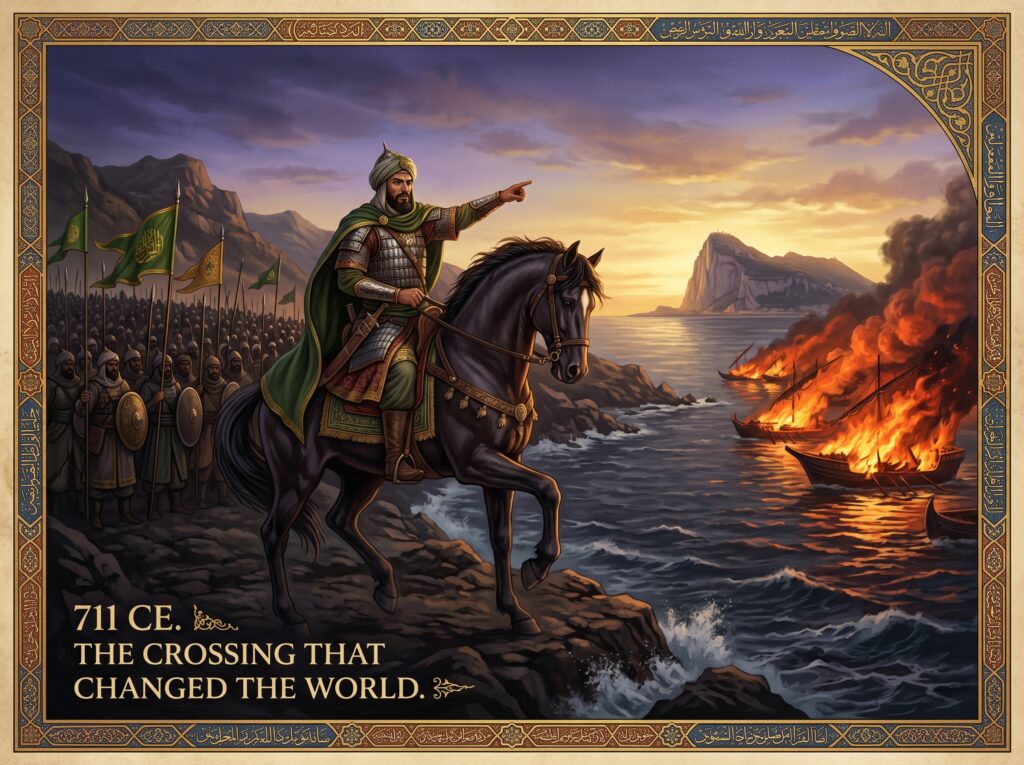
On the southern shores of a narrow strait, 7,000 soldiers stand watching fire consume the last of their ships. The flames are not accidental. Rather, the order came from their commander — a Berber general named Tariq ibn Ziyad, who understood something about human psychology that most military strategists never learn:
When retreat is impossible, the only direction left is forward.
Behind them lies the dark water of the strait they had just crossed from North Africa. Ahead stands the Iberian Peninsula — vast, fertile, ancient, ruled by the crumbling Visigothic Kingdom. To the right, meanwhile, a massive rock formation rises from the coastline like a sentinel, watching everything.
Tariq looked at that rock. The rock looked back at him.
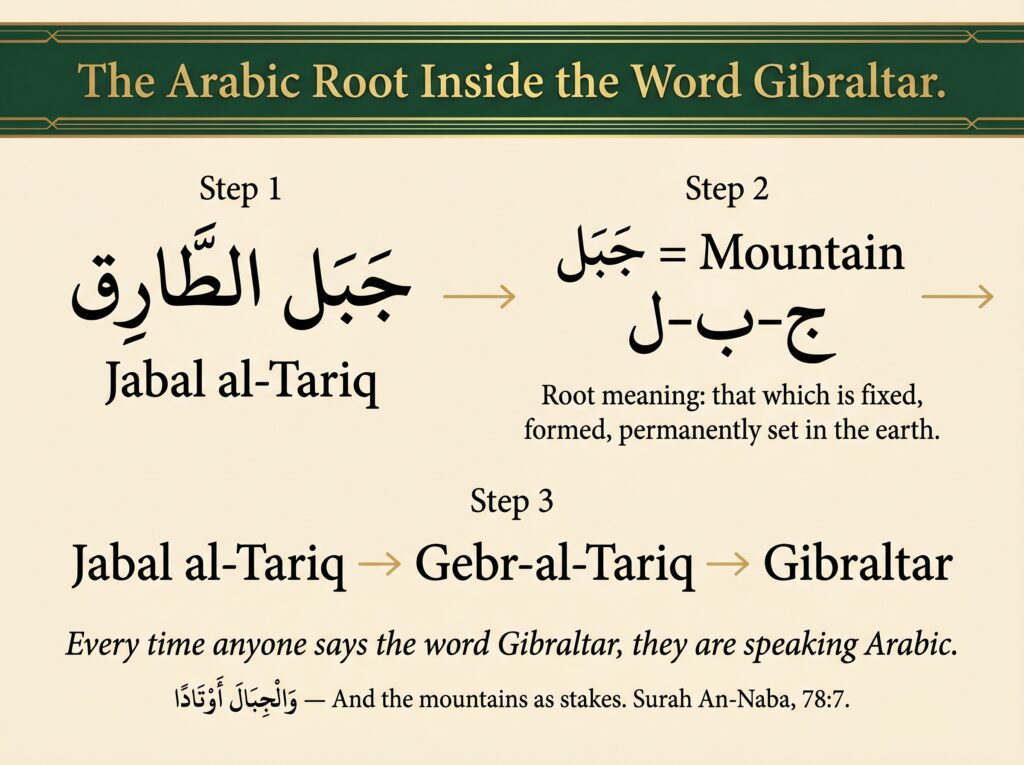
Consequently, he named it after himself. Jabal al-Tariq — the Mountain of Tariq. Over the following centuries, European tongues gradually wore that Arabic phrase down: Jabal al-Tariq became Gebr-al-Tariq, then Gebraltar, then the word every map in the world carries today — Gibraltar.
The mountain still holds his name. It will hold it forever.
Who Was Tariq ibn Ziyad — Before the Legend
History remembers Tariq ibn Ziyad as a conqueror. His origins, however, tell a more remarkable story than his conquests.
Tariq was Amazigh — Berber — from the indigenous people of North Africa who had inhabited the Maghreb long before Arab armies arrived carrying Islam westward. By most historical accounts, he was also a freed slave — a mawla — who had converted to Islam and entered the service of Musa ibn Nusayr, the Umayyad governor of North Africa.
This detail matters enormously.
Tariq did not come from Arab aristocracy. Nor did he inherit his position through lineage or tribal prestige. Instead, he rose through competence, character, and the trust of a leader who recognized his worth. By the time Musa ibn Nusayr needed someone to lead the most daring military crossing in Islamic history, therefore, the man he chose was not a noble Arab general.
He was a Berber convert, a freed slave, and the most capable soldier in the entire command.
This is the man who named Gibraltar.
The Strategic Genius of the Crossing
The decision to cross into Iberia in 711 CE was not impulsive. On the contrary, it was the product of years of political intelligence, a formal invitation from Visigothic dissidents, and a careful reading of the moment.
The Visigothic Kingdom was fracturing from within. A disputed succession had split the nobility into factions. Furthermore, King Roderic had enemies inside his own court who were actively seeking outside allies. Julian, governor of Ceuta — a Christian leader with grievances against Roderic — had been providing intelligence to Musa ibn Nusayr for years.
When Tariq crossed in April of 711, therefore, he was not walking blindly into unknown territory. He crossed with maps, local knowledge, and political contacts on the other side. He also carried the calculated understanding that the kingdom ahead was already breaking.
Notably, he crossed with only cautious, limited authorization from Caliph Al-Walid ibn Abd al-Malik — permission for a reconnaissance mission, not a full conquest. What followed was, by any historical measure, one of the most spectacular military overperformances ever recorded.
The Speech Before Battle
Before the first engagement on Iberian soil, Tariq gathered his soldiers and delivered a speech that historians still study 1,300 years later.
The exact text exists in multiple historical sources with variations — as is common with pre-modern oral transmission. Nevertheless, its essential architecture has been preserved across Arabic historical sources, and it remains among the most studied pieces of military oratory in Islamic history.
The speech did what great oratory has always done — but in a distinctly Islamic register.
Tariq did not tell his soldiers the enemy was weak. Instead, he told them the sea was behind them. He did not promise easy victory. Rather, he reminded them of the purpose that had carried them across the water. Above all, he did not appeal to their courage or pride — he appealed to their understanding of why they were there.
In one of the most quoted passages, he is reported to have said:
“The sea is behind you and the enemy is before you. By Allah, you have nothing but truth and patience.”
This is a speech built on the Islamic understanding that courage is not the absence of fear. Rather, it is the presence of purpose. The soldiers who heard it understood exactly what it asked. They answered it on the battlefield.
The Lightning Conquest
What followed was breathtaking in its speed.
The Battle of Guadalete in July 711 — the decisive engagement between Tariq’s forces and King Roderic’s army — lasted several days. Ultimately, it ended with the complete collapse of Visigothic military resistance. Roderic himself died in the battle or its immediate aftermath. His kingdom, which had stood for two centuries, consequently ceased to exist in a single summer.
Tariq’s advance through Iberia was equally extraordinary. Within months of landing, his forces had taken Córdoba and Toledo — the Visigothic capital. Moreover, they were pushing deep into the heart of the peninsula. City after city capitulated, often without significant resistance, partly because Tariq had established a reputation for treating civilian populations with justice.
By the time Musa ibn Nusayr crossed from North Africa with a larger force — reportedly displeased that his general had so dramatically exceeded his authorization — Tariq had already changed the map of the known world.
He was later summoned to Damascus by Caliph Al-Walid, along with Musa. After that, the historical record of his life becomes sparse and contested. He disappears from the sources — as great figures sometimes do — having done precisely the thing he was made to do.
📌 Ghost Callout Block — Etymology Card
The Arabic Root Inside the Word Gibraltar
جَبَل الطَّارِق → Jabal al-Tariq
جَبَل = Mountain Root letters: ج-ب-ل Root meaning: that which is fixed, formed, permanently set in the earth — that which cannot be moved
Jabal al-Tariq → Gebr-al-Tariq → Gibraltar
Every time anyone says the word Gibraltar — in any language, in any century, anywhere on earth — they are speaking Arabic. They are saying the name of a Muslim general who stood on a shore in 711 CE and decided to move forward.
“وَالْجِبَالَ أَوْتَادًا — And the mountains as stakes.” — Surah An-Naba, 78:7
The Civilization That Followed
What Tariq ibn Ziyad began in 711 CE became something the world had rarely seen before.
Al-Andalus — Islamic Iberia — lasted in various forms for nearly 800 years. At its height, under the Umayyad Caliphate of Córdoba in the 10th century, it was the most sophisticated civilization in the Western world by almost any measurable standard.
Córdoba had a population estimated at over 500,000. London, by comparison, held perhaps 15,000 people at the same time. The city had 300 public baths, 70 libraries, and street lighting — amenities the rest of medieval Europe would not see for centuries. Furthermore, the royal library of Caliph Al-Hakam II held an estimated 400,000 manuscripts when the largest libraries in Christian Europe held a few hundred.
Muslim, Jewish, and Christian scholars worked side by side in Córdoba. Together, they translated Greek philosophy, advanced mathematics and medicine, and produced the intellectual foundations on which the European Renaissance would later build. The works of Aristotle, for instance, returned to European thought through Arabic translations made in Al-Andalus. The algebra underpinning modern mathematics, similarly, bears an Arabic name — al-jabr — that came directly from scholars Tariq’s crossing made possible.
Moreover, the Arabic language — the language of the Quran, carried across the strait by Tariq’s soldiers — planted itself so deeply into Iberian soil that it still grows there today.
Consider the evidence: Spanish words like alcohol (al-kuhl), algebra (al-jabr), algorithm (from Al-Khwarizmi), azul (blue, from lazaward), almohada (pillow, from al-mukhadda) — hundreds of Spanish words carry Arabic roots that have never been translated out of them.
The civilization is gone. The language it planted, however, is still speaking.
What Tariq’s Story Says to Muslims Today
Tariq ibn Ziyad was Berber, not Arab. He was a convert, not born into Islam. Furthermore, he was a freed slave who became the architect of an 800-year civilization.
His story is, therefore, a direct and permanent answer to anyone who has suggested that Islamic greatness belongs to one ethnicity, one background, or one type of Muslim.
The Arabic language — the language Tariq’s civilization spread across Europe, that still lives inside Spanish and Portuguese to this day — was never the private property of the Arab world. Instead, it was carried by a Berber general across a narrow sea, planted in European soil, and left there for thirteen centuries.
Ultimately, it belongs to every Muslim who learns it. It always has.
→ Explore how the Arabic root system works — and why 30 roots unlock 70% of the Quran: [Link to Arabic Root System Anchor Post]
→ Start your root learning journey with the free vocabulary PDF: [Link to Free PDF Page]
Share This History
History like this deserves to travel.
→ Share this post with a Muslim who loves Islamic history — in your family group chat, your Islamic studies circle, or your community feed.
→ Subscribe to the Islamic history series — Al-Andalus, the scholars of Córdoba, the Arabic roots that Europe never erased, and the stories of the people who carried this deen across continents and centuries.
→ Follow on social for daily Islamic history posts — one story, one root, one piece of the civilization that shaped the world.
May Allah have mercy on Tariq ibn Ziyad — the freed slave, the Berber convert, the general who burned his ships and moved forward. And may He make us people who carry what he carried: not an army, but a language, a book, and the unshakeable conviction that truth moves forward even when the sea is behind you. Ameen. 🌙
