
6 Names of Allah to Connect With Deep Arabic Root Meanings
Each of Allah’s 99 names carries a root meaning that goes far deeper than any English translation.
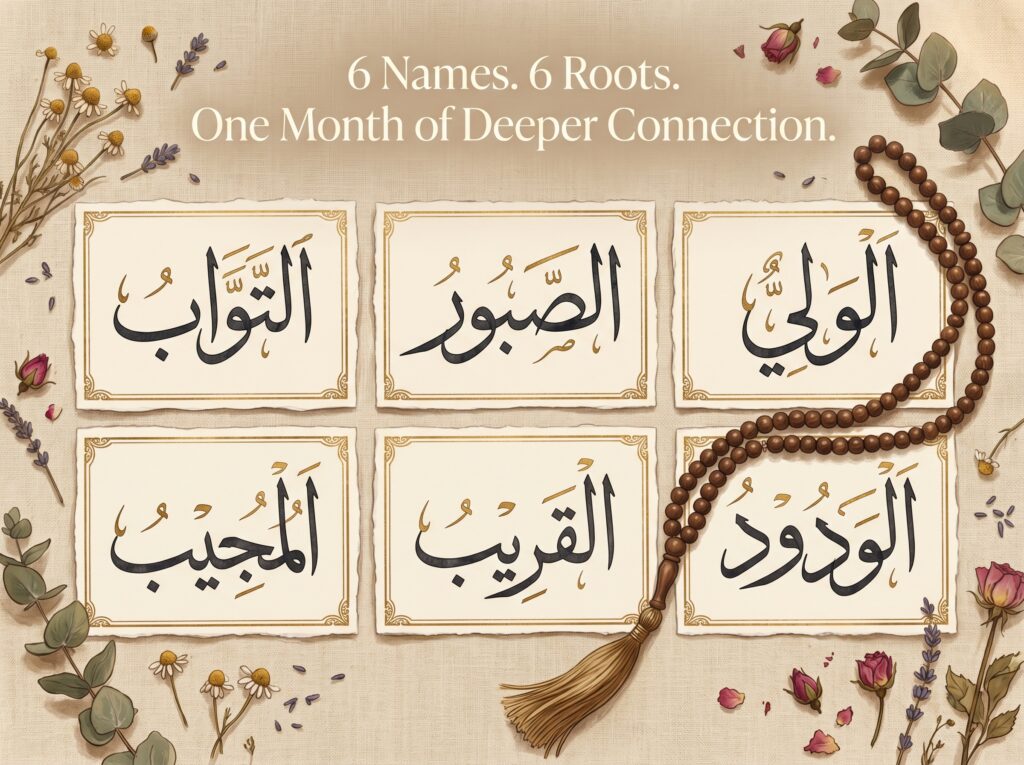
When we say Al-Rahman — The Most Merciful — and leave it there, we have touched the surface of something vast. The Arabic root beneath that name reaches into the physical, the visceral, the most intimate image of protection and enveloping care that the Arabic language possesses. The translation is not wrong. But it is standing at the door of a room it has not yet entered.
This month — in the weeks of Shawwal that follow Ramadan, in this season of return and renewal and gentle rebuilding — here are 6 names of Allah to sit with. Not just to read. To enter.
For each name: the Arabic, the root letters, what the root actually means, where it appears in the Quran, and a reflection to carry into your daily life.
1 — التَّوَّاب — Al-Tawwab
The Ever-Returning in Mercy
Root letters: ت-و-ب (ta-waw-ba)
Core root meaning: To turn. To reverse direction completely. To return to a place of origin.
The root ت-و-ب does not simply mean repentance in the way we typically understand it — as a human act of remorse and apology. It describes a physical turning, a complete reversal of direction, a returning to where one originally belonged.
And here is what changes everything: the name Al-Tawwab is not describing you turning back to Allah. It is describing Allah perpetually turning back toward you. The verb form — the faa’al pattern of التَّوَّاب — indicates intense, repeated, continuous action. Allah is the One who turns toward His servant again and again and again, meeting every act of tawbah with a divine turning that was already on its way.
In the Quran: “Then He turned toward them so they could repent. Indeed, Allah is Al-Tawwab, Al-Raheem.” — Surah Al-Baqarah, 2:128
Reflection: In the weeks after Ramadan, when you feel the distance between who you were in those blessed nights and who you are in the ordinary days that followed — this is the name for that feeling. Not as an accusation. As an invitation. Every time you turn, He has already turned. Every single time.
2 — الصَّبُور — Al-Sabur
The Infinitely Patient
Root letters: ص-ب-ر (sad-ba-ra)
Core root meaning: To bind tightly. To hold a shape under sustained pressure. To endure without breaking at the point of greatest strain.
The English word “patient” carries a quality of waiting quietly, of not reacting. The root ص-ب-ر carries something far more active and structural. It describes the strength of something that holds its form under force — the binding of a wound, the setting of a bone, the discipline of an archer holding still at full draw.
Al-Sabur is not Allah waiting passively. It is Allah holding — with structural, active, chosen strength — in the face of every act of human disobedience, every ingratitude, every delay. And crucially, it is a name that models for us what our own sabr is meant to look like.
In the Quran: The root ص-ب-ر appears over 90 times across the Quran — in “Inna Allaha ma’a al-sabireen” — Indeed, Allah is with those who hold firm. — Surah Al-Baqarah, 2:153
Reflection: When the post-Ramadan rebuild feels slow — when the habits you are building take longer than you hoped, when the consistency you want keeps slipping — connect with Al-Sabur. He is not watching impatiently. He is the very definition of holding firm. And He is with those who hold firm alongside Him.
3 — الوَلِيّ — Al-Wali
The Protecting Friend
Root letters: و-ل-ي (waw-lam-ya)
Core root meaning: To be close. To be adjacent. To be the one who stands immediately beside. The root carries the image of proximity so close that no gap exists between the two.
Al-Wali is often translated as Guardian or Protector — and both are true. But the root reveals something warmer and more intimate than either word fully captures. A wali is not a distant protector watching from above. A wali is the one standing immediately beside you — so close that the protection is a function of presence, not intervention from a distance.
This is the same root that gives us the word for a child’s guardian, for the closest friend, for the one who has rightful, loving authority through nearness. Allah as Al-Wali is Allah as the One who is simply, structurally, always immediately beside you.
In the Quran: “Allah is the Wali of those who believe — He brings them out of darkness into light.” — Surah Al-Baqarah, 2:257
Reflection: On the days when the spiritual high of Ramadan feels far away and the ordinary days feel spiritually thin — remember that Al-Wali has not moved. The distance you feel is not spatial. He is immediately beside you in this ordinary Tuesday the same way He was beside you in the last ten nights. The name says so.
4 — المُجِيب — Al-Mujib
The One Who Responds
Root letters: ج-و-ب (jeem-waw-ba)
Core root meaning: To answer. To cut through. To pierce across a distance and reach. The root carries the image of a response that travels — that crosses the space between the caller and the One called.
Al-Mujib is not simply the One who hears. Every name of Allah that includes hearing is a separate name — Al-Sami. Al-Mujib is specifically, precisely, the One who responds. The One whose answer is already traveling toward you before your dua is complete.
The verb form of this name — the muf’il pattern — indicates that the response is active and ongoing. Allah is perpetually in the state of responding. Not waiting to decide whether to answer. Already answering. Already in the act of response.
In the Quran: “And when My servants ask you about Me — indeed I am near. I respond to the call of the caller when he calls upon Me.” — Surah Al-Baqarah, 2:186
Reflection: Make dua this month knowing you are not sending a message into silence. You are calling to Al-Mujib — the One whose defining characteristic is that He responds. The question is never whether He will answer. The question is whether we are listening for the answer in the form it actually arrives.
5 — القَرِيب — Al-Qarib
The Near
Root letters: ق-ر-ب (qaf-ra-ba)
Core root meaning: To be close. To draw near. To be within reach. The root describes physical and relational proximity — the nearness of something that can be touched, that is within the span of a reach, that does not require crossing a great distance to access.
Al-Qarib is perhaps the most quietly revolutionary of the Names — because it directly addresses the most common spiritual experience of feeling far from Allah. The name is not a promise that Allah will become near if you do enough. It is a description of what He already is. Al-Qarib. The Near One. Right now. In this moment. In this room.
The same root gives us قُرْبَان — an offering, a drawing-near through sacrifice. And يَتَقَرَّب — to seek nearness, to approach. The entire vocabulary of drawing close to Allah in worship is built on this root.
In the Quran: “And indeed, We created the human being and We know what his soul whispers to him — and We are nearer to him than his jugular vein.” — Surah Qaf, 50:16
Reflection: There is no spiritual state — no distance you have traveled from your best self, no length of time since you last sat with the Quran, no version of post-Ramadan disconnection — from which Al-Qarib is far. He is nearer than your own pulse. This is not poetry. It is the name He chose for Himself.
6 — الوَدُود — Al-Wadud
The Loving
Root letters: و-د-د (waw-dal-dal)
Core root meaning: To love with deep, warm, tender affection. To wish well for someone from the inside. To feel fond of — not as a duty but as a natural overflow of warmth toward the beloved.
The Arabic language has multiple words for love — hubb carries passionate attachment, ishq carries overwhelming longing, rahmah carries merciful love. But wudd — the root of Al-Wadud — carries something distinct: warm, gentle, steady, fond affection. The love of someone who simply, consistently, genuinely wishes you well and feels warmly toward you.
Al-Wadud appears only twice in the Quran. Its rarity does not diminish it. It concentrates it. This is the name Allah chose when He wanted to describe not His power over His creation or His authority above it — but His feeling toward it.
In the Quran: “And ask forgiveness of your Lord, then turn to Him in repentance. Indeed, my Lord is Merciful and Wadud.” — Surah Hud, 11:90
Reflection: Allah does not merely tolerate you. He does not observe you from a position of neutral divine distance. Al-Wadud — the One who feels genuine, warm, tender affection — feels that toward you. Specifically. Right now. In whatever state you are in as you read this sentence. This name is the answer to every whisper that says you are too inconsistent, too far, too ordinary to be truly loved by the Divine.
How to Use These Names This Month
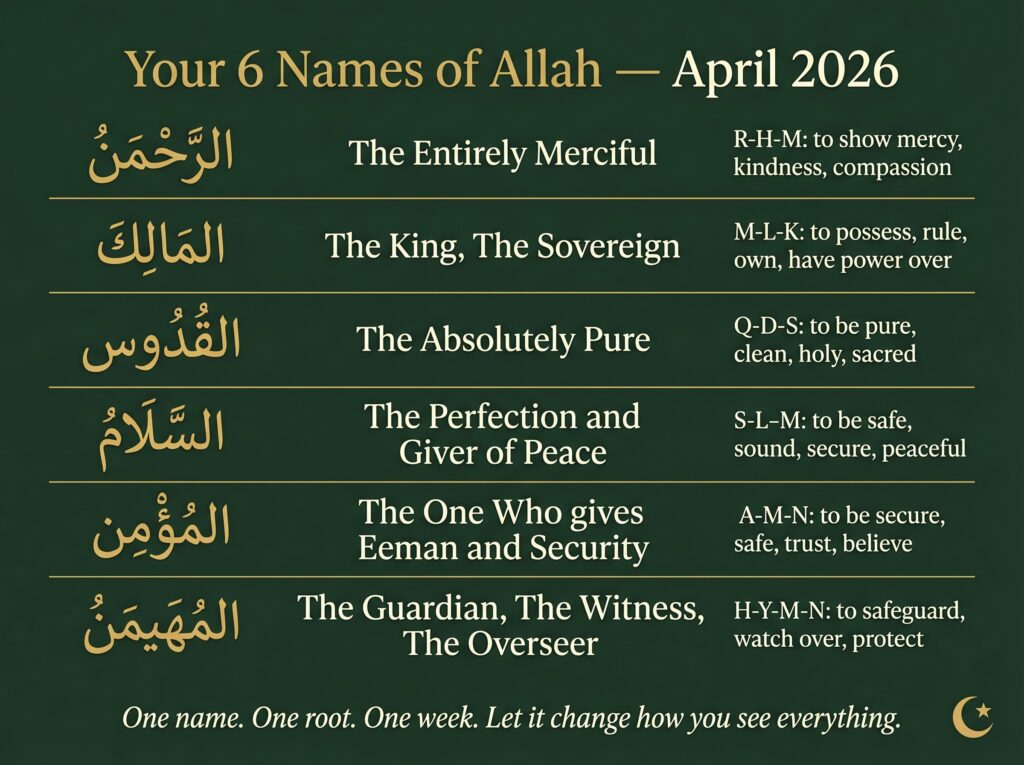
You do not need to memorize all six at once.
Choose one. Sit with it for several days. Say it in your dua. Notice when its quality appears in your day — in a moment of unexpected patience, in a response that arrived when you needed it, in a feeling of unexpected nearness during an ordinary moment.
Then move to the next.
By the end of April, these six names will not be entries in a list. They will be living reference points — ways of seeing and experiencing Allah that you carry into every month that follows.
→ Watch the Arabic Word Mystery series on TikTok — see these roots come alive with examples from daily Islamic life → Explore the full Names of Allah Instagram carousel — save it as your monthly reference
Your Next Steps
→ Download the Free 50-Word Quranic Vocabulary PDF The roots behind these six names are just the beginning. The free PDF gives you fifty of the highest-frequency root families in the Quran — laid out simply, beautifully, and ready to use in your daily Quran reading, your salah, and your dua. No prior Arabic knowledge required.
→ Follow for Daily Names of Allah Content Every week a new name. Every name with its root. Every root with a reflection that changes how you experience your worship. Follow so you never miss one.
→ Share With Your Prayer Group Send this post to the people you make dua with, study with, or simply love. The gift of a name of Allah understood deeply is one of the most lasting things you can pass to another Muslim.
May Allah make these names living realities in our hearts — not knowledge we hold about Him, but ways we experience Him in every ordinary, blessed moment of this month and every month after. Ameen. 🌙
